![PortStrategy[GreenPort]](https://www.portstrategy.com/wp-content/uploads/2026/09/PortStrategyGreenPort.svg)





Outsourced maintenance
Smaller terminals are sticking to third party equipment maintenance service plans, as Alex Hughes finds out
Despite the most wide-reaching global economic downturn since the 1930s, container terminals do not appear to be re-evaluating existing policies on equipment maintenance.
And if external equipment maintenance suppliers are to continue to gain serious market share, the theory goes that their main targets ought to be the smaller terminals, where the cost of retaining specialist in house technical staff should prove prohibitive. The experiences of two relatively modest terminals bear out this theory.
Take the case of Naha International Container Terminal, Inc (NICTI), which is located on the Japanese island of Okinawa in the East China Sea. The terminal, which is 60% owned by ICTSI and 40% by six stevedoring companies, took over established operations at Terminals 9 and 10 for a period of ten years as from 1 January 2006. Throughput is just 70,000 teu per year, meaning that NICTI has captured a market share in the port of 20%. However, given the fact that Okinawa serves 40 surrounding islands, it is thought that there is scope to grow the business quite substantially.
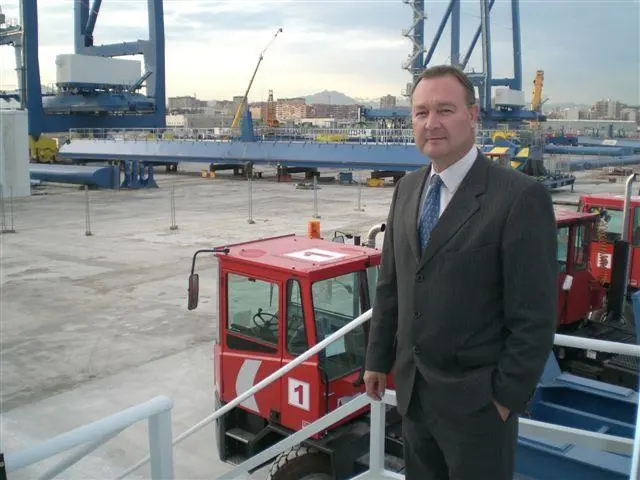
Front line equipment consists of two quayside gantry cranes and 12 straddle carriers, which ICTSI executive vice president Edgardo Q Abesamis, who is also president of NICTI, says are maintained by an outside contractor. Indeed, all equipment and electrical installation maintenance is done by a third party provider.
“Our Naha operation is relatively small, and the maintenance demand is not too intensive. On balance, therefore, it is better to outsource this type of activity,” he says.
A similarly modest container and general cargo operator, Terminales Marítimas del Sudeste, is to be found at the Spanish Mediterranean port of Alicante. It opened for business right at the start of the global economic downturn and has struggled to attract forecast levels of new niche business. Controlling costs has therefore been vital.
Although a small maintenance team is employed, outside contractors are brought in to undertake major and specialised repairs.
“Using third party suppliers gives you the advantage of being able to call on a service 24 hours a day 365 days a week, as well as having almost immediate access to the necessary specialist personnel required. By doing this, you can bring down the fixed cost of having to contract what could become an excessive number of workers needed in this area,” says general manager Emilio Benavent.
He also stresses that there is some equipment and handling machinery that, because of its complexity, really does need highly specialised technical staff to maintain. In such cases, if something goes wrong, or needs putting into operation, only specialist staff should really be considered. Employing these directly could be costly. This is particularly true where sophisticated IT programming is involved, or where electronic components are concerned.
“The economic slowdown has not resulted in us reconsidering our overall maintenance policy. We operate a large range of machinery, equipment and installations and believe it would be impossible to economically contract all the necessary people to fix all the various maintenance problems that naturally emerge,” says Mr Benavent.
NICTI takes a similar viewpoint. Asked whether the current economic downturn had perhaps prompted the terminal to have another look at its equipment outsourcing policy, Mr Abesamis simply notes that the terminal is happy with its present arrangement and that outsourcing will therefore continue into the foreseeable future. Asked to speculate at what stage a terminal might want to take back maintenance of equipment in house, he suggests that this would be when it is operating at 60%-70% of design capacity.
NICTI chose a local company, which provides similar services to other Japanese terminals, to fulfil its maintenance requirements. Mr Abesamis says that when casting round for a provider, there was choice available, despite the location of the port on a relatively remote island complex. He adds that, when assessing which of the companies to use, it soon became clear that the company eventually chosen was by far the most capable.
“In our experience, manufacturers rarely offer maintenance packages when you buy cargo lifting equipment from them. However, some of them do have a preferred or recommended third party provider, which we do give serious consideration to using,” says Mr Abesamis.
In Spain, Mr Benavent has had a slightly different experience with original equipment manufacturers, which he says nowadays do routinely offer maintenance packages along with sales of new equipment. However, Terminales Marítimas del Sudeste has exercised its freedom to look at other companies to determine which offer the best value for money service.
The Israeli port of Haifa, where annual throughput is around 1m teu, is a significantly larger operation than either Naha or Alicante. Logically, therefore, it should have sufficient work available to justify retaining a large maintenance department of its own. And this is in fact the case: the terminal does practically all its equipment maintenance in house.
Mr Friedler Gil, head of the equipment department, explains that outsourcing only takes place when the port needs specialists in areas requiring only occasional attention and/or precise expertise. So external companies are only hired to look after such things as air conditioning, tyre replacement, refurbishment of hydraulic equipment, CCTV maintenance and so on.
“By keeping maintenance in house, we can respond to virtually all problems as and when they occur; this is especially important when we are talking about port lifting equipment. We have the specialist know how to do this which doesn’t exist anywhere else in Israel,” says Mr Gil, who adds that, despite the economic downturn, there is no talk of changing this policy.
Significantly, there are no equipment manufacturers in Israel, while neither their dealers nor representatives actually supply maintenance cover. Mr Gil points out that only if Haifa Port approaches these companies to ask for maintenance support will it be considered; to date, he has identified no trend towards OEMs actively promoting this type of service to their clients.
Asked whether ever more sophisticated equipment might eventually drive Haifa Port to consider outsourced maintenance, Mr Gil is again sceptical. “Here, the maintenance personnel are all qualified technicians, so handling equipment does not present a problem. However, if we have a serious IT problem that requires special tools or a particular software fix then we would look outside the company.”
He adds that most of the problems he has experienced have been solved by the in house technicians using experience gained over a number of years; only on very rare occasions has it been necessary to seek help from the OEM.
“In general, Haifa’s equipment is used more intensively than in other fields, that means we have to deal with breakdowns others don’t seem to have at all,” he says.
Related Articles
 CONTAINER & CARGO HANDLING
 CONTAINER & CARGO HANDLING
 BULK HANDLING