![PortStrategy[GreenPort]](https://www.portstrategy.com/wp-content/uploads/2026/09/PortStrategyGreenPort.svg)





Picking up the pace
APM Terminals CMIT is moving away from years of pain, finds Stevie Knight
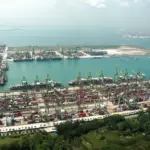
If you want to see ship cascade in action, just look at Cai Mep says Robert Hambleton of CMIT, Vietnam: displaced vessels, paired with Vietnam’s own growth spurt, are helping to bring “years of pain” to a close.
There is another driver toward consolidation: APMT’s investment Cai Mep was a costly so despite the rush of boxes, there are still some questions to answer over CMIT’s bottom line.South Vietnam was notable for building too much capacity too soon, effectively pulling the plug on any meaningful market traction. But now the area is on the up: the terminals at Cai Mep – Thi Vai have increased their volumes by 37.9% according to first quarter-on-quarter figures and the 1.1m capacity CMIT facility – a joint venture between APM Terminals, Saigon Port and Vinalines – is now running almost full after appearing to sustain and even better the 80% rise seen in 2014-2015.
So, what lies beneath the turnaround?
There are a number of stimuli: “Vietnam’s growth is a good news story,” explains Mr Hambleton; the near 8% GDP rise is contributing almost the same amount to total volumes, helped along by industry fleeing rising costs in China. Recently it’s seen Samsung set up its largest-ever manufacturing plant.
Further, Vietnam should soon benefit from a couple of free trade agreements: the long-awaited Trans Pacific Partnership (TPP) may boost its economy by a quarter or even a third and it is on the verge of concluding the EV-FTA with Europe, even though some touchy post-Brexit renegotiation with the UK may be called for.
But according to Mr Hambleton, nearly three quarters of the southern ports’ recent gain comes from calls pulled away from Ho Chi Minh. He adds that while ‘habit’ has played a part in keeping shippers stuck to the city facilities there are other factors now supporting the shift: Cai Mep’s deep water stands in sharp contrast to the issues faced by the urban terminals: “Despite having a 4m teu throughput these can only take 3,500 teu vessels,” he points out.
Most importantly, he says the cascade effect is finally lending its own impetus. “The lines fill up the 18,000 and 20,000 teu vessels first, but then they have the 12,000 to 14,000 teu vessels, which are still pretty big, to think about.” Therefore he believes it’s ship availability ‘push’, as much as market ‘pull’, that helps drive direct calls.
“There are relatively few terminals now that can handle the really big ships and coupled with this the cost of fuel has dropped enough to make a route deviation to other deepwater terminals more attractive.”
Spread the load
Will this mean the extra boxes no longer going to Ho Chi Minh’s Cat Lai will be spread around? Not really, he says, as out of all of the Cai Mep terminals, CMIT has the necessary credentials including 22 across cranes. So, the terminal now boasts two direct deepsea calls to North Europe, two to the US West Coast America and one to its East Coast with another pair of intra-Asia calls adding to the mix.
It has to be added that neighbour SSIT, despite a slow start, is now seeing investment that could heat up the competition: paradoxically, (though typical for the region) it has the same partners as CMIT.
Further, while the cascade effect is helping drive Cai Mep upward, Mr Hambleton adds it might also drive consolidation. “We have 600m of quay, and that means that we can only get one big ship in at a time. The problem is that a terminal sells a berthing window but the slot is often hit by late arrivals.”
At present three different operations, TCTT, SSIT and CMIT, “are all looking out for themselves” but his view is they’d be stronger together than apart. “Even if you are full, extra quay length adds flexibility. Jointly we would have 1,800m of quay, eight quay cranes, and 3m teu capacity to draw on to absorb hitches in the schedule.”
However, approaches to neighbour TCTT (run by Vietnam’s navy) although initially warm have cooled somewhat since CMIT gained the Ocean 3 service. In this arena successful negotiations depend not on strength alone but need – as this translates into which party eventually gains control.
There is another driver toward consolidation: APMT’s investment in Cai Mep was costly so despite the rush of boxes, there are still some questions to answer over CMIT’s bottom line.
Related Articles
 CONTAINER & CARGO HANDLING
 CONTAINER & CARGO HANDLING
 BULK HANDLING