![PortStrategy[GreenPort]](https://www.portstrategy.com/wp-content/uploads/2026/09/PortStrategyGreenPort.svg)





Preparation, preparation
Auckland readies itself for the next generation, writes Iain MacIntyre
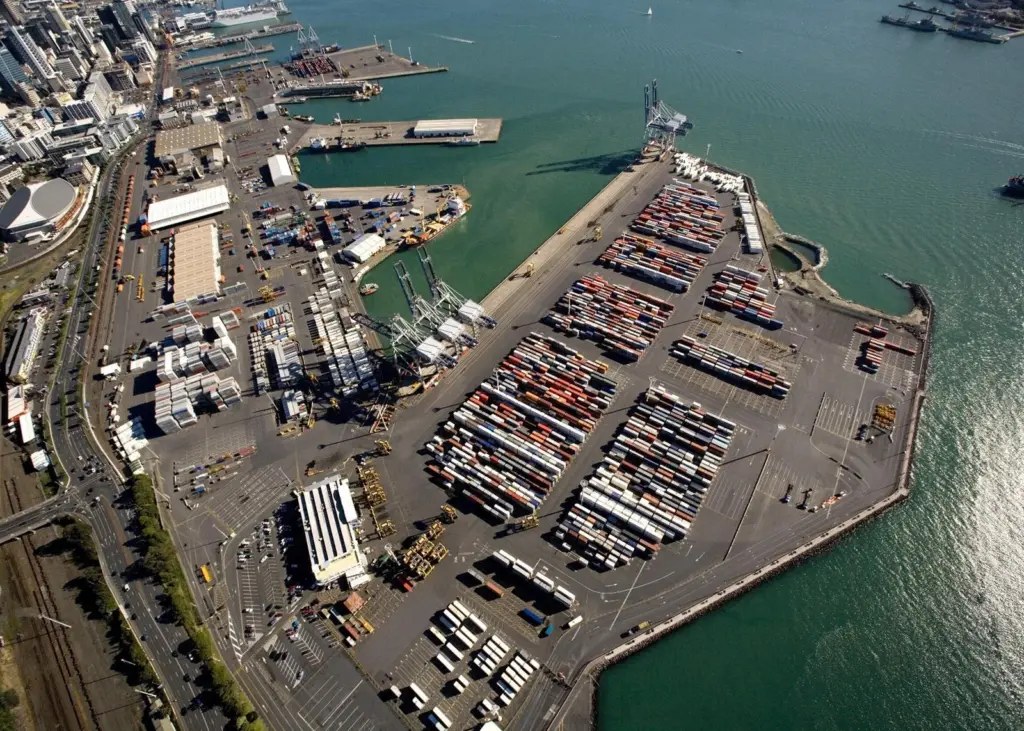
New Zealand’s largest port by both value of trade handled and container throughput, Ports of Auckland, is entering a key developmental phase as the country readies for the next-generation of containership callers.
Expected to cost about NZ$8m (US$6.2m), the investment will involve deepening the northern berth at the Fergusson Container Terminal and construction of a mooring “dolphin” to extend the maximum combined length of vessels simultaneously serviced by about 40 metres.
The maximum vessel draught at chart datum on the outer berth will consequently increase from 11.7 metres to 13 metres, complementing the current maximum vessel draught at chart datum for the inner berth of 12.5 metres.
Ports of Auckland chief executive Jens Madsen says the development, which is expected to be completed by the end of 2011, will ensure the business can meet customer needs as vessels in the 3,500 teu to 5,500 teu range increasingly enter New Zealand services over coming years.
“This trend will result in the requirement for major ports to be able to accommodate two such vessels simultaneously,” he says.
“This need is now more pressing than the need to accommodate the arrival of single larger vessels of 6,000 teu and above. We think it is a prudent approach, and one that will sustain and enhance Ports of Auckland’s reputation as New Zealand’s leading container port.
“Our berth deepening and dredging programme, as well as the significant investment in leading plant and machinery since 2003, means we are ready for the next generation of larger vessels.”
Facilitated at seaports on the east coast adjacent to the Auckland central business district and on the west coast in Onehunga, as well as an inland port at Wiri (South Auckland), Ports of Auckland is connected to 176 international ports in 69 countries and employs a total of 570 full-time equivalent staff.
Mr Madsen sees the strengths and advantages of Ports of Auckland, which is 100% owned by the Auckland Council Investments, as being its investment in plant and equipment over the past decade “that puts us ahead if other ports”, coupled with its geographic location as the closest port to New Zealand’s largest population base.
In the 2009-2010 financial year it handled NZ$24.5bn worth of overall trade – equivalent to 13% of the country’s total GDP and double that of any other New Zealand port. It also exchanged a record 867,368 teu at its CBD seaport – maintaining its ranking as the country’s top container port with 37% of New Zealand’s total container trade.
As well as increasing its breakbulk volume 6.7% during the year to over 2.8m tonnes, Ports of Auckland’s vehicle imports rose 17.4% rise to 129,811 units – maintaining its position as the country’s leading port in the latter sector with 70% of New Zealand’s total vehicle imports.
Although cruise ship visits dropped 10.1% to 62, forward bookings for the current year are understood to be about 80, with expectation that the 100-mark is to be surpassed in the near future, reinforcing the port’s premier position in this sector.
These factors contributed to annual revenue rising 1.2% to NZ$165.7m and normalised after-tax profit increasing 55% to NZ$24.4m (when including various one-off factors, net after-tax profit actually rose year-on-year from NZ$5.4m to NZ$37.2m).
Reducing costs have been a major focus of the port in recent times, as evidenced by the consolidation of the previously separate Bledisloe and Fergusson container terminals’ stevedoring teams, and centralising of container trade on the latter terminal.
“Now that signs of a return to growth are emerging, we are a stronger, leaner, more effective port, working hard for the future of the Auckland region and for New Zealand,” says Mr Madsen.
“The challenges have not been insignificant, as the port has faced a combination of intense competition, much higher variability in container volumes through a trend towards larger ships making fewer calls, vessels arriving off schedule and volumes being higher than initially anticipated as a result of shipping service gains in our favour.
“Ports of Auckland is well positioned, with a clear direction and focus on both our employees and our customers.
“We are investing in new technology to lift the quality of our interactions with our customers and to support our people. The first phase of a new Terminal Management System, for example, will be rolled-out in the second half of this coming year providing great opportunities for efficiency gains.”
Ports of Auckland has made a solid start to the current financial year, with container throughput rising 8% and vehicle imports lifting 25% year-on-year for the first three months.
Related Articles
 CONTAINER & CARGO HANDLING
 CONTAINER & CARGO HANDLING
 BULK HANDLING