![PortStrategy[GreenPort]](https://www.portstrategy.com/wp-content/uploads/2026/09/PortStrategyGreenPort.svg)






RMG article
RMGs get short shrift when operators consider quayside container handling options, but are they unfairly tagged as unflexible? Alex Hughes believes so
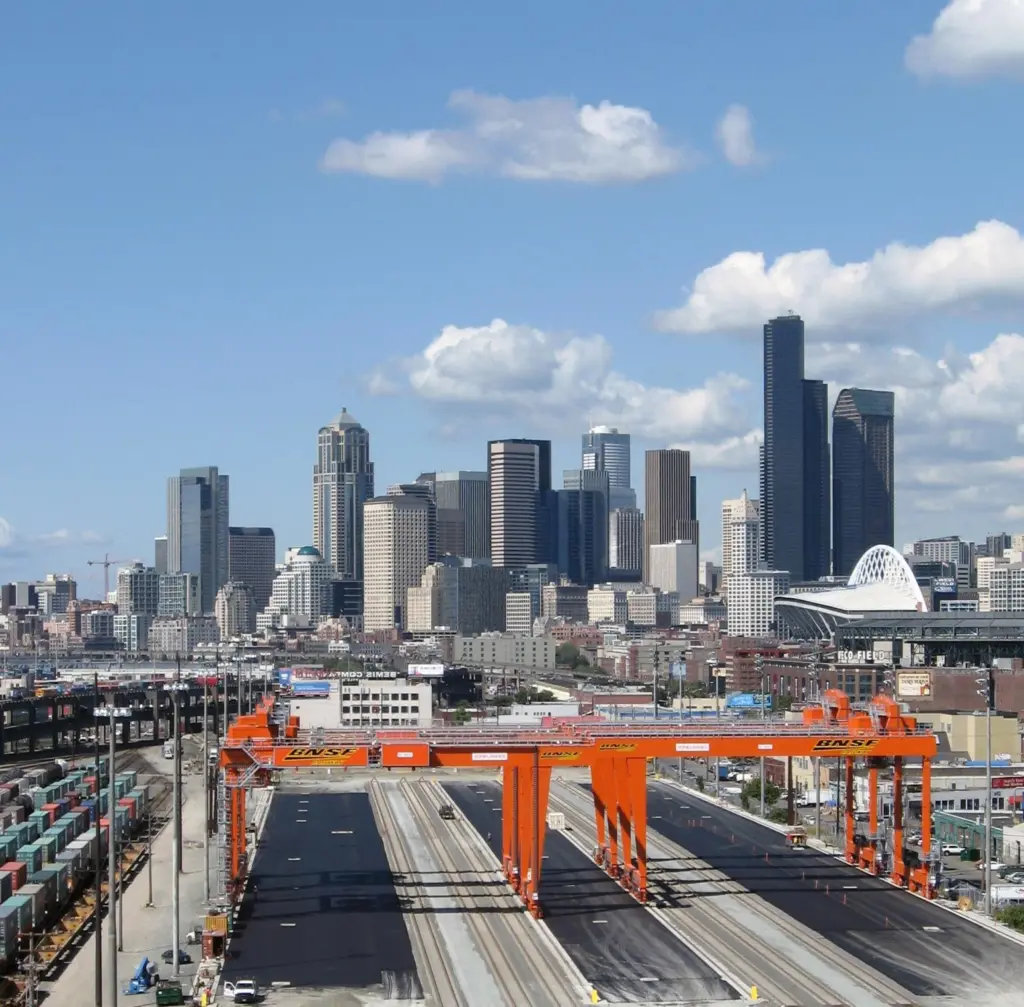
Yard stacking equipment sales have long favoured the agile rubber-tyred gantry crane (RTG) over its rail-mounted sibling. But while RTG proponents cite greater flexibility and fewer infrastructure costs, those hardy few that plumped for RMGs are now reaping the benefits of longer term lower operating costs.Higher oil prices and decreasing freight rates are already biting into what container terminals can charge shipping lines. And as the business environment worsens, ship operators are demanding ever more competitive rates.
To a certain extent, terminals have increased efforts to source more cost-effective equipment, especially in the stacking yard. Major attempts at reducing the operating costs of RTGs have been high on the agenda, but despite some success RMGs appear to remain the cheaper operational option. Gantry speeds on RMGs are often double those of RTGs and, on occasions, even higher than that, while automating rail-mounted units is easier.
On the down side, civil works associated with RMG operation are higher, but this won’t necessarily erode their cost advantage, says Jyrki Melaanvuo, crane product line manager at Konecranes. The relatively recent introduction of new energy storage devices on RTGs will certainly go some way towards making them cheaper to operate, says Mr Melaanvuo, but possibly not at the very busiest terminals.
“The cost of these storage devices is not insignificant and RTGs undertaking 40-50 moves per hour won’t have enough idling time to really justify fitting them. However, on average, RTGs handle around 20 boxes per hour, which does imply significant idling. In these types of situation, we calculate that a terminal can save around 30% on its fuel costs by fitting storage devices.”
A better alternative might be cable reel feeding, which Konecranes has incorporated into its most recent RTGs. Mr Melaanvuo believes these offer similar cost saving advantages enjoyed by RMGs during regenerative braking.
There is also an important question about the new energy storage devices that nobody has yet been able to answer: how long will they last for? The answer is crucial, because it will determine the ultimate return on investment calculation. Before widespread adoption takes place throughout the container handling industry concrete figures will have to be produced, says Mr Melaanvuo. In the meantime, RMGs are the already-proven cheaper, long term option.
Port Strategy asked both Mr Melaanvuo and Künz sales director Michael Geiger whether the market for RMGs in port terminals is growing, stagnating or diminishing. As far as Konecranes has been able to calculate, demand for RMGs is definitely growing, says Mr Melaanvuo, prompting immediate agreement from Mr Geiger. The latter attributed this to the higher stacking ability demonstrated by rail-mounted gantry cranes, the efficiency they provide in intermodal operations, the ability to automate them and their need for less maintenance.
“Overall, RMGs provide operators with higher availability compared to other yard equipment and give better productivity,” he says.
Environmentally, they are a better bet, too, he says, pointing to the lack of diesel drive units and an almost negligible need for hydraulic oil. Indeed, all new units being produced by Künz are fully electrically driven. This allows electricity to be regenerated during braking operations using active front end units, thereby cutting the cost of powering them compared with a diesel-driven RTG. RTGs, furthermore, require extensive maintenance on wheels, fuel lines and engines.
Konecranes’ Mr Melaanvuo adds: “RMGs have certain advantages, which are helping to boost sales. For example, they can be substantially quieter than other yard equipment and environmental factors are influencing sales nowadays. In addition, because they work off of mains electricity, rather than diesel, they can be significantly cheaper to operate,” he says, highlighting the absence of locally produced emissions as a particular plus point influencing purchasing choice.
“All the RMGs manufactured by Konecranes are electrically powered,” he says. “As a result, the standard model that we offer customers allows electricity that is not being used by crane to be returned to the grid. This can lead to really important cost savings. Furthermore, mains electricity is, in virtually all cases, cheaper than powering a yard cranes using diesel.”
Künz’s Mr Geiger does not accept the argument that RMGs are less flexible than RTGs, pointing out that getting the yard concept right at the beginning opens up a whole host of possibilities. He, nevertheless, concedes that RMGs are usually larger than rubber-tyre units, so moving them from one facility to another does require a major effort.
“At Künz, we have discovered that, if you configure your yard correctly, RMGs can be twice as efficient as RTGs,” he says.
Mr Melaanvuo sees the argument slightly differently, pointing out that many RMGs are specified because the environment into which they are going to be deployed is already space restricted. In these types of terminal, clearly their perceived inflexibility is not a handicap.
“There is also a very good case for stating that the RMG is a highly productive unit and, in many cases, productivity can be better than what an RTG can offer,” he adds.
For Künz, after sales is an important area, despite the fact that RMGs don’t have such extensive service requirements as RTGs. It nevertheless offers operators the option to sign a full service contract, if required, or something less extensive, if most maintenance and service requirements can be met by terminal personnel.
“We incorporate a lot of features in to our RMGs to make them relatively easy to maintain. For example, they all come with a crane management system and also with a quick release system, both of which help cut the amount of service outs,” Mr Geiger says.
With proper maintenance, he notes, an RMG can remain in front line service for 20-30 years, without causing operators major headaches. Mid-life refurbishment is also becoming more common and a good investment option, since it allows legacy material to be updated in many ways, with a change from hydrostatic drive to electric drive being one that Künz particularly recommends.
Konecranes, which prides itself on being able to give high quality back-up support to its customers, includes RMGs in its standard support package, although maintenance requirements are definitely easing as engineering systems improve.
“In the case of Konecranes, both our RMGs and RTGs are similar in that they are designed with high availability in mind, because we try to incorporate as many low maintenance components as we can. So, for example, the trolley is easy to maintain, while the incorporation of a crane monitoring system can help operators avoid several potential headaches,” says Mr Melaanvuo, adding that in difficult trading conditions such extras will definitely help money to be saved.
“You also have to look at RMGs in a number of other ways when considering return on investment. Not only can they remain in front line service for 20-25 years, but they can also be refurbished to make sure that they incorporate the most up to date technology. The basic metal structure of the cranes, of course, is built to last,” he says.
Related Articles
 CONTAINER & CARGO HANDLING
 CONTAINER & CARGO HANDLING
 BULK HANDLING