![PortStrategy[GreenPort]](https://www.portstrategy.com/wp-content/uploads/2026/09/PortStrategyGreenPort.svg)





Running the rails
Alex Hughes examines the often arms length relationship between terminals and rail
Few ports and terminals are lucky enough to benefit from fully integrated rail services. Any number of reasons are to blame for this lack of intermodal cohesion: the original construction era of the port; limitations to the existing infrastructure; the management/ownership model chosen; whether it’s publicly or privately owned; or the evolution of the rail network in general.
Many port authorities shy away from adopting roles actively promoting the integration of rail and sea operations, since they don’t view this as part of their overall remit.
When Port Strategy asked the Swedish port of Gothenburg to explain how it co-ordinated the activities of its rail providers with those of its various operating terminals, it was unable to do so; instead, it referred PS to its three main terminal providers, as it’s at that level that co-ordination tends to be managed.
But Gothenburg is not alone: other port authorities approached by PS to explain how this crucial interface is managed simply gave a metaphorical shrug of the shoulders, as though they were being asked to justify an activity that plays no role whatsoever in boosting their bottom line performance.
Italy main terminal operating group, Contship Italia, does acknowledge that there are real problems out there that require a solution. All too often, a lack of joined up co-operation allows the road haulage industry to mop up more than its fair share of traffic, even when it is illogical for them to be doing so.
Natural evolution
Italian ports, explains Contship Italia’s Daniele Testi, have evolved over a long period of time and are, more often than not, today surrounded by large conurbations. Added to this, ownership of port facilities has changed, with the state ceding terminals to either private companies, or a mix of public and private, although infrastructure and land remain under exclusive public ownership, with terminals operated as concessions.
Private operators are doing their level best to boost intermodal traffic. Indeed, Contship italia is considered by the market to be at an advanced stage of “integration” in respect of the overall port-rail interface.
“When La Spezia Container Terminal was originally conceived, rail was always seen as having a role connecting land and sea operations,” Mr Testi says.
Beyond its terminal operating activities, the group’s other companies have also evolved and nowadays perform key roles in the overall logistics chain. Contship Italia companies, for example, provide long haul rail freight services, rail-based shunting operations (to/from the quay and to/from the national rail network), multimodal services, inland port management, final truck mile delivery to direct end users, customs clearance and warehousing.
Mr Testi believesContship must be doing something right: “If efficiency may be defined in terms of key performance indicators (KPI), La Spezia is the lead ranked port/system in Italy, with approximately 30% of throughput arriving/continuing by rail,” he says. Indeed, it operates the most trains and/or number of containers handled as a proportion of its quayside volumes.
Usually, port and terminal IT systems are not linked to those of rail operators, but at La Spezia Container Terminal, in house software has been developed to oversee the main terminal management processes. In addition, Port Community Systems are evolving and will play a strategic role by bringing together the individual components of the logistic chain.
“At Contship, we are reviewing a product evolution to enable the booking of rail borne transport while the container is still at sea. This has become possible due to improvements in Italy’s customer clearance processes, which now offer a variety of options, thereby providing efficiency improvements in the container flow,” says Mr Testi.
Rail benefactors
Other ports have realised the benefits of on-dock rail. In the US, Jacksonville Port Authority’s (JAXPORT) is now the proud owner of a new intermodal container transfer facility at Dames Point, which was funded through a combination of federal and state grants. Before its official opening to commercial cargo in August it’s being used in support of a high-level military training exercise.
Barcelona is planning its own project to get freight traffic off the roads and onto rails. By 2018, the port will have a rail link connected directly to the wider Mediterranean rail corridor. Currently, just 13% of containers discharged at the port make their onward journey by rail.
The new rail link will connect with the trans-European freight network, known as the Mediterranean Corridor.
In Poland, upgrades to the main line into the port of Gdansk should be ready by August, boosting capacity from 30 to 180 trains a day and raising line speeds from 50km/h to 100km/h. The project includes upgrading of the 12km double-track section, construction of four viaducts and 10 bridges as well as track-doubling on the single-track sections of the line. Rail links to all four of the country’s main ports – Gdansk, Gdynia, Szczecin and Swinoujscie – will be reconstructed by 2020 with the aid of co-financing from the European Union.
Working together
Asked whether there are any significant improvements ports need to make to boost rail’s percentage of business, Mr Testi acknowledges that, “ports, in isolation, would not able to boost maritime rail traffic”.
Nevertheless, he adds, ports in Italy can and are improving their processes to efficiently transfer containers ex-ship to gate out. Again, he cites La Spezia, where 10% of import containers exit the terminal within one day of a ship arrival. Pre-clearing, now firmly established at the main Italian gateway, is offering further opportunities for shipping agents, shippers and freight forwarders to anticipate customs operations or postpone clearance at inland terminals, thus further reducing the dwell time at port for import trades.
“Here, at the Contship Group, we have been the first operator to test the fast rail customs corridor between La Spezia/Genova to Melzo (Milan). A process where cargo does not need any specific customs documentation, because containers are monitored in real time and clearance can start at inland ports,” he says.
Despite these advances, he says, further progress is required to continuing driving seamless processes in the import/export market.
Road transport, for example, is an area that benefits from operating on a non-level playing field, despite revised national legislation required on taxation and subsidies. The drop in the oil price has been crucial in enabling it to retain market share, even though it is hardly the greenest option out there.
“There is also resistance to change,” Mr Testi says. “We need to break down barriers, remove vested interests and truly adopt ‘green’ credentials, instead of just issuing ‘popular’ statements.”
Drawing inspiration
Ports and port terminals could perhaps learn lessons from other industries when interfacing with rail. “We should all be open to change, while continuously reviewing process and best practice. In Italy, rail transport of maritime containers is constrained, but solutions are available and are well known. Why, for example, is it still considered “normal” to use trucks to move cargo for distances of more than 500 kilometres? This makes little sense.”
He points out that the 6.3 million teu of annual import-export maritime containers represents only a small percentage of the total truck journeys each year in Italy, estimated at 47 million. Even so, serious questions need asking as to why these continue to be moved by road.
“At Contship, we are promoting a portfolio of rail products to support continental and maritime trades. At the same time, haulage operators will have the chance to differentiate their products by investing in swap bodies and intermodal units, instead of just trailers, thereby improving the national share of rail transport for the benefit of the maritime trades, which will have access to more competitive and frequent rail services.”
LA RAIL LINK HITS THE BUFFERS
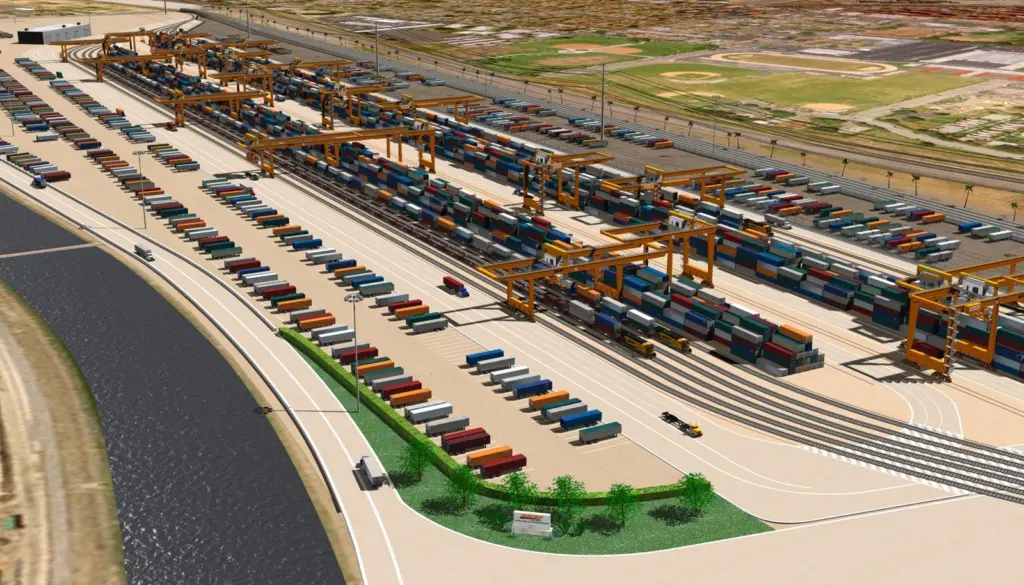
Not everyone is able to cash in on the benefits of an intermodal link, as Los Angeles recently found. BNSF Railway looks set on cancelling its plans to build a new intermodal rail facility near LA and Long Beach after a Californian court questioned the rigidity of the project’s environmental review process.
The proposed Southern California International Gateway (SCIG) project was designed to eliminate millions of truck miles, routing cargoes via rail instead. The court ruling questioned the analysis of air quality, greenhouse gas, noise and traffic impacts and ordered that the project be halted until the Port of LA undertakes another analysis.
In response to the ruling, BNSF described the eight-year environmental review as exhaustive and said that it is not clear “whether or how the project could be built under the framework set by the decision”.
Related Articles
 CONTAINER & CARGO HANDLING
 CONTAINER & CARGO HANDLING
 BULK HANDLING