![PortStrategy[GreenPort]](https://www.portstrategy.com/wp-content/uploads/2026/09/PortStrategyGreenPort.svg)






Santos capacity set to double
Capacity at the Brazilian port is set to double over the coming year. Rob Ward reports
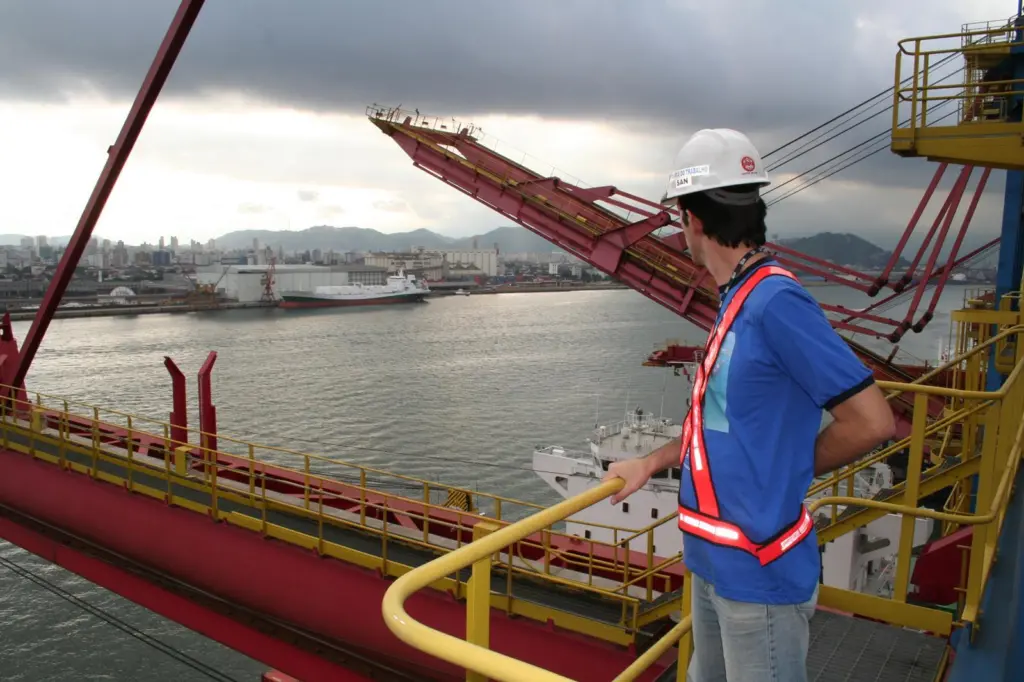
Massive changes will take place in South America’s biggest port for general cargo before 2009 is played out. For Santos is not only going to have its draught increased from today’s 11.3 m-11.8 m down to 14 metres, but several new developments at existing terminals – notably Santos Brasil and Tecondi – will be completed which will eventually add around 1m teu of extra capacity to the port complex.
And on top of that a number of brand new terminals – Embraport, Brasil Terminal Portuaria (BTP) and Barnabe Bagres – are being constructed and processed which could add even more capacity, eventually more than doubling capacity from today’s 3.5m teu per annum up to around 10m teu.
Driving these projects forward is the fact that the economy of Brazil – one of the BRIC quartet of fast-emerging economies that also includes Russia, India and China – is still expected to grow this year (by between 2% and 3.5%) despite the world economic slowdown.
Terminal operators contacted by Port Strategy said that throughpout was up during the last quarter of 2008 – a rarity throughout the box terminal world – but volumes had dipped during January and February, a fall which may be seasonal, and connected to an early than usual Carnival.
Leading the drive forward among existing port operators in Santos is Santos Brasil flagship facility Tecon Santos. In 2008, Tecon Santos handled some 1.26m teu (up from the 1.25m teu) handled in 2007.
For the port of Santos as a whole the, admittedly tentative, forecast for this year is for a fall of only between 5% and 10%, despite a slowdown in both exports (due to shortfall in worldwide demand) and imports (due to the weakening local currency, the Real, against the US dollar).
Santos’s current capacity is said to be around 3.5m teu, but when put under pressure (as it was during the various public sector strikes in early 2008 and mid 2007) the infrastructure creaks loudly and congestion is, to quote several shippers and operators “an absolute nightmare”.
With this in mind shipping lines have been enviously watching Hamburg Sud develop its own deepwater (15-metre) hub port complex at Itapoa (near the existing port of Sao Francisco do Sul), and MSC develop a strong presence at Portonave (Navegantes) and now others want a slice of the Santos/Brazil port action to safeguard their own strategic interests.
Maersk Line’s sister company APM Terminals already has a presence at Teconvi (Itajai), Pecem (Brazilian north coast) and Terminal 4 (in Buenos Aires), but Santos is the most valuable ECSA prize. Even so it was something of a surprise to hear that the president of Santos Port authority Codesp, Jose Roberto Serra, say on the record that the APMT plan for a a new terminal at the Alemoa Pier, with 700 metre quay and capacity for an annual 1.2m teu and draught of 14m was “likely to be approved”.
APM Terminals has put forward a proposal to build a $700m box terminal in the key Brazilian port of Santos.
According to Santos insiders Codesp’s Mr Serra was supposed to keep the $700m project out of the public eye for a while, but once out of the bag, APMT has been happy enough to talk about it.
And appointing Paulo Simoes to head up this project was a shrewd move by APMT. Mr Simoes used to be the general manager for Mitsui OSK Line in Brazil until a year ago and he knows the needs of ocean carriers operating in Santos.
Soren Jakobsen, vice president of project implementation at APMT, tells Port Strategy: “We make no secret of the fact that we are looking to develop a port terminal in Santos.”
And Santos’s third-largest terminal Tecondi is also gearing up for when box throughput goes back into over-drive.
It is investing some Reais180m ($79m) in a new quay and bringing in two new ship-to-shore gantry cranes. Total equipment expenditure will be around Reais30m ($13m).
Luis Araujo, commercial director for Tecondi, says: “So far, looking at the 4Q throughput figures, Santos and Brazil has escaped the worst of the financial meltdown, and it is not easy to extrapolate from the first two months of the year in Brazil because of everything stopping for Carnival. By the end of this year, though, throughput is likely to be down.”
Related Articles
 CONTAINER & CARGO HANDLING
 CONTAINER & CARGO HANDLING
 BULK HANDLING