![PortStrategy[GreenPort]](https://www.portstrategy.com/wp-content/uploads/2026/09/PortStrategyGreenPort.svg)






Skipping the queue
Stevie Knight explains why feedering by barge is the fix-all for congested terminals
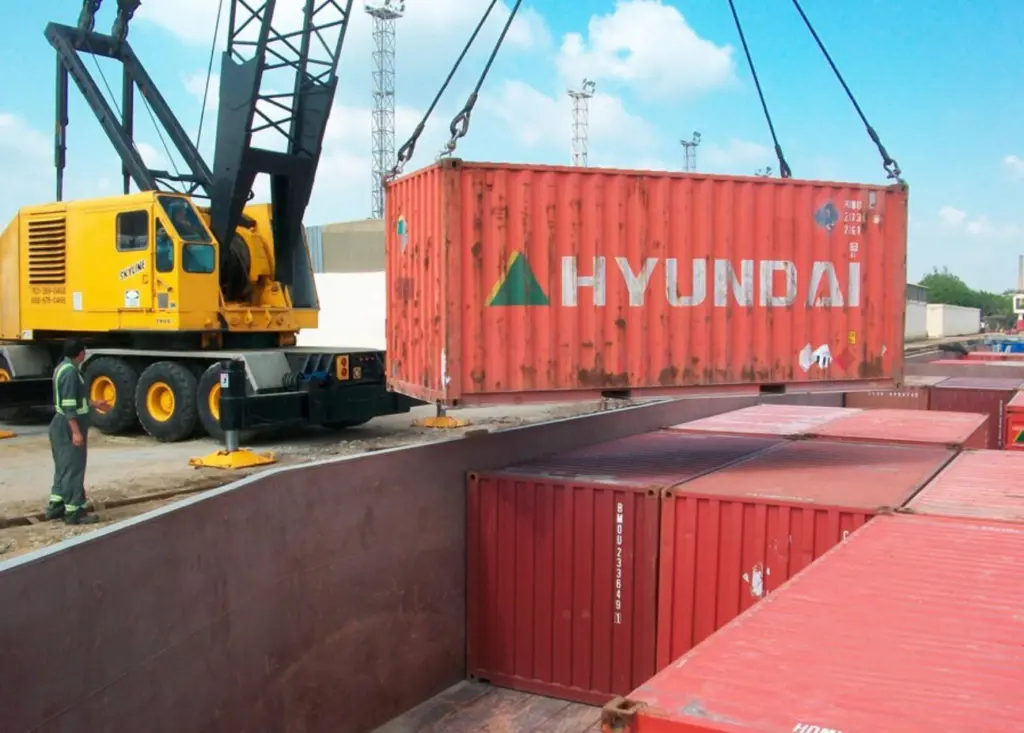
Despite the arguments about big ships pushing smaller ports into feeder status, the over-riding issue of landside congestion remains.
In these places, ‘going round to the front door’ maybe the only way to get over the bottlenecks sitting at the gate.
“In many ports, yard and evacuation capacities run out before berth capacity does,” points out Gagan Seksaria, chief financial officier and head of investments for ICTSI’s Africa region. He adds this state of affairs is especially prevalent in emerging economies, citing Durban, Lagos and Mombasa as places “where the waterside infrastructure could handle more ships if there were corresponding capacity on the land side”, so a terminal’s efficiency rests more on these factors than the normally cited quay length.
It is certainly an issue for Africa’s broader economic health: a recent World Bank study pointed out that cargo waiting times at most African ports is “a major bottleneck to trade” and a stumbling block to the country’s economic integration.
So there’s good reason for congested port systems to develop relationships with barge-linked freight stations and depots: “One 90 teu barge along the quay could take out least 45 trucks from the yard and roads,” says Mr Seksaria: in Africa the overall savings would clearly compensate for any double handling but the principle holds true for many emerging markets.
Satellite wins
Given this potential win-win, some like Dharamtar near JNPT in Mumbai, India, have already successfully made the transition to a ‘satellite’ facility.
Certainly, Dharamtar’s location on the right bank of the Amba River hadn’t previously been seen as an unmitigated blessing, restricting its draught to 3.5m and making dredging implausible. However, it’s river position puts it only around 26km – a three hour barge hop – from JNPT and it’s also not that far from the industrial zones along the river which Dharamtar is able to service a lot more easily than the convoluted, congestion-ridden truck run. Alongside this, the facility is only 2km from the main Mumbai to Goa road and the new focus has brought rail links with the main line heading up into the northerly part of the country.
However, even if you think of Dharamtar as “a warehousing operation with a waterfront”, as Sameer Varma of Tuscan Projects suggests, the offering isn’t as simple to assess as perhaps it seems at first glance. Mr Varma points out that “it’s not really a volume game” anymore and measuring Dharamtar’s efficiency by tonnes isn’t particularly enlightening.
“While on paper we could put through over 60,000 teu per year, equal to the biggest container freight stations in the country and yes, we get round the queues on the road, there’s still some capacity constraints at JPNT’s berths and so there’s a limit to the barges that we can get in,” he says.
Therefore he says a better view to take is that it is “a commodity driven” facility, by which he means that it’s more important to manage overall flow and meet the needs of the cotton or maize producers through their steep seasonal spikes.
Playing strengths
This is where Dharamtar has picked its game quite carefully. As Mr Varma explains: “The bottlenecks are not the same from industry to industry, and we play to our particular strengths,” he says. “For example we don’t do a lot of finished product management as these can be measured in single container loads. On the other hand raw materials and bulk products need large staging areas and the flexibility of extra space at short notice, so this is where we can provide a value-added solution.”
Certainly the port’s normal 22,000m2 of warehousing space is capacious enough but it can be scaled up to 180,000m2 without too much lead in time: containers benefit from the Customs-notified area so they can be emptied and released without paying levies for 30 days while the bulk side is also helped along by in-house automatic bagging plants.
Despite all this there is no additional handling involved at Dhamratar: Mr Varma explains that the normal pattern is to push the cargo to a ‘mother warehouse’, move it to a container freight station and from there bring it into the terminal for loading: “What we are trying to do is ditch the mother warehouse, so the actual number of moves stays exactly the same and in fact costs work out a little cheaper.”
Another feeder operation which pins its survival more on pragmatism than tonnes sprang from the back of a door-to-door barge service run by Nile Logisitics, a subsidiary of Citadel Capital. Tanash Port in Greater Cairo, Egypt is part of the National River Ports Management Company (NRPMC) network; the facility being originally kickstarted back in 2010 by a five-year governmental wheat transport contract.
Road diversion
However, it’s been able to survive the tumultuous changes in the region partly because of its independence of the road network which has become burdened by both congestion and political issues over the last few years. So despite everything, NRPMC has added to this 27,000-square-metre operation in North Cairo with facilities in Alexandria (Nubarreya), Damietta, Tibbeen (South Cairo), Assiut, Beni Suef, Minya and Aswan making a network that reaches from the Mediterranean to Upper Egypt.
They are a mixed bag, some of them are outright owned facilities, some are rented while others are from third-party clients says Citadel’s managing director Ahmed El Sharkawy. But though “one million tonnes doesn’t seem to amount to so much” he explains this isn’t really the point. The central idea, he says, is that the ports are part of an integrated end-to-end service which includes the stevedoring, storage, river transport and site delivery- so it has to be sensitive to local requirements.
For example, NRPMC’s Alexandria operation has developed in response to the needs of cargo passing through the main port: “We provide a loading and offloading service for anchored vessels, so instead of waiting in line the cargo gets around the quay queues and much of it can simply go straight through to a bonded warehouse in Cairo. It’s a friendlier, less pressured environment, and it’s often closer to the cargo’s destination.”
Although some, like grain imports, have to pass through a Ministry of Health check, this can be done onboard the vessel, and on the whole the process is much faster. “This avoids not only the customs delays but also the extra berthing costs associated with putting in at Alexandria, and many times its much less hassle too,” he adds.
Related Articles
 CONTAINER & CARGO HANDLING
 CONTAINER & CARGO HANDLING
 BULK HANDLING