![PortStrategy[GreenPort]](https://www.portstrategy.com/wp-content/uploads/2026/09/PortStrategyGreenPort.svg)





THE NEW KID IN TOWN
A new player, Shanghai International Port Group (SIPG), is quietly preparing to emerge onto the international terminal operator scene, writes James Macpherson.
With the recent demise of CSX World Terminals as an international terminal operator through the sale of its significant portfolio to Dubai Ports International, the global scene continues, more than ever now, to be dominated by just a few players. SIPG will surely give the likes of Hutchison Port Holdings (HPH) and PSA International, a run for their money.
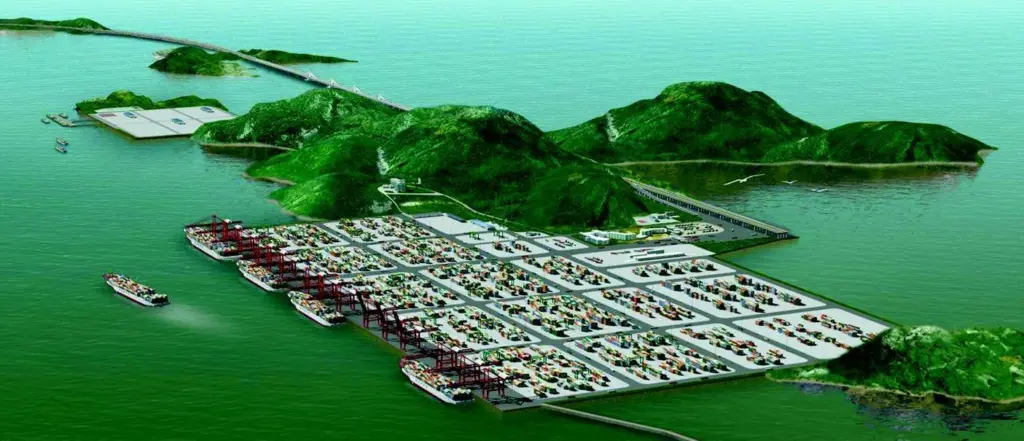
For the moment, SIPG is concentrating on Shanghai and its huge new offshore development at Yangshan. However, the company’s president, Lu Haihu, declares: “We will follow a PSA-type model in the future. We will become involved in international operations in the future.
Several foreign ports have approached us to consider an investment in their terminals. We will look at the proposals when there is a mature project and when the timing is right, we will go there.”
It may be a couple of years before SIPG fully enters the international scene, but it has a clear intent to expand. Formed from the split of the Shanghai Port Authority into two entities in 2003, it has been freed from the restrictions of state bureaucracy and is now operating with a clear commercial vision. With a registered capital of US$610m, and total assets of US$2.3 billion, SIPG can become a major player, but Lu knows that considerably more funds are needed to expand on the international arena.
The company has just embarked on its first phase of financial expansion by turning itself into a joint stock holding. In December 2004, the Hong Kong conglomerate, China Merchants Holdings Ltd, paid a reported US$670m for a 30% stake in SIPG. Other investors included Tongsheng Investment, Shanghai Assets Operation Company and Shanghai Dansheng Holdings. SIPG holds the majority stake of 50%.
Lu continues: “In the past, the Shanghai Port Authority was operating and managing the port, but it was not meeting the marketing demand. Commercial and administrative functions were not separated and it was hard to pursue profitability as a major goal. In the end, a kind of vicious circle was created.
“After the reorganisation, SIPG has a much better strategic position in the market. The major purpose of the reform was to increase the productivity of Shanghai. Profitability is also important and now we will only pursue projects that we believe will make money.
It is a totally new way of thinking for us and we have a much clearer idea of what to do and what not to do.”
As well as overseeing the successful operation of the first two phases of the Yangshan project over the next two years, SIPG will embark on what Lu refers to as the company’s “globalisation strategy”. As well as gaining funds from overseas investors, SIPG plans to become a listed company on the Stock Exchange. This may take place in 2005, although a definite time frame has not been set.
Even at this early stage, it seems that a number of companies are interested in SIPG as a business partner. As an incentive for prospective companies, SIPG will probably, within another five years, be managing the largest port in the world. The China economic bubble is not likely to burst and Shanghai’s current annual growth rate far exceeds that of Hong Kong.
At present, China has some of the world’s largest shipping lines in Cosco and China Shipping Container Lines, some of the largest shipbuilding yards, and indeed container vessels. Within a short period, it may well have one of the largest terminal operating companies. Time will tell whether SIPG realises investment at other hub ports, or at niche ports, within Asia or further afield. But it will become a force on the international terminal operator stage and competition for HPH, PSA and APM Terminals cannot be a bad thing.
Related Articles
 CONTAINER & CARGO HANDLING
 CONTAINER & CARGO HANDLING
 BULK HANDLING