![PortStrategy[GreenPort]](https://www.portstrategy.com/wp-content/uploads/2026/09/PortStrategyGreenPort.svg)





TOUGH OPERATIONAL ECONOMICS MAKE THIS A MARGINAL BUSINESS
Inadequate port infrastructure or specific operational economics still prompt some stevedores to make use of sophisticated floating terminals, reports Alex Hughes .
Europe’s F.L.Smidth Group, the world’s leading producer of equipment for the cement industry, also specialises in the conversion of bulk freighters to floating terminals through its H.W. Carlsen subsidiary. Screw-type unloaders and bagging equipment is sourced from other group members.
According to marketing manager Henrik Vinther, H.W. Carlsen’s main task is to design the conversion, leaving the vessel owner to outsource the work to specialist yards in low-cost labour countries, like Taiwan or China.
Big cement producers such as Cemex and Holcim, or major production plants in low-cost economies, are the main users of floating terminals, he claims, pointing out that these are deployed in markets where sufficient dockside facilities are not available, or where quayside infrastructure is insufficient to support either a mechanical ship-unloader or a packaging plant needed to convert bulk cement into 50kg bags. Given that cement is a fairly low-value commodity, shoreside upgrading work cannot always be justified, he explains.
Once a floating cement terminal has been docked at the quayside, it uses the screw unloader to offload consignments of bulk cement from ocean-going bulk carriers which anchor alongside.
This can often involve the floating terminal undertaking a 180infinity manoeuvre alongside the quay in order to position the loader on the side nearest the incoming vessel. Then, by using the rails on the deck, the unloader can be moved up and down to enable it to enter any of the holds of the transport vessel. “Afterwards, ” says Vinther, “the cement can either be blown directly into shoreside silos or into waiting trucks, or bagged for despatch by road haulage companies.
The packaging equipment we provide comes from a sister company, Ventomatic.”
Greece’s Titan Cement was a major operator of floating terminals in the 1970s, although nowadays owns only shoreside facilities.
International trade director Nicholas Vlassopoulos explains that, partly, the move away from floating terminals had been to assure customers of Titan’s long-term commitment to the industry.
However, at the time, there had been unprecedented demand from the Middle East for bagged cement, so the easiest and quickest way to satisfy that had been to set up floating import terminals based on converted older bulk carriers in the 18,000dwt to 65,000dwt range.
The economics of importing this cement into the region depended on bringing it in in bulk, then bagging it.
“We would take another look at floating terminals if we had to set up a cement import operation in a hurry, ” comments Vlassopoulos.
“However, it is an expensive process and we would really need to have a long term contract to justify the investment, since it can take anything up to a year to undertake a conversion with perhaps even a longer lead time to source suitable handling equipment. Furthermore, to achieve breakeven, it would be a question of handling 250,000300,000 tons per annum.”
Conversion of freighters to floating cement terminals is not a huge market, given the low value of the product being handled. Only two or three ships annually have such work undertaken since the cost of the unloader alone can set an owner back ? 1m. As a result, only two other companies apart from the FL Smidth group – Buhler and BMH Marine – specialise in the market.
Although Vinther sees scope for the handling of both coal and gypsum by floating terminals, he believes that grain handling is not really suitable for the type of freighter conversion his company specialises in. However, Sweden’s BMH Marine has undertaken conversion of bulk vessels to floating terminals to handle a variety of commodities, including cement, grain, iron ore pellets, aggregates, coal and copper concentrates.
OVER 20 FLOATING TERMINALS In the 1980s, the company supplied equipment to over 20 floating terminals worldwide dedicated to cement handling. Typically, unloaders were used to transfer consignments from 35,000dwt-60,000dwt deep-sea vessels at handling rates of 600-800tph. A typical recent conversion was the 18,000dwt RED SEA SPIRIT which was outfitted in 1999 with a 300tph Siwertell ship unloader and a Nordstroms mechanical and pneumatic on-deck conveying system.
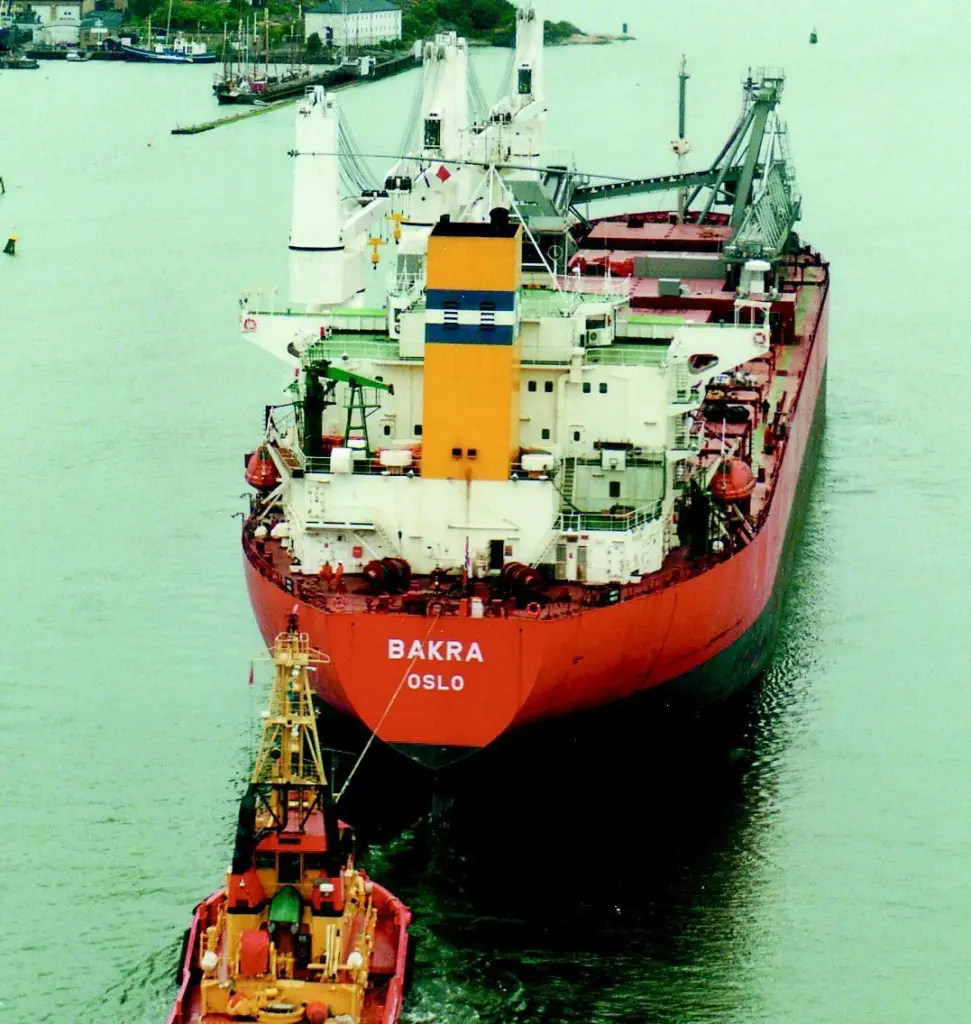
In the same year, the 70,000dwt BAKRA was converted into a transfer vessel designed mainly to handle iron ore pellets, as well as aggregates and coal at either 2,500tph or 1,515m 3ph. The conversion involved the fitting of deck-mounted conveyor discharging equipment and a conveying boom. A year earlier, the company had supplied a transfer barge to P.T. Freeport’s plant at Irian Jaya, Indonesia, transferring copper concentrate ore offshore to incoming Handymax vessels.
In 2001, the BALSFJORD, a similar sized vessel to the BAKRA, was converted into a transfer platform. This involved fitting cranes mounted on eccentric arms in order to transfer cargo from Capesize vessels into its own holds. A deck-mounted Nordstroms conveyor system was also fitted essentially with iron ore pellets in mind, but also potentially for aggregates and coal.
In Brazil, BMH Marine helped put together a floating grain transhipment terminal at Itacoatiara on the Amazon River in 1997.
This was not a converted bulk carrier, but rather an 86 metre long and 35 metre wide pontoon equipped with a travelling Siwertell continuous screw-type shipunloader for 2,250dwt barges and a fixed ship loader for 40,000dwt ocean going vessels, both of which can attain un/loading rates of 1,500tph.
US stevedoring group Cooper T. Smith also uses a catamaranstyle floating terminal, the AMERICA, which it acquired secondhand some 18 years ago and is now deployed on the Mississippi River at Darrow, Louisiana, undertaking midstream transfers of export grain by-products between river barge and deep-sea vessel. However, beyond this essential function, the terminal also has a limited storage capability, whilst also performing weighing functions. Although Cooper T. Smith also owns a second floating installation on the river, the socalled RGI unit is simply an elevator-barge, nowadays little used.
Instead, competition for by-products comes from the K2 rig operated by Cargill and from the GEMINI which handles similar products for ADM. A fifth terminal, the DELTA was formerly operated by SSA, but sank some years ago.
“The AMERICA mostly handles grain by-products on behalf of Bunge, but we do have some additional capacity that we can offer to third party customers, ” notes Ed Laurendine, Cooper T. Smith’s bulk handling manager. “It is the same with the other two rigs, with K2 mainly concentrating on Cargill traffic and GEMINI on ADM’s.
However, nowadays, land-based terminals are also competing for grain by-products. They unload grain brought in by barges, weigh it and immediately put it on an ocean-going vessel without it really having entered a shore-based elevator complex.”
To make matters worse, many of the US’ former export markets have invested heavily in developing their own by-product industries, reducing imports of processed grain, such as animal feed or flour, in favour of more heavy grain shipments. All of which has hit the economics of operating mid-stream terminals in the US.
“There is more than sufficient capacity on the Mississippi River to handle available volumes, concedes Laurendine. “Therefore the financial case for building a brand new floating terminal, which would cost in the region of $15-18m, would be difficult to make, especially since existing operators are using equipment that is fully depreciated and know all about competing in an industry which has left many of them well beaten up. In fact, operational margins on floating rigs are pretty thin.” He points out that when the AMERICA was built 25 years ago it was in a period when there seemed no end in sight for rising exports of locally produced grain.
To make any sort of case at all for the construction of a new floating terminal, Laurendine argues that a new market entrant would need a long-term contract from a major player in the grain industry before even approaching potential financiers. Such contracts, he says, practically no longer exist.
Related Articles
 CONTAINER & CARGO HANDLING
 CONTAINER & CARGO HANDLING
 BULK HANDLING