![PortStrategy[GreenPort]](https://www.portstrategy.com/wp-content/uploads/2026/09/PortStrategyGreenPort.svg)



Dry bulk congestion soars
Congestion for dry bulk carriers at Rotterdam, the Netherlands has soared following Russian’s invasion of Ukraine.
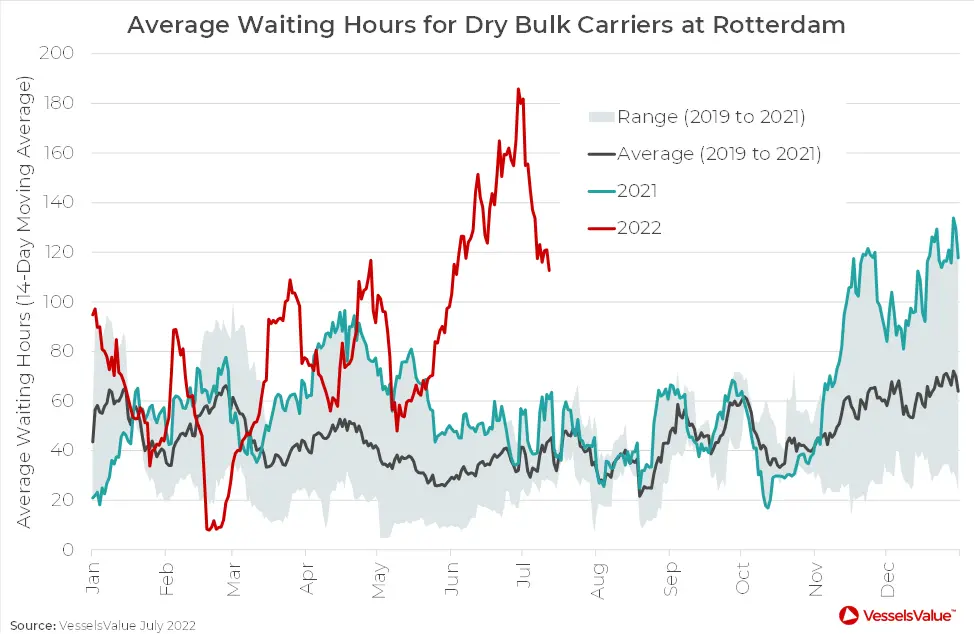
Analysis by VesselsValue shows that since the outbreak of war in late February, the average waiting time for a bulker at Europe’s busiest port has often been above the high end of its three year range.
But over the seven week period from 9 May to 29 June, it escalated from 48 hours to 186 hours. It has since eased to 113 hours but remains very high for the time of year.
Dry bulk imports increase
Dry bulk imports into northwest Europe have been steadily recovering since the depths of the Covid-19 pandemic in mid 2020. But growth has accelerated since the Russian invasion and volumes are now higher than pre pandemic levels with much of the global increase driven by flows from within Europe.
In the April to June period, trade flows from within the region increased by 21% on the same period last year. Intra-northwest Europe trade was 8.2 million tonnes higher, more than offsetting a 2.9 million tonne drop in imports from the Baltic Sea region, where there are several key Russian ports.
The second biggest driver is trade from Africa, which rose by 72% in the same period compared with the previous year. European energy companies have been buying up South African coal, despite high prices, in the wake of a ban on Russian cargoes.
This has lifted coal trade from South Africa to northwest Europe to levels not seen since 2014. Rotterdam in the Netherlands is the region’s main coal import terminal, but several other countries, including France, Germany, Italy and Poland, received cargoes, having imported no coal at all from South Africa in the year ago period.
Related Articles
 LEGAL, RISK & INSURANCE
 NEWS
NEWS
 PORT & TERMINAL NEWS