![PortStrategy[GreenPort]](https://www.portstrategy.com/wp-content/uploads/2026/09/PortStrategyGreenPort.svg)



DO-IT-YOURSELF OR OUTSOURCE?
Should ports with a continuous need for maintenance dredging automatically outsource the work to a contractor? At what point does the do-it-yourself solution make sense? Alex Hughes investigates.
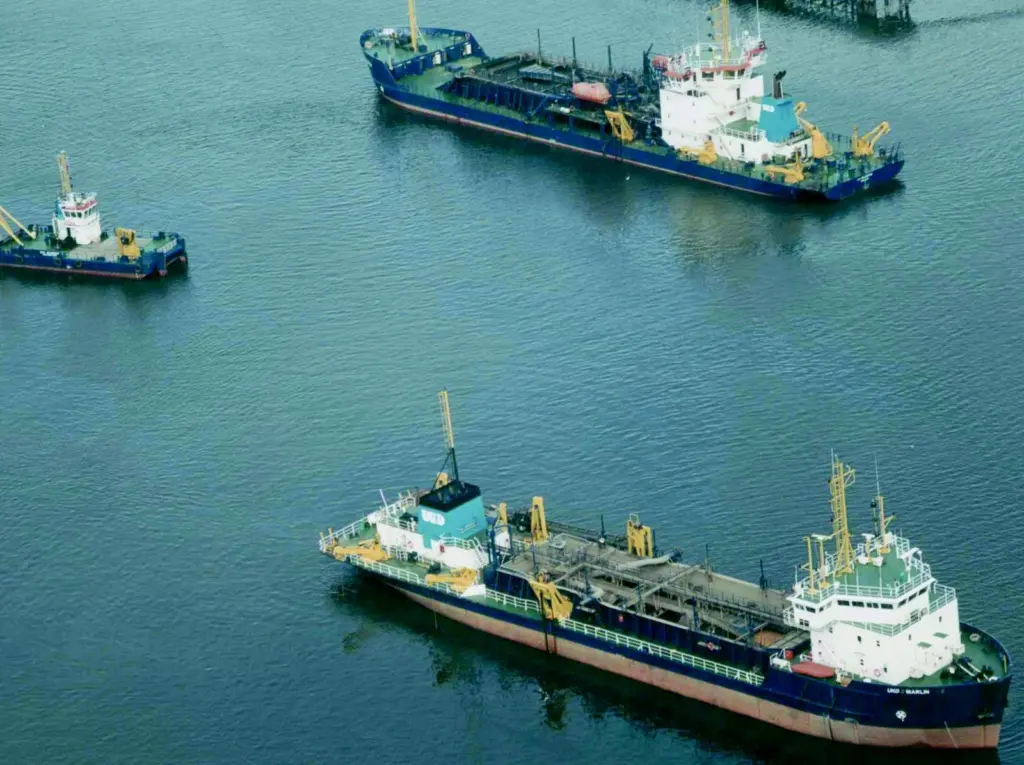
When Associated British Ports (ABP) was formed in 1983, it inherited a considerable amount of dredging plant from its various component arms. Many of the formerly stateowned ports owned their own dredgers, while two large dredging fleets were available to the company on the Humber River and in South Wales.
The new UK-wide group gradually began to integrate dredging resources, although some ports still continued to contract-in dredging services from third-party providers. Although some smallscale rationalisation did take place, it was not until 1996 that ABP adopted an overall corporate dredging strategy. This involved the establishment of UK Dredging (UKD), a wholly-owned division of the company, with a remit to consolidate and rationalise the existing dredging fleet as well as developing the resources necessary to carry out all of the company’s considerable maintenance dredging requirements. Nowadays, virtually all of ABP’s routine maintenance dredging is carried out by UKD. However, occasionally, small-scale work is awarded to contractors where specialist plant not owned by the company is required.
In addition, any spare capacity was to be marketed to third parties, while its Hydrographic Survey capability was also to be made available to potential customers.
In terms of the fleet, a number of older dredgers were sold and a new Trailing Suction Hopper Dredger, the UKD BLUE FIN, was commissioned in 1997, with two multi-purpose plough vessels, the UKD SEAHORSE and the UKD SEALION, being added later.
According to UKD general manager Jeff Neale, the benefit to ABP of having its own dredging arm is both financial and strategic.
“ABP is able to maintain a fleet capable of carrying out all of its own maintenance dredging, thereby protecting it from the fluctuations of the contract dredging market. In addition the possibility exists to offset the costs associated with the fleet by utilising spare capacity to earn external revenue, ” he notes.
While Neale concedes that, for the ports industry in general, inhouse dredging operations are, often justifiably, regarded as inefficient and costly, UKD recognises that full utilisation -whether on in-house works or as in the case of UKD, a combination of in-house and contract work – is key to achieving the cost effective position necessary to justify its role. This can only be successful where productivity can match that of commercial competitors.
To ensure that it remains competitive, UKD has therefore had to invest in both training and technology, which has resulted in it being able to develop a modern and efficient dredging capability. The UKD fleet currently achieves utilisation levels of 90%.
“ABP has a very strict discipline governing investment return; this also applies to capital required for investment in dredging plant. Cost savings generated by the in-house operation must be proven together with the revenue generated on third party contracts, ” emphasises Neale.
Around 35% of revenue is nowadays derived from third-party works. Vessels are marketed at commercial rates and tenders are submitted for suitable projects. As with all contractors, a commercial judgement is sometimes made where possible long-term benefits may accrue. The volume of repeat business, claims Neale, is testimony to the efficient and competitive operation of UKD’s fleet.
The current customer base includes major port authorities, the Ministry of Defence, local authorities, civil contractors and other dredging contractors both in the UK and on the near Continent.
Asked to compare the economics of undertaking capital as opposed to maintenance dredging, Neale draws a clear distinction:
“Capital dredging generally requires different types of equipment and there is no return business! Pricing principles are basically the same, but the risks associated with the variety of materials involved can be considerable compared to genuine maintenance dredging where, the material is, by definition, recently deposited and therefore easier to remove.”
UKD has even carried out a number of capital projects of its own, both for ABP and for third-party clients, but only where its existing plant was suitable for the work required. Nevertheless, Neale insists that if a financial case can be made, UKD will also contract in the equipment and skills required. In addition, Neale’s division also manages large capital projects on behalf of the parent group, utilising its own vessels where appropriate and contracting in where necessary.
According to Constantijn Dolmans, secretary general of the International Association of Dredging Companies (IADC), the financial return on any maintenance dredging equipment depends on many factors, including the overall size of the port and the type of material to be dredged.
BUT THE TREND IS STILL TOWARDS OUTSOURCING “In general, ” he notes, “larger vessels are able to undertake work more cheaply, although most global ports do not have enough work to justify the acquisition of such medium or large size vessels.
Furthermore, privately owned vessels often find themselves working up to 168 hours a week throughout the year; port-owned vessels, on the other hand, might be used for just 40-80 hours a week.”
By keeping maintenance dredging in house, he argues, ports have to undertake significant investment both in retaining experienced personnel and in managing state-of-the-art equipment. Such investment competes with other priorities that the port invariably has, inevitably resulting in less flexibility; indeed, the larger the port, the bigger the problem.
Dolmans also emphasises the so-called “economies of scope” obtainable via out-sourced dredging, pointing out that these result in more differentiation of dredging services offered by contractors; in other words the right vessel is deployed for each individual job. Furthermore, there is also a transfer of risk: by outsourcing dredging services, part of the risks associated with such work are transferred to experienced dredging contractors that are often better able to handle dredgingspecific risks because of their worldwide experience and knowledge.
He estimates that around 60% of all global maintenance dredging is now outsourced, noting that there are still large differences between countries and regions. In Europe, for example, depending on whether UK Dredging is regarded as being independent or not, it could be argued that over 90% is undertaken by private contractors, whereas in India the maintenance dredging business is nearly 100% state controlled.
“Throughout the world, there was a move towards greater privatisation of maintenance dredging in the 1990s. Nevertheless, and somewhat remarkably in my opinion, major markets such as India, China and the USA remain even today either state-controlled or effectively closed to international competition, ” observes Dolmans.
Asked to identify certain regions where changes are currently taking place, he cites, in particular, Eastern Europe, where outsourced maintenance dredging contracts are definitely on the increase. This trend has also been seen in several other countries worldwide, most notably in Argentina in the mid-1990s. “If I were to give reasons for these changes, I would point to the general trend towards globalisation and free trade;
the lack of (public) money in ports to buy state-of-the-art dredging vessels;
and insufficient experienced personnel available in ports to operate more modern vessels. Furthermore, I am not aware of a single region where maintenance dredging services are being taken back into public hands when trials have been undertaken with outside contractors, ” he emphasises.
Given the strength of the arguments in favour of outsourcing, the IADC believes that those port authorities still retaining dredging services as part of their remit will inevitably look to source from the open market whenever the need arises for more capital expenditure.
“Specific ROI will depend on location and the material to be dredged, but in general outsourcing a large part of maintenance dredging should work out significantly cheaper for most ports due to the economies of scale private dredging contractors can command compared with an individual port which is operating one or possibly a handful of vessels, ” Dolmans stresses, adding that, invariably, the operating costs of vessels per cubic metre of dredged material decrease when larger and more modern vessels are deployed. “Due to the large amount of investment made by private dredging contractors over the last few years in new state-of-the-art equipment, outsourcing has definitely therefore become cheaper.”
Ports should ask themselves what their core business is: port management or dredging. For most ports, transaction costs at the market place are lower than the costs of keeping maintenance dredging in house.
Related Articles
 CONTAINER & CARGO HANDLING
 CONTAINER & CARGO HANDLING
 EQUIPMENT