![PortStrategy[GreenPort]](https://www.portstrategy.com/wp-content/uploads/2026/09/PortStrategyGreenPort.svg)





A POLITICAL FAVOURITE
The Baltic Sea is a busy place with over 60 ports handling some 230m tons of cargo annually. The Russian port complex at St.Petersburg is the largest of these and, in its entirety, is known as the Great Port. Lena Beloglazova reports.
Absolute leadership among Russian ports volume-wise belongs to the port of Novorossyisk on the Black Sea but it should be noted that 78% of Novorossyisk throughput comprises oil. In respect of all other commodities, St Petersburg is the leader.
The port is given particular political importance evidenced by the fact that the reform of the state system of port administrations has started from here.
In 2003 the Great Port of St Petersburg handled 42m tons, this figure excluding Primorsk – largest of the Baltic oil ports. A significant share of St Petersburg’s own turnover also constitutes oil and oil products as well as container cargoes, the two groupings in the past year having increased by 4% and 13% respectively. The structure of the port’s cargo turnover is illustrated by Figure 1.
Russia today emphasizes two priority groups of cargoes: oil to feed it today and containers – to feed it tomorrow. And facilities handling these kinds of cargoes are of particular importance among the many operators within the Great Port of St Petersburg.
OIL FOR TODAY Oil has not been a major cargo in St.Petersburg until recently as historically liquid bulk was handled in the deepwater ports of the Baltic States, primarily Ventspils. Upon the USSR’s disintegration, St Petersburg’s oil terminal grew rapidly and the Russian North-West with the Great Port of St.Petersburg as its principal conduit, has a good chance to take over from Novorossyisk. A number of projects already underway and being planned promise to take oil and oil products handling to surpass 100m tons. The port of Primorsk, launched late in 2001, already handled 18m tons in 2003. In 2004 its handling is forecast to approach 40m tons. with the new LUKoil products terminal due to be launched this year. Meanwhile, terminals with throughput capacities of over 10m tons each are planned by BPTNK, Surgutneftegas and Rosneft, on the Gulf of Finland.
With problems such as the new regulations of the Turkish government hindering the stability of exports via southern ports, particularly Novorossyisk, Russia’sstate officials have already been mentioning plans to start rerouting the oil cargo flow onto the existing and to-be terminals in the North-West.
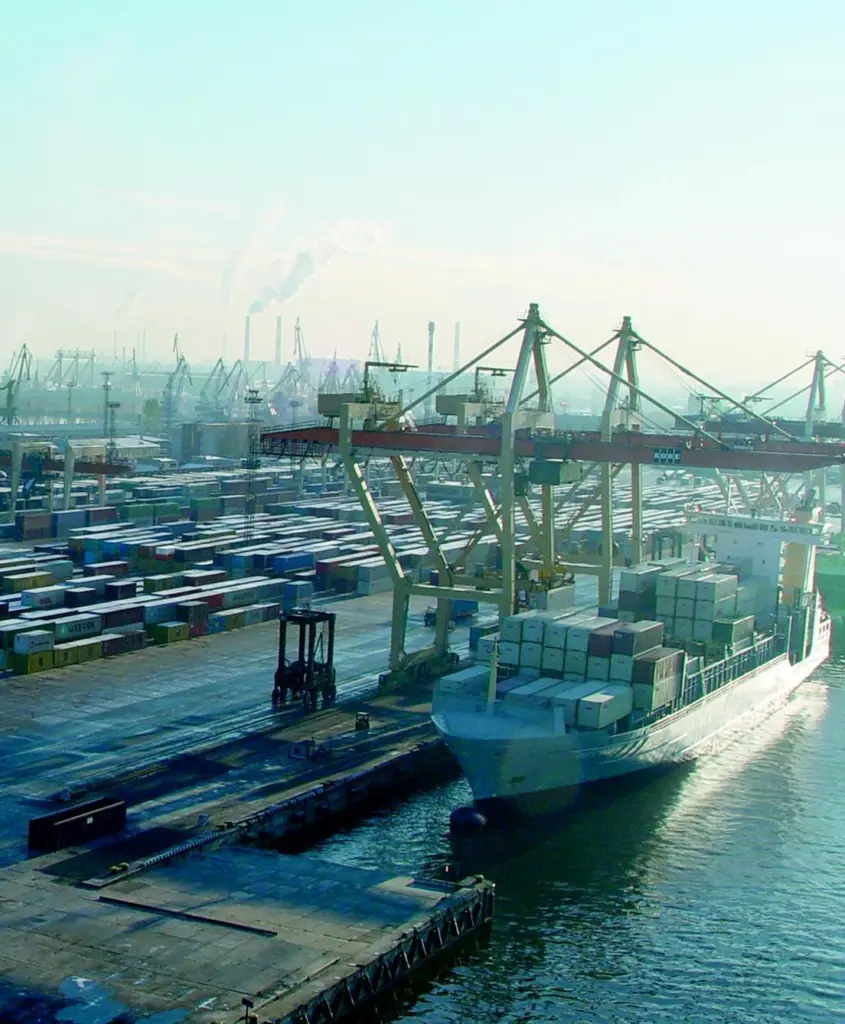
CONTAINERS – BREAD FOR TOMORROW Today, St Petersburg’s First Container Terminal (FCT) is the largest on the Baltic – almost. ‘Experimenting’ with the terminal’s operating structure in the course of 2003 set it behind and forced it to yield first prize, which it only won in 2002, back to the port of Helsinki. Its present capacity is 700,000TEUs per annum and the plan is to upgrade it to 1.3mTEUs by 2007. FCT’s reefer terminal is now the third largest terminal in Europe and fifth in the world.
FCT today forms the basis for a system to ensure the smooth operation of the all-Russina terminals (port and inland) network to offer the efficient multimodal container service projected by the National Container Company (NCC). NCC was set up by the shareholders of the Sea Port of St Petersburg (JSC) – the Great Port’s largest stevedore (Table 3). At present FCT is the major operating NCC asset. Among other NCC port assets are shares in Vladivistok and Vostochny in the Russian Far East, a terminal by the port of Astrakhan on the Caspian launched in 2003, the NUTEP terminal in the port of Novorossyisk to be launched imminently. And the jewel in the crown: the Ust-Luga terminal.
UST-LUGA: NCC AND EUROGATE’S BABY The Ust-Luga port is located on the Gulf of Finland, 110km west of St Petersburg. In comparison with other bays in the Baltic, the UstLuga area is reckoned to be one of the best sites for port placement in the region. The dredged channel of about 4.5 km length, 150 metres width and 14 metres depth by the anchorage allows the servicing of 50,000dwt vessels. Further dredging up to 16.3 metres to allow vessels of up to 70,000dwt, is planned.
In May 2003 NCC and Eurogate entered into an alliance to cooperate in the new container terminal. Construction is planned in four stages with the development of annual throughputs from 800,000 up to 3.3mTEUs. The completion of the first stage and the start of terminal operations is planned for 2007. The total investment with the full development of the terminal will cost around $0.5 billion.
HHLA GETS CONTROL OF PETROLESPORT Petrolesport (PLP) is the second largest container operator in St Petersburg. Its current annual capacity is 120,000TEUs handling 90,000TEUs in 2003. PLP’s strategic partner is Hamburg’s HHLA which acquired the controlling stock in PLP (25%+1) late last year from the terminal owner Orimi Group.
According to PLP chairman A. Kolosnitsyn, by 2006 the modernised container terminal will be able to handle 220,000 TEUs.
Theinitial expansion project is worth $50m whilst in the longer term, by 2013 the terminal’s throughput is to be increased to 500,000 TEUs, requiring $140m of investment.
AND THEN THERE WAS? In 2002 Kronstadt opened a container terminal of 75,000TEU capacity exclusively for Finnish operator, Containerships. The General Scheme (masterplan) of the Great Port of St Petersburg development stipulates a 160,000TEU capacity for this terminal.
Meanwhile another terminal of 360,000TEU capacity is planned Lomonosov port.
To sum up the container facility projects, cast a look at Table 2 comparing capacities today and, following expansion, by 2010. Thus the Great Port of St Petersburg intends to increase its container throughput by over 7.5 times, which, even taking into account the acute capacities deficit, appears somewhat optimistic.
Related Articles
 PORT & TERMINAL NEWS
 EXPANSION & DEVELOPMENT
 PORT & TERMINAL NEWS