![PortStrategy[GreenPort]](https://www.portstrategy.com/wp-content/uploads/2026/09/PortStrategyGreenPort.svg)





All welcome
Cargo diversity is the name of the game in Southern European ports, as Alex Hughes finds out
Mediterranean ports are wising up to the fact that product diversification is a key component in helping ports weather economic storms. Consequently, larger ports in the region are eagerly seeking all types of traffic.
At the Italian Port of Genova, for example, traffic last year amounted to 51.4 tons, down just 0.4% on the previous year: a sharp increase in container throughput offset a 17% slump in dry bulk to 4.2m tons. Genova’s dry bulk specialist handler, Terminal Rinfuse Genova (TRG) was acutely hit with volumes plummeting 42.8%, from 1.4m tons to 817,430 tons.
The problem is being addressed, according to Pietro Dante Oddone, the port authority’s communications and promotions director. At the beginning of this year, the concessionaire was acquired in full by Italiana Coke, which forms part of the Genova-based Ascheri Group, one of the leading producers of coke in Europe with a 30% market share of the European production of coke in past years.
“Italiana Coke is committed to an average annual increase in total traffic to 2020 of 4.6%, which can be broken down into growth of 2% for black dry bulk, 8.5% for cement and 6% for white dry bulk commodities,” says Mr Oddone. TRG is also equipped to handle the complete range of traditional dry bulk traffic, as well as breakbulk, containers and ro-ro.
The Business Plan submitted by Italiana Coke foresees an investment programme of €13m to be implemented over the next three years, which will focus primarily on reducing the environmental impact of terminal operations, and on the purchase of new handling equipment, while the port authority remains committed to upgrading the on-dock rail links.
Bulk leader
The Catalan port of Tarragona did somewhat better than Genvoa, posting a 4.2% increase in traffic last year to 33m tons. However, in line with Genova, the state of the general economy means little change is forecast for this year.
Tarragona remains one of Spain’s leading dry bulk centres, with nearly 11m tons handled in 2012, an increase of 17%. Coal, which rose by more than 6%, accounted for 5.5m ton; agribulk increased by nearly 35% to 4.5m tons.
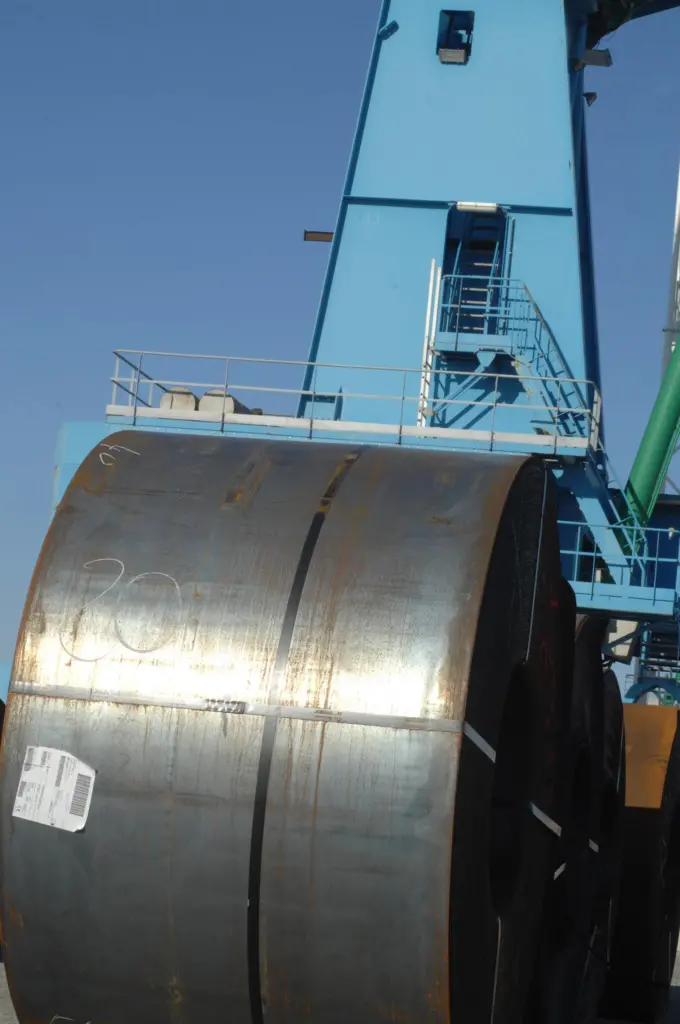
But here to, the port is developing an ever wider traffic base. Last year, for example, it handled 1.1m tons of breakbulk traffic, most of which is accounted for by iron and steel products and paper pulp.
“Both of these grew and have good future prospects,” said Jordi Armengo, commercial director of Port de Tarragona (APT). “The APT is putting its weight behind this type of traffic and is positioning the port as a Mediterranean hub, with more than ten trains weekly leaving for different destinations laden with breakbulk.”
Project cargo is another target market, based on good land access and the availability of open areas within the port that such traffic requires. Tarragona also handled 111,000 finished vehicles in 2012.
“We have superb facilities for new vehicles, since we don’t have congestion, while our damage ratio is the lowest of any Spanish port,” says Mr Armengo. However, as in most Spanish ports, Tarragona has yet to address issues as to whether stevedores or significantly cheaper casual workers should be allow to move vehicles once they have been disembarked.
Box goal
Tarragona, not previously a major container port, is also investing in this sector, which Mr Armengo says reflects a policy of product handling diversification.
“Two major freight corridors – the Mediterranean and Henares – actually pass through here and we want to take full advantage of that. Opposite the container terminal, we have therefore put in place a customs office and border inspection post, installed a container scanner, and built an intermodal terminal,” he says.
Almost half of the existing box traffic is transhipment, although Mr Armengo says that, in the long term, the target market remains import-export boxes.
In France, Marseille handled 84m tons, down 3%, in 2012, mostly the result of handling less liquid bulk traffic as imported crude oil fell because of the restructuring of the refinery sector in Europe.
According to Arnaud Ranjard, director of development at Marseille Fos: “Liquid bulk traffic will continue to fall this year, but we have seen growth in all other sectors, especially dry bulk, where we expect to handle around 13m tons, because of an increase in production at Arcelor Mittal, which is located in Fos,” he says.
Coal, iron ore, bauxite and construction materials account for the majority of this traffic. The aforementioned steel plant and the Eon electricity generating station at Gardannes, some 50 km from Fos, are the main customers.
Mr Ranjard believes that the location of the Acelor Mittal plant on the coast gives Marseille some form of future-proofing, in that it can switch production easily between customers in Europe and those in the rest of the world.
“It’s this type of location that is going to survive in the medium term in Europe,” he says, noting that 2.3m tonnes a year of finished products, such as steel coils, were produced last year, with 90% exported.
Breaking up
The Arcelor Mittal plants generates most of the breakbulk traffic, too. The port, though, is particularly keen to diversify the sort of products handled.
“Previously, most breakbulk traffic went to Antwerp and Dunkirk, because Marseille was not reliable or price competitive; nowadays, we are,” says Mr Ranjard, noting that the port authority is working with Eurofos on a planned new scrap metal handling terminal, with potential customers already lined up.
Last year, Fos handled 220,000 vehicles, down on the previous year because of the economic situation, although Mr Ranjard stresses that the port still believes in this traffic. In future, a lot of vehicles will be imported from Turkey, while Renault is also present in Morocco and has plans for Algeria, too.
“Four months ago, we issued a tender for a logistics provider to take up a larger area at Fos to handle finished vehicles traffic and a contract is to be awarded shortly,” says Mr Ranjard.
Related Articles
 PORT & TERMINAL NEWS
 EXPANSION & DEVELOPMENT
 PORT & TERMINAL NEWS