![PortStrategy[GreenPort]](https://www.portstrategy.com/wp-content/uploads/2026/09/PortStrategyGreenPort.svg)





CARVE-UP THREAT TO DUISURG EXPANSION STRATEGY
Strategy and future planning at Europes biggest inland seaport and logistics service centre, Duisburg on the Rhine, appeared under a cloud as the year changed after reports that both the German Government and the local state of Northrhine Westphalia were considering selling their shares. Tom Todd reports.
Berlin was reported keen to dispose of its one third share in the E46m nominal value of the Duisburger Hafen AG port authority to finance tax reforms. In North-Rhine Westphalia, First Minister Peer Steinbruck was quoted as saying his state wanted to sell its one third share and believed there were parties in the logistics sector very interested in privatisation.
However local Chamber of Industry and Commerce transport and logistics expert Werner Kuhlkamp went on record as saying he doubted privatisation of the concern would work. He said any private majority shareholder would have to guarantee neutrality in dealings with port firms and also respect the infrastructural and local significance of the port. “All of these aspects would have to be covered in contract negotiations”, he was quoted as saying. He also tipped Duisburg would not yield the dividends private investors sought.
There was no word from the City of Duisburg itself about its one third share in the Duisburg Hafen AG. However it appeared unlikely the city would rock a local institution which is home to more than 200 firms, mainly in transport and logistics, and which employs 15,000 people directly or indirectly. Indeed, Duisburg Mayor Barbel Zieling was quoted as criticising Berlin. The time was not auspicious for sales of shares – just as the port was currently involved in a very important development and planning phase – one designed to improve its future cababilities, she reportedly said.
The Duisburg Hafen AG itself, along with its subsidiaries, employs about 200 people. It handles around 36 million tonnes a year and has pushed a 2003 business turnover of about E40m up from E36.5m in 2002 – along with a profit of E2.2m. Some 20,000 vessels call every year and ship cargo transfers total about 50 million tonnes while rail handling stands at about 20m tonnes.
The port is located where the Rhine and Ruhr meet, at the heart of Europe’s biggest industrial region with a population of some 30m.
These days it is not only an industrial centre but also one of Europe’s most important logistics locations. Its significance was built on the local coal and iron and steel industries, but the volume of transhipped coal and ore has declined dramatically since the mid 1980s. As that has happened, container transport and short sea shipping have grown in importance and the port has also its expanded transport and logistics services. A study in 2000 said port-induced capital projects were worth around E500m a year.
Looking ahead, officials said the Port of Duisburg planned to strengthen its role as an engine for growth. It was “pursuing a policy which exploits geographic and infrastructural site advantages and is focusing on a logistics sector for which an excellent long-term future is predicted”, they added.
50% OF EUROPE’S INLAND SHIPPING The Rhine, Europe’s most important waterway, links Duisburg directly with Amsterdam, Rotterdam and Antwerp as well as with the European inland waterway and canal system. The river accounts for over 50% of Europe’s inland shipping. Major European railroad lines also pass through it and five interstate highways make for fast connections to all European capitals. This transport infrastructure has created ideal conditions for a major international tri-modal logistics hub served by water, rail and road.
The Duisburg Hafen AG’s Gerlies Hoffmann-Grimm told Port Strategy : “Logistics are and will remain for many years a growth market which will expand in spite of a global economic environment which is often difficult.
This optimism is ? justified by continuing globalisation and the growth of international trade and associated cargo flows. The extension of the European Union into the countries of Eastern Europe is one of the factors which are expected to boost cross-border trading”, she said.
This new environment and a rapidly changing Europe led Duisburger Hafen AG to redefine its strategies in the late 1990s. The new approach was marked by a new trade name “duisport”, which “symbolises the role of an infrastructure provider as well as of a market and customer- oriented service provider for the logistics sector”, Hoffmann-Grimm reported. The aim, she said, was to transform a traditional bulk cargo port with large surface needs, limited value-added functions and restricted employment into a leading international high-grade cargo logistics hub with an important contribution to make to value chains and with enhanced labour needs.
Warehousing facilities for the storage and distribution of highvalue consumer goods have been built in the traditional port areas on the eastern bank of the Rhine and at the ‘logport’ site on the western bank quadrupling capacity between 1997 and 2001. By the end of 2003 capacity reached about 350,000 sq m and that will rise to 600,000 sq m by 2005.
The ‘logport’ international logistics centre is a key element of the new strategy. It is under development on a former Krupp steel mill site. Originally 15 years had been estimated for completion but according to Hoffmann-Grimm “the development and marketing progress achieved to-date suggests that plans can be implemented twice as fast as anticipated”.
The strategy focuses on winning big logistics investors. Among those already on board are logistics service providers like Japan’s NYK Group, the British Wincanton Group, Swiss-based Kuhne & Nagel as well as Interspe Hamann and Rhenus Logistics. Leading European vehicle logistics service provider Cobelfret joined ‘logport’ in late 2002 and numerous medium-sized companies have also set up shop there.
The marketing heart of ‘logport’ is the Duisburg Intermodal Terminal (DIT) and its tri-modal container terminal, commissioned in 2002 designed for an ultimate annual capacity of 400,000 TEUs. Combined transport rail links alone connect Duisburg by rail with some 70 terminals in Germany and other European countries.
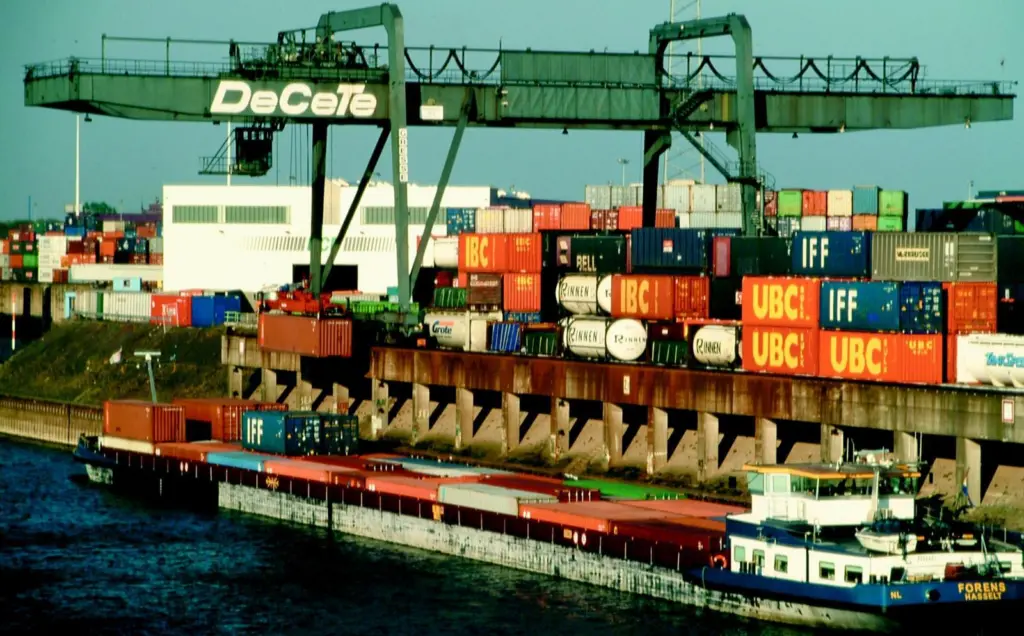
Total handling capacity at Duisburg’s DIT, DeCeTe and Rhein-Ruhr Container Terminals combined is currently put at 600,000 TEUs and is set to grow to about a million TEUs by 2010. Expansion is set against the background of predicted growth in container shipments via major seaports, where storage capacities may become a limiting factor. Already every third tonne of cargo handled in Duisburg passes through Rotterdam and improved hinterland hub functions on the Rhine will help to ease capacity pressure on Rotterdam and Antwerp, officials said.
“Close cooperation with other ports and logistics locations is essential for developing new transportation services and establishing Duisburg as an important link in the transportation chains”, Hoffmann-Grimm told Port Strategy.
Duisport strategy was thus “to win new partners for cooperation at the national and international levels and to build strategic alliances.
Networks are needed to develop the Port of Duisburg into a leading European logistics hub. It is our objective to transform (duisport) into a logistics centre which will employ some 20,000 people in a few years time.”
Pointing up that target, and Duisport’s geographical versatility, is a new multimodal landbridge, via Duisburg and between Rotterdam to the west and east Germany’s biggest Baltic seaport Rostock to the east. Inland ships or trains of Railunion subsidiary Conliner handle container transport between Rotterdam and Duisburg. From there they move to Rostock on an overnight shuttle train service, three times a week, which is organised by Kombiverkehr. From Rostock containers move by Ro-Ro ferry across the Baltic to Scandinavia for pickup and on-transport by road or rail. All involved appear to think the new link offers time and cost advantages over more conventional routes. Duisburg, the hub of the wheel, looks like being a big winner.
Related Articles
 PORT & TERMINAL NEWS
 EXPANSION & DEVELOPMENT
 PORT & TERMINAL NEWS