![PortStrategy[GreenPort]](https://www.portstrategy.com/wp-content/uploads/2026/09/PortStrategyGreenPort.svg)





Easterly chill
Russia still incites optimism despite the recent falls in volumes as Stevie Knight reports
The container trade may be a fraction of Russia’s overall cargo but along with almost everything else, it has dropped through the floor since 2013. So, why do some still believe it still has potential?
Stefan Wilkens, general manager of Bronka Port, is honest about the present state of play: “The fact is Russia’s ports have lost around 30% of their containers in the last couple of years – although it’s recently regained a few percent, so it seems at least the fall has halted.”
However, he doesn’t expect the kind of bounce seen after the global crisis: “We are getting more positive feedback from our clients, but it’s not like 2009. Then, the industry rebound took just a year… now, we have a feeling that while it will come back, it’s going to be much slower.”
It’s not, he says, much to do with European sanctions, explaining that many foodstuffs that came in from the EU are now simply being sourced from elsewhere “so the sanctions have not directly affected the goods so much”. A point also made by Alexander Goloviznin of Morstroytechnology, is that “legally grey or even black cargo is finding a route through”, adding that in Baltic ports, documents are often changed to save fees; for example “a flat screen TV is miraculously converted into canned food” .
A much bigger impact, however, comes from the oil bust: “The oil price and rouble are directly connected,” says Mr Wilkens, as Russia has depended heavily on its energy exports.
Predictably, the drop in business has resulted in plummeting containers says Mr Goloviznin. It’s the end of a promising run. Box cargo multiplied nearly four times between 2004 and 2013, growing from 1.3m teu to 4.8m teu – despite a World Bank report that put Russia in 94th place for quality of infrastructure, behind both China and India. However, the last year or two has really taken the wind out of Russia’s sails: “People just don’t have the buying power,” Mr Goloviznin explains, adding a side issue “is that now there are actually far fewer empty containers around to carry out exports”.
But Mr Wilkens has faith in the longer term potential represented by Bronka – and Russia’s eventual, inevitable demand for containerisation. He points out that at 28 teu per capita it has a long, long way to go even against a world average of 97 let alone Europe’s 122. The new port, which only opened in January, is posting itself as the modern alternative to the congested city facilities in St Petersburg and is starting off with a full suite of services that can make use of its 14.4m depth and easy approaches. So, although Bronka is starting with a modest 500,000 teu capacity plus 130,000 ro-ro units, it has got the space to bring this up to 1.9m teu and 260,000 ro-ro without too much trouble.
Faith in growth
He’s not alone: DP World also believes there’s room to grow Russia’s container segment. Last year it got together with the Russian direct investment fund (RDIF) to form DP World Russia and promptly went out fishing for bargains with a $2 billion pot, landing a 49% stake in the 65 ha NUTEP container terminal at Novorossiysk.
The terminal had just started on developments aimed at bringing in vessels up to 10,000 teu by lengthening the quays to 335m and deepening the draught from 12m to 15.5m, all of which will help lift capacity to 700,000 teu. Although the slump has knocked volumes, at present the plans seem to be intact partly because Russia needs to keep hold of its Black Sea market share.
Even given the current parlous state of Russian cargo, expanding the Black Sea capacity is a necessity says Mr Goloviznin: while the losses have loosened the straitjacket the relief is temporary: he explains other ports do not have the depth and Novorossiysk itself “has serious space constraints”. Further, many of the country’s assets are outdated: Russia saw a lot of its port infrastructure sliced away with the breakup of the former Soviet Union and it had to cobble together whatever was left. Sadly these now do not match up to modern timetables or rising vessel sizes.
Somewhat surprisingly, DP World is also seeking to replicate its Jebel Ali success far away from the waterfront in the region – in Kazakhstan. The idea is simple: despite its apparently unlikely position, Khorgos-Eastern Gates is a 240 ha special economic zone strategically located on a railway node near the Chinese border.
DP World might have a point: container volumes doubled between 2014 and 2015 and now Khorgos, a joint venture with local transport operator Temir Zholy, is looking at raising its present 50,000 teu capacity to 130,000 teu. Certainly Kazakhstan is more than happy to offer itself up as stepping stone in China’s Silk Road initiative and last year announced investment of around $20bn to 2020 in infrastructure, mostly focused on connecting East and West with a spur to newly emerging, and potential partner, Iran.
“Everyone there is talking about Chinese cargo, making Khorgos a local gateway and a transit route to the west,” says Mr Goloviznin. However, he adds realistically, the volumes are as yet “tiny”.
There are also some major initiatives close to Russia’s hydrocarbon heart. Sabetta port on the arctic Yamal peninsula has suddenly risen from the icy wasteland around it – even before the financial agreements were completely finalised. It will have over 800 m of gas berthing and be able to export 16m tonnes of LNG, potentially extending this to 25m tonnes capacity. Despite the hype about an Arctic Sea route this is an expensive undertaking, but Russia is sensitive about its grip on market share and is, according to analysts, willing to ramp up production to shut others out.
Developments lacking this driver are a much less safe bet. There’s often “a stir of interest” pushed into the limelight by local players that then withers on the vine, explains David Bull of RHDHV. For example there are a number of coal projects that together would add over 100m tonnes to Russian capacity – “too many to be realistic,” adds Mr Goloviznin, saying he expects only a few of the larger ones to see the light of day.
BETTING ON THE ‘NEW’ NOVOROSSIYSK
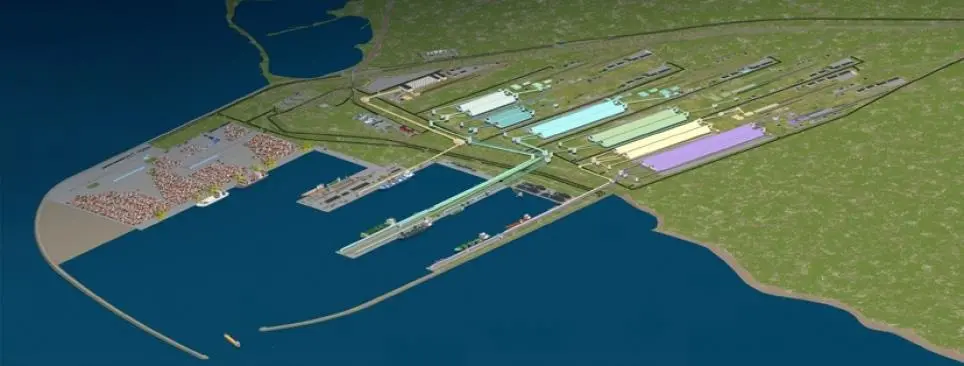
Taman, already a 10.5m tonne oil and gas terminal, was initially headlined as “another Novorossiysk” in the making. With a capacity of nearly 93m tonnes, no less than 10 terminals, 19.6 m draft and a total quay length of 8 km it was to pull both dry and liquid bulk away from Ukrainian transit ports and bring them home.
Unfortunately, a third of the project’s total budget of $5.4bn got diverted to a pet project of President Vladimir Putin’s, the nearby Rb228bn ($3.5bn), 19 km land bridge across the Kerch Strait which aims to give a physical underpinning to Russia’s political annexation of Crimea.
The ‘monumental’ Kerch Bridge stole the show – and the financial support. And then, to add to Taman’s woes, the money started to run out with the oil price slump which sucked away a large part of Russia’s revenue stream.
Despite all this – and the inevitable tangle of red tape that at one point threatened the entire project – the investors got together to push the development further along. They seem to be winning: the latest news is that the OTEC group is going ahead with a new urea (fertiliser) and ammonia plant, a synthetic fuel facility, a variety of agribulk and greenhouse complexes along with specialist terminals and a large project cargo base. Putting wheels, quite literally, under the whole idea is a plan for a train line linking the peninsula with the main network – this too is going to be a private-public partnership project, a first for Russian rail. It’s also possibly been smiled on because it may help link Crimea with the Russian mainland.
There are some pretty strong market forces behind the Taman project. As Mr Bull notes, much of Russia’s infrastructure story still turns on hydrocarbon development, “especially as the country has extremely low production costs”. But with oil revenues down, diversifying into other chemical exports such as ammonia, urea and methanol (which can be co-produced from natural gas) could prove the safer, more profitable bet.
Related Articles
 PORT & TERMINAL NEWS
 EXPANSION & DEVELOPMENT
 PORT & TERMINAL NEWS