![PortStrategy[GreenPort]](https://www.portstrategy.com/wp-content/uploads/2026/09/PortStrategyGreenPort.svg)





INVESTING WHERE IT MAKES SENSE
Hamburg-Bremerhaven joint venture Eurogate will reach its target of 11.7mTEUs this year and remain focused on Europe, with no plans to go global. It will also continue a strategy for success which has seen its handling nearly double inside just six years. Eurogate Board chairman Emanuel Schiffer spoke to Tom Todd in an exclusive interview after a year in which the group again broke new ground with the creation of the dedicated, 50-50 joint venture terminal, MSC Gate.
Eurogate helped break down traditional German port rivalries in 1999 when it was created through the merger of Hamburg’s biggest private container handler Eurokai and the container division of BLG – at that time the Bremer Lagerhaus Gesellschaft, now the Bremen Logistics Group. It was the first time that Hamburg and Bremen port operators had joined forces.
The new concern, with terminals in Hamburg and Bremerhaven, announced plans for strategic links with other ports many of which are now in place. It said at the time, rightly as its success now demonstrates, that in the face of globalisation, increasing concentration among shipping lines and cutthroat competition among ports and terminal companies, it was vital to bring the whole range of container services to the customer as “an overall, integrated provision – right across Europe.”
Eurogate handled 6.3mTEUs in its first year. That has risen each year to 10.7m in 2003, when turnover also rose from ?346.9m to ?414.7m and profits from ?26.2m to ?32.9m. Schiffer revealed 2004 would be another record year: “We’re on plan and will achieve the targeted 11.7mTEUs. Business this year has been good and, because of high demand, better than expected”.
Looking back Schiffer says: “The creation of the Eurogate joint venture was the logical consequence of the market situation.
Eurogate has stood the test of time and been a success. Inside just a short period the concern has grown into the market leader. Handling volumes and results have proved to be as positive as was expected when the company was created.”
“There are always dangers lurking, ” he cautions. “Nonetheless, we will continue with our present strategy and will, unwaveringly, develop our three main operational pillars – container handling, cargo-modal services and intermodal transport.”
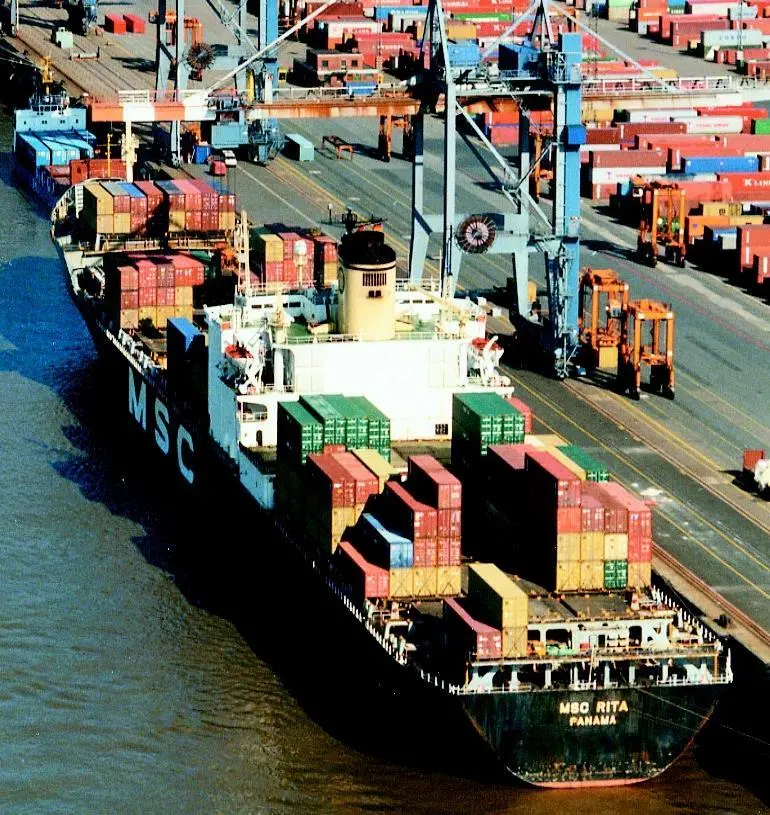
Eurogate’s latest move is MSC Gate in the south of the giant Bremerhaven Container Terminal (CTB) which is also the home of Eurogate’s Weser terminal. MSC Gate is a 50-50 joint venture with MSC. Opened in October it is backed by a ?34m superstructure investment from Eurogate itself and a ?19m infrastructure blessing from the state of Bremen.
With plans for an initial 400,000TEUs rising to 600,000TEUs and with a declared capacity of 1mTEUs, MSC Gate is a “milestone in the development of the container port of Bremerhaven, ” Schiffer says. “The fact that we succeeded in clinching this deal was a feather in Eurogate’s cap because it brings not only the world’s second biggest shipowner to Bremerhaven but also a strong growth concern.”
By using such dedicated terminals “owners like MSC can secure a share of steadily decreasing handling capacities while terminal operators can plan for years ahead with guaranteed handling volumes”, he says. “However, a dedicated terminal only makes sense for us when a certain container volume is ensured.”
Eurogate has always concentrated on Europe. Was it interested in eventually going global ? “No. Our focus will remain Europe and the neighbouring countries”, insists Schiffer.
Would the group also continue its traditional pincer strategy?
Currently it offers one-stop shopping with maximum access to Europe’s markets via the Northern Gateway of Germany, via Lisbon in the southwest and via the Southern Gateway of Italy where Eurogate operates in La Spezia, Ravenna, Livorno, Salerno, Gioia Tauro and Cagliari, through Contship Italia?
“We are investing where it makes sense to invest”, says Schiffer.
“We are investing heavily in expanding terminal capacities in Bremerhaven and Hamburg. But in southern Europe as well, capacities will be increased as required. Our base in Cagliari on Sardinia was only added in 2003 and it has developed splendidly since then.
“Eurogate is in the happy position of being able to finance its investment out of its cash flow”, he continues. “Not only are we investing in terminal expansion and in new facilities like MSC Gate, but we are investing strongly in further automation and IT at our terminals. It is also important to us to train our own management recruits and that’s why we have trainee programmes”, he says.
Speaking about prospects for business in eastern and central Europe now that economies there are reviving, Schiffer describes Russia as “the growth market of the future”. He says “container transport there is very important but still under-developed” and notes “there are still opportunities and the Russian market promises to be one of high growth”.
Russia may not be a member of the EU but all the other countries and ports in which Eurogate is represented are. Given Schiffer’s comment about staying European, any additional future Eurogate port bases are also likely to be in EU member states. So how does Eurogate feel about Brussels’ second attempt to introduce a directive liberalising market access to EU ports – the so called Port Package 2 – a year after the unexpected defeat of the first draft of the controversial legislation in the European Parliament in 2003?
“The Port Package 2 is completely unnecessary”, Schiffer says.
“Competition within Europe works very well already. Shipping companies have access to ports, as dedicated terminals demonstrate. Also, handling prices are much lower in Europe than in the USA and the Far East.”
Meanwhile phase four (CT4) expansion of the Bremerhaven Container Terminal has just begun. It will add 1681 metres of quayside and four new berths, the first in operation by 2006. Handling at the CTB will rise to about 6mTEUs by around 2010 and reach the terminal’s expansion limit and capacity.
That’s why the city-state of Bremen, of which Bremerhaven is part, has joined forces with nearby Wilhelmshaven on the Jade Estuary in its planned new Deepwater Container Terminal. That facility, which is not called the Jade-Weser Port for nothing, should be up and running by about the same time to soak up overflows from the Weser terminals.
Hamburg too was initially in favour of the project but later withdrew deciding instead to invest in its own internal expansion. Eurogate has said that withdrawal was regrettable and has predicted that Hamburg could lose much big ship and feeder business as a result. Schiffer says:
“The Jade-Weser Port in Wilhelmshaven is simply the ideal complement for the container terminals in Bremerhaven and Hamburg.”
Eurogate wants the operating concession for the Wilhelmshaven Terminal and has long made its intentions in that respect very clear.
BLG head Detthold Aden said just recently his group was ready to invest _300m in the project to complement its Weser and Elbe terminals. A decision on concessions, expected next year, has now been complicated by interest also shown in Wilhelmshaven by the giant Rhenus transport group.
Why is the Wilhelmshaven operating concession so important to Eurogate? “By the time CT4 is completed in Bremerhaven in 2010, capacities there will have been saturated. Only limited growth is possible in Hamburg as well, ” Schiffer replies.
“Wilhelmshaven, with its water depth of 18 metres, is ideal for handling the big container ships of the next generation. We expect the container boom to continue over the next few years. MSC, for example, has ordered 46 new container ships this year. That demonstrates the volumes that will have to be moved.”
Asked about Rhenus’ plans, Schiffer adds: “The fact that another concern is also applying for the operating concession shows just how important the Jade-Weser Port project is. We will work out an operating concept and we will take part in the bidding.”
But if it came to it, would Eurogate be prepared to join forces in running the Jade-Weser Terminal? “We have no plans to enter into a co-operation deal with Rhenus, ” Schiffer replies.
Related Articles
 PORT & TERMINAL NEWS
 EXPANSION & DEVELOPMENT
 PORT & TERMINAL NEWS