![PortStrategy[GreenPort]](https://www.portstrategy.com/wp-content/uploads/2026/09/PortStrategyGreenPort.svg)






LOCAL STEVEDORING GROUPS DOMINATE BOX MARKET
Spains rapid economic growth has spawned powerful terminal operators and the second biggest car industry in Europe.
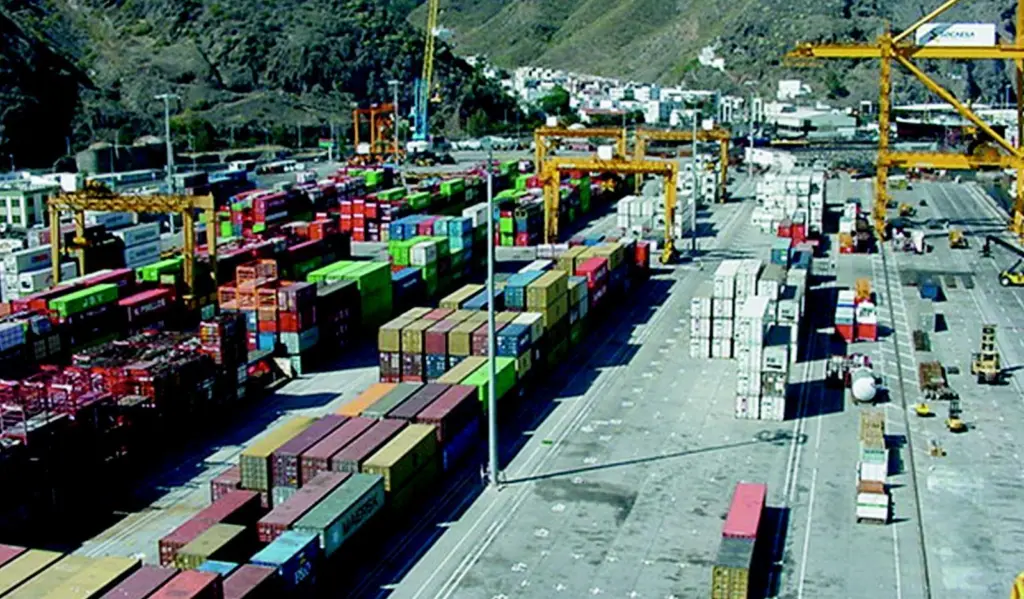
Alex Hughes analyses the activities of Grup TCB and Dragados-SPL in the former sector, and Termicar in the latter.
The Spanish container market, which has demonstrated strong growth over the last decade, has remained almost entirely free of outside influences in terms of terminal ownership. Instead, two dominant domestic groups have emerged: Grup TCB and DragadosSPL, the former headquartered in Barcelona, the latter in Madrid.
Grup TCB, which has as its nucleus Barcelona Container Terminal (TCB), has a presence in Valencia, Algeciras, Gijon, Tenerife and La Palma, not to mention overseas interests in Paranagua (Brazil) and Havana (Cuba).
Total group throughput last year amounted to 2.03m TEUs, up 12.8% over the previous year’s performance. According to group marketing manager, Miguel Duro: “An increase had been expected, but this was somewhat better than budgeted.”
Within Spain, Barcelona registered growth of 6% in reaching a throughput of 884,824TEUs, although has struggled in recent years to add volume at its home base, while rival box terminal Tercat has enjoyed double-digit growth. Even so, it is now fast approaching its design capacity of 1.1m TEUs, although the current concession makes it incumbent upon the port authority to provide up to 50% additional capacity adjacent to the existing terminal.
Duro nevertheless points out that productivity of 30 moves-percrane-hour makes Barcelona one of the most competitive container terminals in the region.
TCB also has a limited foothold in the burgeoning box market in Valencia, taking a majority stake in TCV Stevedoring, which emerged in 2002 as the result of a merger of two multi-purpose terminals. In that year, throughput reached 325,000TEUs, a rise of 50,000TEUs, thanks in part to an increase in transhipped boxes from China Shipping. Last year, traffic amounted to 380,000TEUs, a whacking increase of 46.71%.
Earlier forecasts had suggested that throughput might even top 450,000TEUs.
However, TCV Stevedoring is faced with two major headaches:
the design capacity of its 300,000 sq metre facility is just 600,000TEUs, while productivity is little better than 21 moves-percrane-hour, according to general manager Jose Luis Alabau, although rumours suggest this might be higher than achieved at the port’s main box terminal managed by Maritima Valenciana.
Earlier, in 2001, Grup TCB had taken minority stakes in the new Gijon container terminal in northern Spain and also at the Isla Verde development at the port of Algeciras. Duro explains that traffic at Gijon is confined to calls from feeder vessels serving markets in northern Europe. Even so, throughput rose more than 20% last year to 11,000TEUs, which is more than acceptable given the size of the operation in the port. Duro holds out major hopes at Isla Verde, where the port authority had sought an operator for a new public container terminal to complement the established dedicated base that MSL has there. Operations only started in November 2003, but the idea is to target both transhipment traffic crossing on north-south and east-west routes and import/export boxes. CMA-CGM is the most notable customer to have signed to date although expectations to expand the traffic base are high.
TCB also holds a stake in two terminals on the island of Tenerife, consisting of a small ferry terminal at La Palma and a bigger base at Capsa, where traffic rose 5.5% last year. “Capsa mainly handles cabotage containers, but there are also other international services, one of which links the port with South Africa and northern Europe.
“There is no reason why Tenerife should not handle significant levels of transhipment traffic in the future, ” he adds.
NEW OPPORTUNITIES CONSIDERED Duro also emphasises that, although TCB’s existing network of terminals gives it effective Iberian coverage, any new opportunities would be considered, which includes looking at both the northern Mediterranean and Latin America. “Outside Barcelona, we do not hold a 100% stake in any of the terminals where we operate, although we do insist on retaining control of dockside activities, which is where our specialist know-how can be put to best use. At Isla Verde, for example, we hold only 20% of the equity of TCA, but are totally in charge of the operational side of the business.”
Centralised purchasing of equipment has been adopted by the group, although a preferential supplier system has not been established. When new cranes are needed, for example, TCB seeks out the best market possibility available at that moment. However, in terms of IT, an in house programme has been developed, which has been taken up by all group terminals, obviating the need to shop around.
Spain’s other dominant stevedoring group, Dragados-SPL, registered overall growth of 14% in container throughput during 2003, when the number of boxes handled went up from 2.5m to 2.85m TEUs.
Its main powerhouse is the Marvalsa Group, which is based in the port of Valencia. The leading terminal, Maritima Valenciana, handled 1.43m TEUs last year, a 6.1% improvement over 2002, broadly similar to Barcelona Container Terminal, its main import-export rival on the Mediterranean coast. Significantly, the port authority preferred the bid offered by MSC to that of Marval when recently allocating a 30-year concession to operate a new container terminal to be built on Fangos Quay. MSC, Marval’s leading customer, will nevertheless continue to handle 400,000-600,000TEUs at the Dragados-SPL facility, which is dangerously close to reaching its nominal 1.8m TEU capacity within the next few years.
Marvalsa also holds a minority stake in TCV Stevedoring, which it inherited from Terport SA and where it faces rival Grup TCB across the board room table. Levante Quay, the location of the TCV Stevedoring terminal, was formerly home to Marval, until it shifted facilities to the other side of the port several years ago.
Marvalsa is also in partnership with Herrera in Alicante, where the two control Alicante Container Terminal (TCA). In 2003, throughput grew by 7.2% to 131,444TEUs, effectively reaching operational saturation point. The port authority is now to spend ? 13.2m in increasing future capacity to 300,000TEUs.
Marmedsa, another branch of the Dragados-SPL group, also manages small terminals in Castellon (Tecasa) and Catagena (TMC), which handled 10,051TEUand 8,400TEU respectively in 2004. This arm of the group will also open a brand new container terminal in La Coruna in 2004.
AN INDEPENDENT TERMINAL ON SPAIN’S SOUTHERN COAST In addition, Dragados-SPL holds direct equity at Terminales del Sudeste, the new 800,000TEU box handling facility at Malaga, which is due to commence trading this year, although not in direct competition with nearby Algeciras. While import/export trade should provide the majority of the throughput, it is tempting to speculate whether certain shipping lines seeking an independent terminal on Spain’s southern coast to tranship boxes might be inclined to switch business here.
In Bilbao, Dragados-SPL is also a shareholder in the brand new ATM terminal in the port’s Outer Harbour development, which handled 189,347TEUs last year. The challenge in Bilbao is to grow the business, which has stagnated in recent years as stevedores ATM and TMB have struggled to hang onto clients in an otherwise saturated port.
In the Canary Islands, Dragados-SPL has established a successful transhipment operation, essentially for MSC, at its Opsca terminal, where throughput rose by a staggering 38% in 2003 to 640,217TEUs.
Internationally, the group is also in partnership at the Northern Chilean port of Iquique, has a stake in the Caudeco box terminal in the Dominican Republic and will also open a new facility at the Chinese port of Jing-Tang during the current year.
Managing director Pablo Abril-Martorell notes the group’s position within Spain’s container terminal market is now considered to be very solid. “In the short term, we do not see the need to establish a presence in any other Spanish ports, ” he stresses.
In terms of investment, this has been quite considerable over recent years so 2004 will very much be one of consolidation. “We are looking at possibilities in China and South America with a view to undertaking investment there as from 2005, ” he acknowledges.
“Domestically, our main current investment is at Malaga, where we plan to establish an annual capacity of 700,000TEUs.”
As with TMB, Dragados-SPL has adopted a policy of centralised purchasing, while it is attempting to standardise its IT systems around the CATOS package which has recently been introduced in both Malaga and Bilbao and is being considered for Valencia.
Related Articles
 PORT & TERMINAL NEWS
 EXPANSION & DEVELOPMENT
 PORT & TERMINAL NEWS