![PortStrategy[GreenPort]](https://www.portstrategy.com/wp-content/uploads/2026/09/PortStrategyGreenPort.svg)





Low Countries aim high
The ports of Holland and Belgium, together with their watery hinterlands, have long served as breeding grounds for innovation within the cargo handling and port construction sectors. Nick Elliott offers a sampling.
Rotterdam handled 369m tons of cargo in 2005 and Antwerp 160m. Rotterdam’s container movements jumped by more than 12% to 9.3m TEUs whilst Antwerp registered 6.5m TEUs. So with 529m tons and almost 16m TEUs between them, it’s not surprising that there’s such a concentration of port related activity in the region. And whilst competition is fierce between the two port complexes, Holland and Belgium share much in common when it comes to their port and cargo handling industries.
AC TRANSPORT: BRIDGING THE GAP Universities, the business community and government bodies in the Rotterdam region have joined forces to make sure scientific port and transport know-how can be optimally used in everyday practice. This is achieved through the Academic Centre for Transport (AC TranspPORT) involving both Erasmus (Rotterdam) University and Delft University of Technology.
Through AC TRANSPort, these institutions are making innovative know-how available to companies operating in Rotterdam’s port and industrial complex through concrete research projects. Thus the business community is offered access to knowledge that is not always present within their own organisations. At the same time the universities have pragmatic studies that they can get to grips with. In effect, AC TRANSPort bridges the gap between theory and practice.
For example, terminal operator ECT and AC TRANSPort have teamed up to assess the long-term development of container volumes. With the rapid emergence of China as the factory of the world, existing formulae for making prognoses are no longer representative and the new economic balance. AC TRANSPort has therefore developed new indicators. Ulco Bottema, ECT’s senior commercial executive says: “We in Rotterdam’s port business community hardly noticed how much knowledge is present at the universities. “AC TRANSPort is an outstanding key for unlocking this know-how. As ECT, we also aimed to regularly organise brainstorming sessions with the universities. Last summer for example we discussed the effects of China’s emergence as the motor of the global economy with, among others, a number of professors. This sharpened the insights of both parties. The universities were able to test their hypothetical theories against our practice-based experience. And we as ECT have obtained a more accurate indication of what the world of tomorrow will look like.”
TERBERG: DETERMINED INNOVATOR As a leading light in the terminal and ro-ro tractor market, Terberg has to stay on its toes as market trends and the regulatory climate constantly shift. Nowadays the firm is focusing on the analysis of lifecycle costs, the pros and cons of leasing, renting or purchasing and other such ‘soft’ issues as well as the more traditional areas of research, design and development.
“What you see at the moment is implementation of the new Tier 3 drivelines and engines, ” says director George Terberg, referring to the latest emission controls being imposed in Europe and the US (PS October 2005, p.36). “Safety, visibility, performance, driver comfort and ergonomics and easy accessibility for maintenance – these are also all continuous issues for us.
“We’ve increased the space for the driver with extremely good visibility. They want optimal safety regarding ROPS/FOPS (rollover/falling object protective structures); and easy accessibility – in the past we had five steps now we have four. And all water coolant and oil level checks must be readily accessible.
“In the ro-ro sector you see similar developments: the driver is looking for optimal visibility, safety, lower noise levels, and on top of that are increased cargo weights so that the driveline layouts enable these increased loads to be handled safely.
“It is a never-ending story of constant development. Without innovation, the show would be over in one year’s time. With innovation we try to keep our technical advantage. We listen closely to our customers. In practice things may go wrong, or your tractors do not fulfil their requirements, or they are more vulnerable in special situations or special types of work. So we are there. We listen to them. And we try to react and respond immediately. That is the type of company we are.”
On the horizontal movement of containers to/from stack/quay crane, Terberg insists there will always be a place for the tractor/trailer combination. “I’m not afraid that the market will disappear in the future. We may lose a certain part of it but on the other hand, overall, it is a growing activity so we see sufficient opportunities for our tractors in that kind of application. And demand for multi-trailer systems is growing.
10 to 15% of Terberg’s order intake is through tendering with the rest being sales through its distributor network. “And of course we try never to lose existing customers, ” says Terberg. “We try to please them so they will come back. If there is something wrong, then we want to solve the problem immediately. That’s our attitude. That’s how we manage our business.
“But what you see in the market now, ” he concludes “is that you are getting fewer and fewer customers with all these huge takeovers and mergers. How rapidly that is going on in the world now. It is incredible! You see Hutchison and DP World – the influence they have in the market and what they control. This is an opportunity but it is also a threat so you have to be very awake and follow these developments very, very carefully to know what is going on. The market is not shrinking but the number of customers is. So if you miss one it has a big impact.”
ECT: COPING WITH BARGE SURGE Rotterdam has had to cope with a huge increase in the number of inland barges since container volumes began soaring in 2004.
Bottlenecks were common so both sides, port and barge operator, had to work out ways of tackling the problem. Through continuously improving co-operation, communication and planning, service levels are now heading in the right direction.
ECT has added 282 new employees and has an investment programme of some ?270m anticipating the surge in container handling.
It will have increased its capacity by 53% by the end of this year.
To cope with the increase in barge traffic, combined project groups were formed with the port, shipping lines, barge operators and terminal operators including ECT. One of the first tangible results was a pilot scheme with a number of Rhine barge operators for handling barges at fixed times. At the time agreed upon, ECT Delta does its utmost to provide space and people, while the barge operator guarantees a minimum volume and makes sure that all accompanying container information is present before a vessel arrives.
DP World Germersheim (DPWD) was the first participant. Each Thursday from 1200h to Friday 0600h, quay space is reserved at ECT Delta. DPWD’s Hans Gorissen says: “If circumstances force us to depart from Germany later, we pick up speed to make sure we arrive at the Delta on time. This is simply part of the deal.” Other similar pilot schemes have been initiated.
Another plan involves the exclusive allocation of one of the barge cranes at ECT Delta to the Dutch Association of Inland Terminal Operators. This group of barge operators and inland terminals are guaranteed round the clock occupancy.
Exchange of data amongst the participants is vital. One of the Port of Rotterdam project groups has charted exactly which party should provide whom with what information and when. The ambition is to turn this into a port-wide agreement.
Most barges have to call at various terminals. This makes planning difficult. One of the current initiatives therefore focuses on the clustering of container flows in the hinterland which allows inland vessels to just visit the Maasvlakte terminals or those in the city area. An overall planning system can offer insight into the space available at all of Rotterdam’s terminals. Based on this, it is possible to determine the optimum route through the port for each individual barge. (extracted from ECT’s fast forward).
JAN DE NUL: NEEDS MUST . . .
As reported in PS December 2005, in the last 10 years, international grain traders Cargill, Bunge, Aceitera General Deheza, Molinos and Dreyfus have invested US$800m in boosting capacity at Argentinean ports on the Parana River. They are also willing to spend a further US$600m, but only if the government deepens the draught on the river from 32 feet to 36 feet. At present, many vessels can only be half loaded because of draught restrictions, which means that Argentina loses an estimated US$200m per year in revenue. With the extra four feet, it is estimated that each vessel will be able to load an extra 7,000 tons of export grain, thereby reducing costs by US$220m.
A dredging project scheduled for 2006 would cost US$ 40-50m to implement, although the scheme would cost an additional US$30m annually in maintenance dredging.
Indeed, the US$1.3bn Rio Parana project – the deepening and widening of the Rio de la Plata – presents an interesting example of an innovative solution to an awkward problem.
Director of Jan De Nul’s International Division, Gery Vandewalle, explains that his company is now maintaining this waterway under a long-term 18-year concession which started in 1995.
“After many years of channel maintenance being neglected when in the hands of the government, it had really become dangerous. Lights, buoys and demarcations were never inspected and the channel was not in depth. So in 1994 they decided to go private. Now, under the terms of the renegotiated concession, we are exclusively paid by the customers of the channel. We levy a toll on each ship that passes.
“Initially the government paid a yearly fee, then they promised to pay and promised again, but with the financial crisis in 2000 they were finally unable to pay so we redefined a new toll with the government’s consent and this arrangement is working.
“Now the navigation is safe to the benefit of everybody. The insurance premiums are lower because it is a safe channel. And much bigger vessels can be accommodated at Rosario (32 ft) and Santa Fe (22 ft) now.” Formerly barges would deliver export grain to ships anchored in the Punta Indio Channel. Now these deep-draughted vessels can enter into the river ports to load. Subsequently, exports have become cheaper.
“We studied the traffic, ” explains Vandewalle. “Then we had to define the levy set on the net registered tonnage. So regardless of whether the ship is empty or laden, a levy of US$1.65 is payable per NRT.”
The concession was initially for 10 years but because of the substantial investments and obligations that had to be made and met, and to successfully achieve all the plans and enhancements that Jan de Nul wanted to see, “instead of money on the table, the concession was extended to 18 years.”
Can such a formula serve as a model for other parts of the world where funds are short for approach channel deepening and maintenance? West Africa for example? Vandewalle is circumspect:
“It’s not that easy because in normal circumstances, of course you need the security of funding to make it safe to take the risk over a prolonged period. Secondly, you have to grant policing powers to the authorities on behalf of the concessionaire so he can detain the ship if the levy is not paid.”
“So yes, ” he concludes, “it can be a viable solution, but it is also dependent on the political power and will to issue and implement such a law – to create a legal forum to exercise such a plan.”
VAN OORD: IN CHARGE Van Oord’s colours flew over Richards Bay last year as its trailing suction hopper dredger LELYSTAD and water injection vessel JETSED were there dredging a trench and deepening the harbour basin. And in early January the first phase of the port expansion work was delivered.
With 2,000ha land surface and almost 1,500ha of water, Richards Bay is the largest port in South Africa. The need for a new deep seaport became evident in the sixties as large bulk carriers needed for coal exports, could no longer enter the port. The South African parliament ordered the construction of a new port in Richards Bay in 1972, in a large natural lagoon, easy to maintain at the desired depth and in the direct vicinity of a rail connection. The port was inaugurated in 1976 and some 80m tons of mostly coal is shipped annually.
The booming demand for coal created the need for a mooring berth for bulk carriers. The National Port Authority awarded the contract to expand the port to a consortium in which Van Oord participates along with three other civil contractors. Within the joint venture, Van Oord is in charge of all dredging work.
The first phase of the project is to dredge out an 18m trench in which caissons will be placed later, and the deepening of the basin.
Project manager Cees Geerlings explains: “The trailing suction hopper dredger dredges sand and clay and deposits it outside the port at some seven nautical miles from the site. Water injection vessel JETSED then moves the material from the shallow areas to deeper parts of the port where it can be dredged up by the LELYSTAD.
“As in other places, ” he continues, “Richards Bay also has regulations with regards to the water quality. In order to comply with these we have set up a water quality programme.”
While Van Oord was dredging, the consortium partners built eleven caissons of 33 m long, 20 m wide and 24 m high in a building dock. The dock is filled up with water and tugboats will tow the floating caissons to the trench. When the soil improvement works in the trench are complete, the caissons will be filled with water and sink.
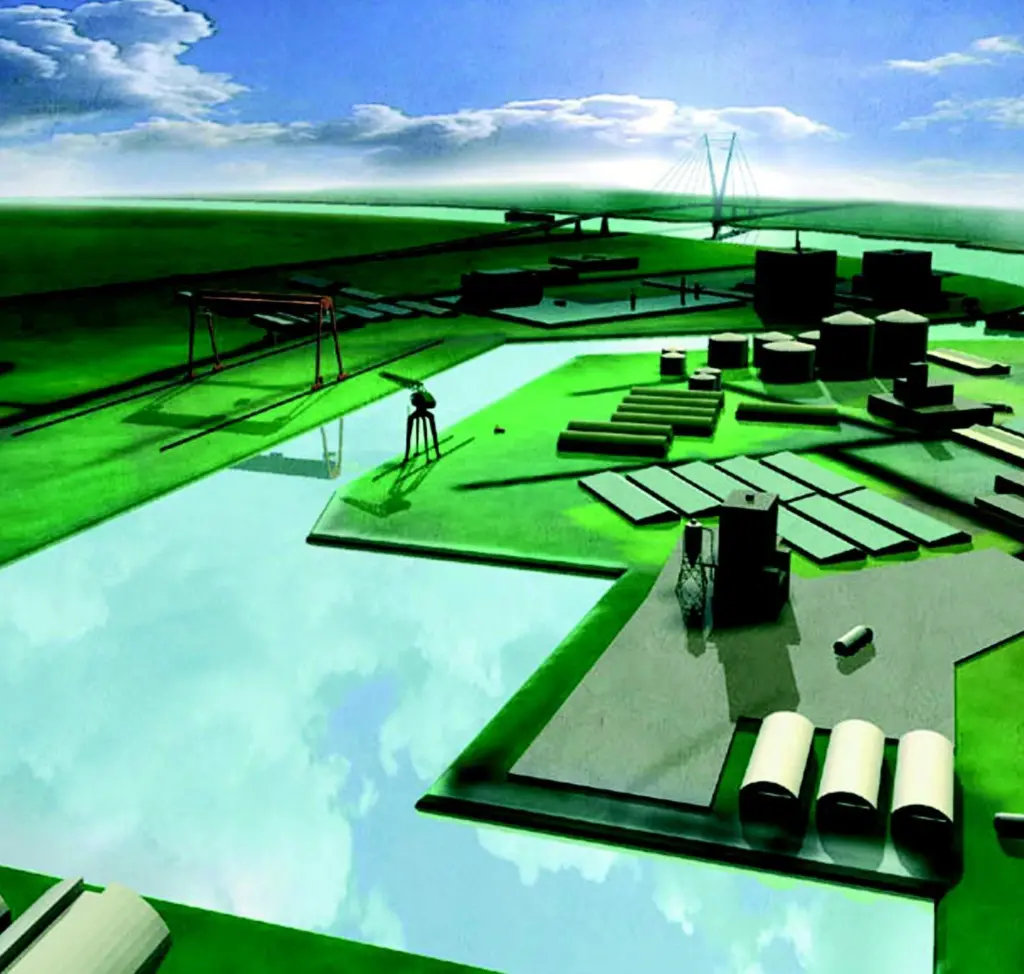
DEME: PPP IN PRACTICE A lot has been written on public-private partnerships, yet realisations there are few. At least one notable example proves that PPP schemes do work: the construction of ‘Zuiderzeehaven’ in Kampen.
Kampen is in the northeast the Netherlands, along the river IJssel which discharges in the IJsselmeer, formerly known as the Zuiderzee until a 30km long dam closed it off from open water. Coasters of up to 4,000 tons can reach the deep inland port of Kampen. Projects for the new ‘Zuiderzeehaven’ have been discussed since at least 1993 – but they just didn’t materialise until a PPP-structure created the right conditions. In February this year, dredging and land reclamation have begun for real.
Linking up with smaller industrial zones in the vicinity, the new dock will have a length of 600m and is 70m wide. Total area is 66ha with access roads and utilities, yielding a net 49ha of developable land for sale. The 49ha will be sold in four packages, as the project unfolds. A first package of 10ha is currently being prepared. Marketing started on New Year’s Day and the first options are already secured – well ahead of construction.
The ?27m Zuiderzeehaven Kampe’ is the first PPP-port in Europe, and one of the very few successful PPP port constructions worldwide. A project development company was established between three public and seven private partners.The public partners are the municipalities of Kampen and Zwolle, and the province of Overijssel. The seven private partners include a core consortium of three contractors: Dutch companies Dura Vermeer and de Vries & van de Wiel together with the Belgian group Dredging International. The first one carries out all infrastructure activities such as construction of roads and sewage; the two latter companies are both specialised in marine engineering, dredging and earth moving works.
Dredging International, de Vries & van de Wiel and IPEM are members of the DEME-group of companies, synergies being a big part of the project. Decisive factors were the fact that a comprehensive package of specialised know-how was offered, which included future park management. Also, one of the DEME-companies in the private consortium, Antwerp-based International Port Engineering and Management’ (IPEM), had already won its spurs on the Dinh Vu harbour development project near Haiphong – an early example of public-private partnership.
The agreement was concluded for fifteen years in 2003. Both public and private partners develop, finance and manage port construction and future port facilities. It is a win-win situation for everybody: private companies are involved in an upstream project with lots of added value potential, and public authorities can benefit from substantial savings by sharing financial risks in a project that would otherwise have cost some ?60m.
Kampen port will be progressively developed as demand for industrial facilities increases. Since future financing is secured by the proceeds of the first sales of land, upfront investment can be limited.
The total execution of the Kampen development is spread over eight phases of two years each – but depending on the success of sales, several phases may be carried out simultaneously or even advanced.
After an initial study and design period following the award of the tender, preparatory works such as demolition, clearing, and diversion of canals have been finished.
Dredging, marine engineering, earth removal and infrastructure works are carried out by a joint venture of three contractors, called ‘Uitvoeringscombinatie 3D.’ The ‘3D contractors’ are Dredging International, de Vries & van de Wiel, and Dura Vermeer.
The first phase includes construction of a sheet pile wall under the existing seawall, closing off the land from the river and the IJsselmeer.
This wall must allow for dredging the dock. At the same time, a big new embankment will be thrown up at the western side of the project area. According to the contract conditions, this 1.3km long, 23m wide, 4m high embankment is a full seawall which will encircle the new port from the landside.
Timing is a critical factor, for precautions against flooding are taken very seriously in the Netherlands. It is not allowed to breach the old seawall before overgrowth on the new embankment has taken root. As a consequence, sowing the banks must be finished before summer, which means that construction of the 63,000cu m core of the dike should be completed in the coming months. In that case and only then, the optimal scenario would be that the seawall can be breached in November 2006 at the very earliest, allowing for the first vessels to call at Kampen in the course of next year. However, this scenario depends on the further success of land leases.
The volume of dredged material does not match the needs for land reclamation, which are about twice as high. For this reason, the joint venture of executing contractors has established a “soils bank” for the time being, named ‘IJsselgrond.’ Not only will the bank deal with shortages of filling over cutting, but by applying lagooning and natural gravity dewatering techniques it will offer remediation facilities as well, at least up to a certain degree, for contaminated soils in the broader region.
The bank is established on the premises of the future port, and will be dismantled as the site will be needed for port expansion. Since the output of a soils bank is less predictable than production rates of a cutter suction dredger, the activities of the ‘IJsselgrond’ company are spread over a period till 2020.
Related Articles
 PORT & TERMINAL NEWS
 EXPANSION & DEVELOPMENT
 PORT & TERMINAL NEWS