![PortStrategy[GreenPort]](https://www.portstrategy.com/wp-content/uploads/2026/09/PortStrategyGreenPort.svg)




MARMARA: PRESSURES BUILD
Andrew Penfold considers how Turkey’s Marmara Sea container handling market has developed and future prospects including the critical issue of the balance between supply and demand.
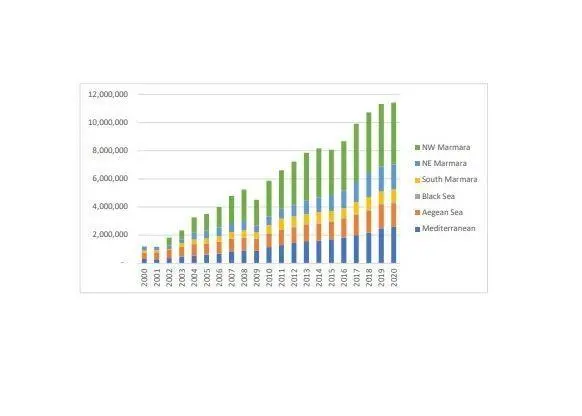
The Turkish container market has remained remarkably stable despite the COVID-19 pandemic, with total volumes handled stabilising at around 11.75 million TEU in both 2019 and 2020, as Figure 1 shows. Average growth has been around five per cent per annum in the past five years. Rapid increases in container capacity have been added in recent years, but there are questions over the future balance of the market.
Although box flows remain imbalanced in favour of imports, the country’s export position has benefited greatly from the weakening of the Turkish Lira, with the number of full export containers almost doubling in the past five years. With the declining Lira imports have been under pressure.
The Marmara Sea terminals account for around 62 per cent of the total Turkish market, with this share relatively stable over the last fifteen years. The NW Marmara area is responsible for more than half of the containers in the region, but this share has slowed over most of the last decade as strong export growth has stimulated demand in the NE Marmara ports. More recently, the opening of the Asyaport terminal and increased transshipment volumes has seen renewed growth for the NW of the region.
Almost half of Turkey’s imports come from Europe and Central Asia, with Russia, China and Germany being the largest trading partners on the import side. East Asia only accounts for 20 per cent of imports, although the role of China is anticipated to accelerate in the next few years.
Around two-thirds of Turkish exports are destined for Europe and Central Asia, with medium sized vessels dominant on these trades. Full exports via the NW Marmara terminals have been declining. Currently, only a third of the region’s full exports are handled in Ambarli and Asyaport.
The opening of Yarimca in 2016 changed the profile for full exports. At first the new terminal saw a rerouting of containers from Evyap but overall volumes are now driven by strong regional exports.
INCREASING DEEPWATER CAPACITY – TERMINAL DEVELOPMENTS
The availability of deep water capacity has seen an increase in transshipment in Marmara, with this sector expanding by around 73 per cent since 2015 to reach 2.65 million TEU. Marmara terminals are playing an increasing role beyond the Turkish hinterland and with continuing over-capacity this is likely to continue.
Ambarli currently comprises three terminals. Marport is operated by TIL (MSC’s terminal operating company) in partnership with Arkas. Local reports indicate that Arkas wishes to exit the terminal sector and is looking to sell its stake. There is clear scope to rationalise the terminal and to increase capacity. A merger with Mardas could offer further opportunities.
Kumport was taken over by China Merchants/Cosco in 2015 and is the focus of Cosco and partner volumes. Cosco states that by using a greater land area and moderninsing operations capacity could be lifted to 3.5 million TEU per annum. Mardas is losing volumes and this is expected to continue. The physical setup of the terminal makes operations challenging and the current owners are reported to be unable to agree the best approach to the modernisation process.
Asyaport is also operated by TIL and opened for operations in late 2015. It is currently focused on Black Sea transshipment, but local traffic is increasing in importance especially for Tekirdag and the surrounding Istanbul suburbs. Asyaport has further expansion potential by developing a proposed dry port and extending the main quay to the south. With further cranes, capacity could reach 2.5 million TEU per annum.
Yarimca was opened by DP World in late 2015 in NE Marmara. In 2017, Yarimca’s volumes increased strongly and have since continued to expand. The greater part of the DP World terminal’s volumes is driven by locally sourced exports.
Derince opened a dedicated container terminal at the end of 2019. In the first year volumes were estimated at around 25,000TEU, but it is expected that throughput will have exceeded 100,000TEU for the full-year 2020, with MSC the dominant customer.
There has been much discussion concerning the development of a new canal to bypass the Bosporus. This will involve the development of new container terminals and radically modifying the regional position. It remains a longerterm project and will need full support from the Turkish government to proceed.
THE MARKET BALANCE
With so much capacity becoming operational in the past five years, utilisation levels in the Marmara Sea have dropped to an overall level of around 54 per cent. This is an unacceptably low level and clearly represents a degree of over-optimism from terminal investors. The result has generated – unsurprisingly – negative pressure on tariffs.
In NW Marmara area, capacity utilisation is slightly better at around 61 per cent, compared to the position in the NE and S Marmara regions, which is around 48 per cent and 44 per cent, respectively. These low rates have caused downward pressure on tariffs, but this impact has varied between sub-regions. Given the different hinterlands of each region this situation will continue.
There has been some limited recovery in average terminal utilisation levels since 2016, but the balance remains weak and this is especially difficult for the largest capacity terminals. The overall impact of these conditions has been minimised for shipping line-controlled facilities, but even here there has been considerable pressure for terminal switching. Given the potential to significantly further increase capacity at limited cost – both for terminal expansion and by improved productivity – it seems certain that over-capacity will remain a structural concern in the region.
SHIPPING LINE STRATEGIES
As always, strategies adopted by the container shipping lines are critical to the outlook for any market region and it is no different in the Marmara, as the following shows:
- 2M Alliance – Maersk and MSC control ample regional port capacity, with significant volumes handled at Asyaport and Marport. The 2M Alliance will continue to place regional transshipment at Asyaport. Moving forward, it is anticipated that as volumes increase and the size of vessels is steppedup, Asyaport will increase transshipment volumes and also progress the role of the terminal in the hinterland markets.
- The OCEAN Alliance also has various options. Cosco has its major regional investments in Piraeus and Kumport. CMA CGM (Terminal Link), via its partnership with Yildirim Group, has interests at Yilport, but no direct interests in the European side of the Marmara market. It should be noted that the long-term status of the relationship between CMA CGM and Yildirim Group remains uncertain.
- THE Alliance has limited involvement in regional container stevedoring. The grouping has a more limited role in these trades and uses generally smaller vessels. These ocean carriers combine a call at Ambarli with use of Yarimca to handle the distinct European and Asian markets. The group also serves the Black Sea with discrete direct services. Until THE Alliance volumes justify the deployment of much larger vessels this pattern seems set to continue.
It is likely that non-affiliated services will continue to serve both Ambarli and Asian Marmara ports for European and secondary deepsea trades. The degree to which feeder and shortsea containers can be combined on the same services will be an important issue and operators such as Arkas will continue to primarily follow the large deepsea alliance groups.
MACRO-ECONOMIC RISK
Growth in the Marmara Sea region has been stimulated by loose economic policy in the past few years and the global uncertainties stemming from the COVID-19 crisis remain unresolved. Turkey may well have minimised a severe recession in 2020, but this has been driven by a credit surge based on low interest rates.
This has seen a worsening trade imbalance and downward pressure on the Lira. Given the longer-term record of the Turkish economy there is a structural risk to financial stability. Recent moves to increase interest rates may well signal an awareness of the need to address these issues.
However, the chances of a hard landing for the economy in 2021 and 2022 remain high. The risk to Turkey’s financial stability is great and the outcome will depend on investor confidence and policy continuity. Notably, external debt is very high and foreign currency reserves very low.
KEY CONCLUSIONS
Terminal investors have banked heavily on a continuation of the economic growth noted in the past ten years. However, the position was already weakening in 2019 and the IMF is projecting a contraction of at least five per cent in GDP for 2020. Supply/demand pressures are already severe in Marmara – any major contraction in demand will push these into severe negative territory. While the upside for Turkey is strong, the downside looks acute.
About the author:
Andrew Penfold is a leading industry analyst with over 35 years of in-depth, specialist involvement across the ports and shipping industry on a global basis.
Related Articles
 PORT & TERMINAL NEWS
 EXPANSION & DEVELOPMENT
 PORT & TERMINAL NEWS