![PortStrategy[GreenPort]](https://www.portstrategy.com/wp-content/uploads/2026/09/PortStrategyGreenPort.svg)





NOURISHING THE BLUE BANANA
If the Blue Banana, the curve of light stretching from northern England through the Rhineland to northern Italy and first observed from space 15 years ago, is the economic heart of Europe, then the Benelux ports are the valves through which its lifeblood of trade is pumped, reports Nick Elliott .
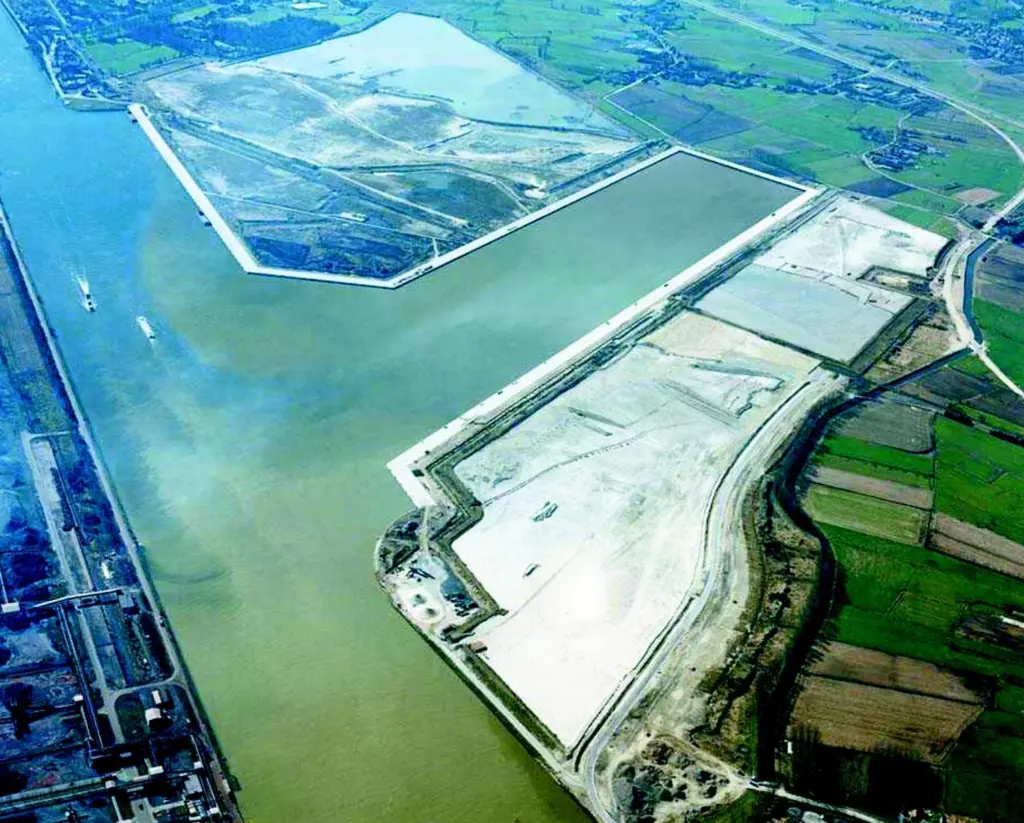
ROTTERDAM: GOVERNMENT INVESTMENT IN MAASVLAKTE 2:
HOW, NOT IF Those valves are being invigorated with investment and stimulated by competition as never before. 2003 saw Rotterdam handling 328m tonnes of cargo. Port Management chairman, Willem Scholten, enthused: “Record figures for the total, liquid bulk, ro/ro and containers. In containers, we are the first nonAsian port to pass the 7 million TEU mark. The Second Maasvlakte has come a lot closer. The Municipal Port Management (RMPM) is to be corporatised and will have more commercial clout as a result.
All in all, a fine year, during which the basis was laid for further development in the future too.”
Scholten went on to single out the Netherlands as ‘Distribution Land’, a concept that other countries envied: ” We must keep that vitalised all the time, ” he said. And crude oil presently coming from the North Sea: “Russia will gradually replace this source. We want to be part of the shift and keep a large share, now some 60%, of the exports via Primorsk. We are not only interested in the oil for Western Europe but also want to be a transshipment hub for other continents, for example America.”
He maintained that container volumes could have been a little if shortsea traffic would have had more room. “Expansion of the Rotterdam Shortsea Terminal (RST) therefore is a priority. Now Hanno will be taken over by ECT, (in which Hutchison recently increased its take to 98%), containers can be shifted from the Home Terminal. The resulting space can be used by RST. On the ECT Delta terminals the 2000-8 expansion project is speeded up and by the end of 2007 the EuroMax terminal can be operational.” Scholten reckoned growth rates of 8% until 2010 could be expected following the “high growth scenario.”
On competition he was just as forthright: “In direct business we have to focus more on Antwerp than on Hamburg. With Antwerp we share more and more closely situated hinterland as well as cargo types. With Hamburg the relationship is mainly restricted to containers. Their core lies in the Baltic and over there they have historic and geographical advantages hard to challenge.”
Cornerstones of Rotterdam’s future strategy are container transhipment, the chemical sector and distribution. To allow these sectors room for growth and renewal, Maasvlakte 2 was conceived.
Earlier in January the Dutch cabinet gave RMPM details on how they believe the project should be financed having already confirmed the government wants to invest and take a stake in the project – even if this means a little creative book-keeping as regards the investment’s phasing. The project will hopefully open in 2008.
Besides the second and third stages of EuroMax – the P&O Nedlloyd/ECT joint venture designed and engineered by Royal Haskoning which will span the river and spread onto Maasvlakte 2 – APM Terminals, the Chinese and four other Asian carriers have all expressed interest in renting terminal space, as has BLG Logistics Group (Bremer Lagerhaus Gesellschaft). RMPM’s press officer, Minco van Heezen, explained that the Dutch Cabinet needed some confirmation that there was trust in the strength of the market before signing off on the project which will assign 1,000ha of lots to the port for leasing out. “They received that from both APM Terminals and P&O Nedlloyd here in the Netherlands but also from the Chinese when our minister for transport, Karla Peijs, visited there late last year.
“Everyone is saying yes we’re interested because trade is booming and no-one wants to miss the boat but in the end it’s always important to see who will sign the lease. However, looking to the future there is little certainty about very deep water locations in western Europe so we are now creating something which will be scarce in the future. This fact will at least gives us the opportunity to ask for some signatures in advance.
As to the corporatisation of the port management: “We’ve always said we wanted more than one shareholder and we urged the national government to participate, ” says van Heezen. “At first they were not enthusiastic but now the interest is there. A third party who might also be interested is the province of South Holland which would have a bearing on the environmental aspects of the project because they’re responsible for the 750ha of recreational and nature area which is part of Maasvkaakte 2.”
ANTWERP: KEEPING DEURGANCKDOK TENANTS ON THEIR TOES Antwerp finished 2003 handling over 142m tonnes, nearly 11m or 8.3% up on 2002. And in December the first phase of the Deurganckdok quay walls was symbolically handed over. The new tidal dock located on the left bank of the Scheldt will be directly open to the river and boast a capacity of 5.5m TEUs annually, more than doubling the port’s present capacity.
Construction of phase 1 was entrusted to the Cordeel-Aertssen consortium, while phase 2 was awarded to the consortium of MBGCFE-Van Laere-Dredging International. The two consortia have since combined to form the Deurganck consortium which will be responsible for construction of phase 3.
Interestingly, initial planning permission for the Deurganck dock was suspended by the State Council in 2000, which found that the principle of urgency had been unjustly invoked. As a result a new environmental impact assessment (EIA) re-examined the project. A compensation plan was drawn up for the loss of flora and fauna and the new EIA accepted. The suspension was finally lifted and phases 1 and 2 are due to enter service in mid-2005.
The western side of the Deurganckdok will be available for Hess Nord Natie (HNN) and the eastern side for the P&0 Ports consortium. In the concession agreements stringent demands will be made regarding the use of space by the concessionaires ( Port Strategy November/ December 2003 p.10 ). Taking into account actual usage, certain parts of the terminal could be reallocated due to under utilisation.Should Maersk/AP Moller Terminals meet with the proposed conditions for further volume growth, then as from 2007 Maersk “would be able to dispose exclusively of a yet to be defined terminal site at the Deurganckdok, ” according to a port spokesperson. The port says it’s convinced that the options taken represent the highest possible contribution for an efficient use of space and allow the port to absorb container traffic growth – close to 16% last year.
The port has transferred a concession it originally awarded to PSA subsidiary HNN to rival P&O Ports. HNN will manage all three container terminals on the left bank of the Deurganckdok, leaving P&O Ports with two concessions on the opposite bank.
P&O Ports intends to start with six quay cranes to handle 900,000 TEUs in this first stage. Straddle carriers will be used initially but when the second phase is delivered RMGs will be introduced. The terminal’s productivity will initially be in line with current performance – around 35 container moves/hour.
Testing the RMGs and developing the associated software will start concurrently with the straddle carrier deployment. For a while the two concepts will run in tandem but once the second phase comes on stream the yard will be converted wholly to RMGs. A spokesman commented: “To obtain the productivity we want we believe we should not opt for AGVs. We know that the concept works but not that we can get the performance, so the RMGs will be fed by runners.” – the mini strads now increasingly appearing on the scene ( Port Strategy November/December 2003 p.36 ). Eventually 24 quay cranes including barge cranes, will be deployed at the terminal.
ZEEBRUGGE: CARS DRIVING GROWTH Zeebrugge also saw good growth in 2003 handling a record volume of 1.55m vehicles – its core commodity – an increase of 12.5% over 2002 or 50% over a five-year period. This reinforced the port’s position as number one vehicle port both in Europe and worldwide.
In 2003 CTO (Combined Terminal Operators) started shipping Mitsubishis pushing volumes up by 160,000 units. CTO also started with shipment of Peugeots and Citroens intra-Europe and to Central and South America. And General Motors decided in 2003 to concentrate its Opel/Vauxhall units in the port, before being shipped to the UK market – 230,000 units annually. Meanwhile Toyota’s volumes leapt by 30% last year.
2003 also saw the implementation of the ’55’-programme’ by which the access channel to Zeebrugge’s outer port has been deepened. This will allow the new generation of container vessels to call regardless of the tide. The port is also planning the construction of the Toyota quay wall and a new double jetty in the Albert II dock. Meanwhile the Flanders Container Terminal concession was regained by the port authority, which is putting the concession out to tender again.
Zeebrugge says its new strategic plan to be launched this year will, it is hoped, allow the port to regain land necessary to develop its facilities still further.
DELFZIJL: THE RIGHT CHEMISTRY Swiss logistics provider, Bertschi has teamed up with chemicals giant Dow to build a new container terminal at Delfzijl due to be opened this summer. “Bertschi was chosen because they had written the best logistics plan, ” says Rene Genee of Groningen Seaports. The port combine has also extended the ConRo Terminal in the Eemshaven.
“The current terminal is increased by 3ha to 15ha, ” says Genee, “and talks are underway with potential customers.” Delfzijl-based shipowner Wagenborg, bought over half the terminal from the port three years ago whilst Socar of Amsterdam uses the facility for used car exports to West Africa.
Chemicals and aluminium are the ports’ leading commodities and last year a record throughput of 6.5m tonnes was achieved – 2% up on 2002. Port land leased or sold also rose from 3.1ha in 2002 to 13.7ha last year and turnover should reach E11m – again an improvement over 2002.
“Our policy is to have facilities available before the client comes to us, ” Genee notes, “because their decision-making process takes six to nine months and to get a facility ready takes around eighteen months. So this gives us the justification for upfront investments.”
TOM TODD REVEALS VLISSINGEN’S SECRET: SHORTER LEAD TIMES Ford has saved an average of three days on the delivery time for new cars to the UK and cut its costs by concentrating most of its Continental car and components handling on a new terminal in Vlissingen.
Ford says costs have been lowered through its co-operation with Antwerp-based logistics provider and short-sea shipping and terminal operator, Cobelfret, while efficiency and transport quality have also improved.
Cobelfret’s new terminal in Vlissingen is a gateway to and from Britain for both vehicles and automotive components and has meant the integration of shipments between the Dutch port and Dagenham in the UK. It was however a two-way operation, the giant vehicle concern stresses, with new Jaguars also being delivered to the Continent and components from British Ford factories moving to Vlissingen on Cobelfret vessels for onward distribution to European Ford plants.
“By integrating the shipment of vehicles and components through one terminal on the Continent and basically just one ferry link, we are making things far more efficient, reducing costs and at the same time increasing the quality of our shipping service, ” Ford Europe Head of Logistics Bill Gurmin was quoted as saying. Cobelfret said the new 60ha Vlissingen ro-ro ferry terminal, which cost E43m and went into full operation in November, had been “an instant success”. It handles cars, trailers and other rolling freight, offering three daily sailings between Vlissingen and Dagenham.
The terminal was built on reclaimed land on the Westerschelde and provides parking for up to 25,000 vehicles and 700 trailers. It boasts four ro-ro berths and three railway sidings. Terminal general manager Serge Temmerman said: “We promised our customers shorter lead times and we kept our promise. ? In fact, Ford was able to reduce its lead times by half!”
For a clearly satisfied Ford, Vlissingen has now become a permanent fixture in an exemplary intermodal chain which links inland waterways, rail and road trailer services, port terminals and shortsea Ro-Ro. New export vehicles from Cologne are shipped daily to Vlissingen on inland ro-ro vessels, carrying 550 cars on their 24-hour journey along the Rhine and Waal and through the Dutch canal network to the Vlissingen terminal – 100,000 vehicles a year.
“We carry out lot formation in Vlissingen” said Temmerman “so that cars can be put onto trailers waiting in the UK swiftly and efficiently. This is how we are able to offer a huge advantage: shorter lead times”.
GHENT: KLUIZENDOK READY – TIME TO DO THE BUSINESS Ghent’s new ? 136m Kluizendok is almost ready says commercial manager, Dirk Houttekier. “We have just announced four contracts with industries that are going to locate onto the 25ha site. Three of the firms are in dry bulk (cement, fertilisers, grain and salt) whilst the fourth is in the steel fabrication business requiring access to both the inland waterway and seagoing routes.”
In all, 4.2 km of quay wall will be available with 13.5 metres water alongside. However, the quay walls are designed for a further deepening of the dock to 18 metres when the port will be made accessible for Capesize vessels by way of a new lock at Terneuzen.
With Kluizendok, the port expects additional sea-borne traffic of some 7.5m tonnes – a 30% increase in current levels.
Although paper products giant, Stora Enso is “not yet very well integrated into the port, ” Houttekier is confident this will change:
“Most of their transport goes by road but the new mill the company has built will need recycled wastepaper as a raw material and Stora Enso has made a deal with the authorities for 30% of its supplies to be delivered by water. We are therefore hopeful that finally there will be a serious benefit from the paper mill.”
The other substantial player in the area is Volvo which has its biggest plant in Ghent with production moving up to 240,000 vehicles annually. This of course has spawned a cluster of smaller suppliers and logistics providers importing through Ghent, principally on the daily DFDS service from Sweden. Volvo’s cars are exported through Zeebrugge however.
Ghent and Amsterdam both suffer the same problem of nautical access making them less attractive to container lines. Ships lose precious time when navigating up the sea canal to reach the port. Also Ghent’s lock system is located in Dutch territory at Terneuzen. “We would like a larger lock but the Dutch are developing the ports of Flushing and Terneuzen. We would like to have a partnership with them though, ” says Houttekier.
AMSTERDAM: LOCKED IN Amsterdam wants a new 500×70 metre lock to the North Sea Canal. “We are aware that the capacity of the exisiting lock will be limited with time”, says the port’s Fer van de Laar. But Amsterdam’s city council has postponed plans for the lock until the Cabinet decides to reserve extra funds. The decision was based mainly on a report studying projected usage whcih concluded that the Amsterdam region would benefit much more than the country as a whole thus justifying a substantial financial contribution from the region. In other words port towns directly benefiting from the new lock should contribute.
Meanwhile the port is chasing the environment-friendly shortsea trades. 160m people live within a radius of five hundred kilometres around the port. With both the Dutch and governments the EU encouraging the transport of goods by water, shortsea and inland waterway freight transport is forming a cornerstone of the port’s strategy. Over 25m tonnes were shipped in and out of Amsterdam to the rest of Europe via shortsea last year.
Mannes Boelen, manager of transport marketing at the port, is convinced that there are excellent opportunities: “A lot of cargo moves to Russia. A major part moves by road, due to low rates. But the new toll collections, delays at the border, an increase in the price of gasoline and the implementation of rest-periods for drivers in Eastern Europe all will force prices up.”
The port is also working on developing shortsea with Portugal. Boelen said:
“There is obviously a market there. Every year 160,000 trucks transport 3m tonnes of goods by road from Portugal to Amsterdam. It is cheaper to transport these by frequently scheduled ro-roship.” There have also been talks with Spain, North Africa and the eastern part of the Mediterranean.
As for the NYK owned Paragon Container Terminal, which has yet to win any business, Amsterdam’s port alderman said recently he wants to give the Japanese firm plenty of opportunity to find clients. The evaluation and possible new plans for the container terminal have been shelved for the time being.
Related Articles
 PORT & TERMINAL NEWS
 EXPANSION & DEVELOPMENT
 PORT & TERMINAL NEWS