![PortStrategy[GreenPort]](https://www.portstrategy.com/wp-content/uploads/2026/09/PortStrategyGreenPort.svg)





On the doorstep
Whichever way the ‘stans look, it’s always Russia on their doorstep. Stevie Knight reports
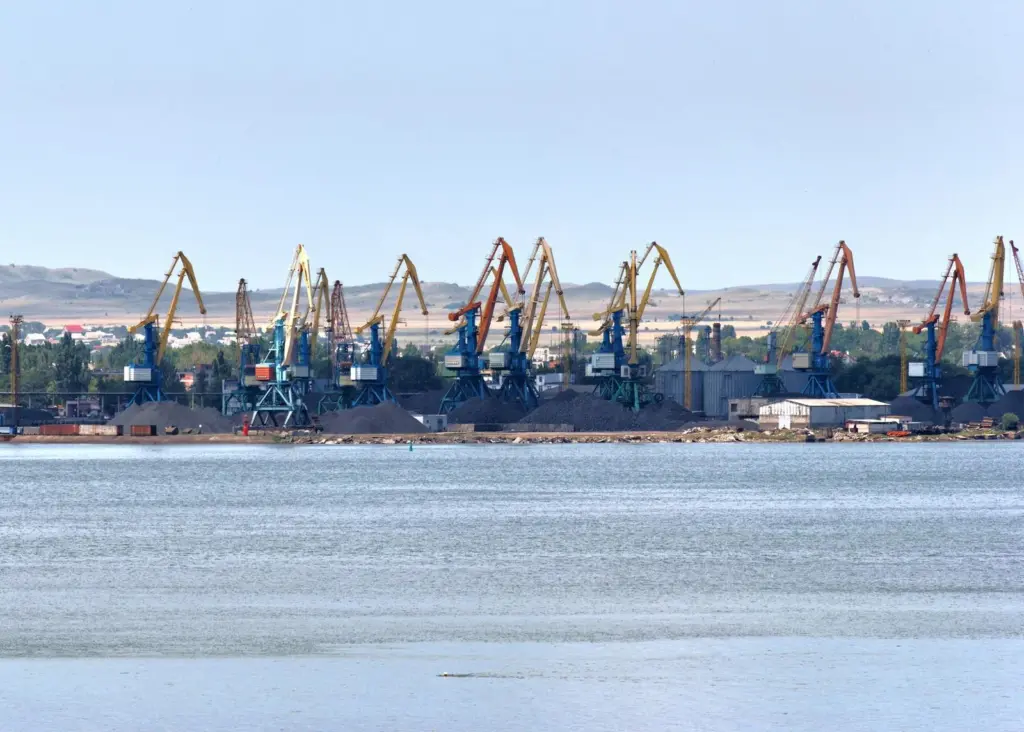
Generally, trade doesn’t like to mix with politics, preferring the relative simplicity of the balance sheet. Unfortunately, politics has no such qualms about playing with trade and ports sometimes end up as both the prize and fall-guy.
Russia’s ‘protection of its interests’ in the Crimea has both elements.
Deals with Ukraine grain suppliers have been discouraged by traders, and despite HPC’s recent push for its terminal at Odessa to function as a direct port of call, Steve Wray of Ocean Shipping Consultants says: “The traffic was being bolstered by the lines’ need to find places to deploy their spare tonnage rather than any real boom in Black Sea import demand, so if the troubles continue and lines have to choose their Black Sea calls then I’d say there may be some wariness around trade into Odessa or Illichivsk. Lines are more likely to plump for Turkish ports over Romanian facilities as the Turkish demand is, compared to others, much more robust.”
More than that, Mr Wray points out that any kind of trouble doesn’t bode well for the very tender shoots of Ukraine port reform that had recently started to take root. Further, Michelle Berman of BMI adds: “Unrest in Ukraine will obviously be a worry for the freight transport network, but the area of greatest concern at the moment is the economic situation.”
Winning ways
But on to the ‘prize’: could Crimean ports be a factor for Russia, beyond the naval presence at Sevastopol? After all, warm water, ice-free facilities must look enchanting given Russia’s constrained coastline and freezing Baltic ports.
Despite this, Alexander Ignatov of Ignatov Associates points out it will be a costly business. First and foremost, all major transport links are presently Ukrainian: “Whether Crimea becomes a region of Russia or an independent state, Ukraine will definitely block those routes.” He adds the only solution will be a road and rail bridge across the Kerch strait to Russia, with more capacity than the plans presently on the table. Plus, this will also require electrified rail links into the Crimean seaports and network expansion on the Russian side.
He also points out that that the ports of Sevastopol, Kerch and Feodosiya need a lot of investment and getting these ports up and running as Russian alternatives would be “hard, expensive and not clearly financially beneficial”.
Despite this, Russia has proved it has deep pockets when it comes to getting what it wants, especially if it can do double duty as an ideological bulwark: investment in the winter Olympics at Sochi came to around $51bn. Further, Crimea has been central to Ukraine’s Black Sea offshore developments, also linked to the country’s weaning itself off Russian gas supplies.
Energy and bulk trade, more than containers, are central to the dynamic here especially in relation to countries like Kazakhstan, Uzbekistan and Turkmenistan which need to capitalise on oil and mineral wealth to fuel their economies. Mr Ignatov explains that though there are facilities on the landlocked Caspian coast such as Kazakhstan’s Aktau port, Russia’s Olya Seaport or Turkmenistan’s Turkmenbashi with big plans, in reality these still have limited capacity; further, despite the Volga’s reach all the way to Moscow, it’s shallow, silty and there are still, as yet, no large bulk terminals that can reload from ship to train.
Blinkered view
Whichever way the ‘stans look, it’s always Russia on their doorstep. Russian trains are the only realistic route toward Western markets that doesn’t involve crossing the Caspian and negotiating a number of rail networks that don’t always fully mesh before coming out in the Black Sea ports at Georgia or Turkey, says Mr Ignatov. So, apart from the Azerbaijan-Iran link – not an option for EU exports now – “it’s Russia again”. Further, he adds that even going eastward toward China the dearth of connectivity means dipping back on to Russian rail.
But it’s not a straightforward tariff, says Alexei Zakharko of Dentons in Moscow and it can be expensive: “There are different tariffs depending on whether its coal or grain and the geography of the transportation; plus cheaper passenger tickets are counterbalanced by higher charges on freight.” The steep railway charges have been one reason that Ukraine had been taking some inward bound Russian cargo, “as shippers tried to minimise their dependence on the Russian rail network”.
Mr Ignatov adds it’s not always fair: “Russia plays different political and economic games with each of the ‘stans depending on what it wants to achieve at the time. So, if for example it wants to lower the competition from Uzbekistan products, the government just raises port or rail tariffs for them or says Russian ports can’t accept the tankers. On the other hand if it wants to agree on a political deal the payment may involve cheap transits for associated goods. And, although cargo may be destined for European seaports, the Russians may say, ‘if you use our trains, then you have to use our facilities as part of the deal’.”
Pipe dreams
Whatever the driver, a growing network of oil and gas pipelines including the Central Asia-China pipeline on one side and the BTC pipeline which connects Azerbaijan with the Turkish port of Ceyhan via Georgia on the other have dented energy transits via Russia, although the eastward pipeline also tops up with Russia’s oil while the Caspian oil fields get going.
The question is, what if the pipelines that export Russian gas to Europe (around a fifth of Europe’s supply) get choked off while passing through Ukraine as most of them do? It could speed up Europe’s search for other supplies, something that’s been slowly happening since the last time Russia shut off the gas in a spat with Kyiv in 2009, leaving eastern and southern Europe in the cold.
It may mean that LNG shipping and port facilities gain – on both import and export sides. This could cover both existing terminals as well as those in the US originally built to import gas that now could be turned around to export LNG, and may even put the starting blocks under projects that may have been put on hold.
Despite this, the gas lines may not be so easy to strangle as since 2009 there are more pipelines that avoid Ukraine plus there are talks afoot about rerouting some of Russia’s oil and gas, though it’s both technically and politically difficult. On the other hand, if Europe and the US wanted to hurt President Putin, turning away from Russia’s oil and gas exports would do the trick as Europe accounts for around a third of Gazprom’s total gas sales and over half of Russia’s total budget revenue comes from this sector.
However, it wouldn’t be so easy for Europe to throw the switch and simply go shopping for US gas supplies which aren’t yet up for export. Although some could be forgiven for seeing it as a tempting prospect Mr Putin is obviously carefully balancing the political game against hurting Russia’s bottom line that much.
Related Articles
 PORT & TERMINAL NEWS
 EXPANSION & DEVELOPMENT
 PORT & TERMINAL NEWS