![PortStrategy[GreenPort]](https://www.portstrategy.com/wp-content/uploads/2026/09/PortStrategyGreenPort.svg)






germany/poland outstanding 1
Polish and German ports are vying for Northern European business but with so much to go around it seems no one will lose out. Stuart Pearcey reports
Where the power of Google delivers a virtual connection to the rest of the world, the combined shipping power of ports in Germany and Poland provide the reality for mainland Europe and beyond.
Borders between these northern European neighbours became ‘blurred’ in December last year when Poland joined the Schengen Zone, a virtual country formed through the alliance of 23 nations which have swept away border checkpoints and controls.
As well as opening borders, Poland sees it as an opening of opportunity to be a gateway for goods from as far afield as Sicily and southern Greece – even though membership brings with it the responsibility for security, since its borders with Russia, Belarus and the Ukraine, as well as its coastline, are also the zone’s borders.
The zone, named after a small town in central Luxembourg, was created in 1985 with the signing of a treaty aimed at unifying Europe by allowing its citizens more freedom of international movement. As a result, it’s now possible to travel all the way from Poland’s Russian border to Portugal, France’s Atlantic coast, and even Iceland, unhindered by border controls.
Joining the zone is another step on a journey for the port of Gdansk, which has ambitions to treble its turnover in the next two decades. Courtship between it and far eastern trading partners led to an engagement in January, when delegates from the Chinese city of Ningbo were in the Polish port to sign a co-operation agreement expected to lead to substantial volumes of containerised Chinese cargo entering Europe there.
Already Hondas and Mitsubishis made in Japan for drivers in Russia travel through Gdansk, and when UECC added a twice-weekly call to the port in the middle of January it signalled another increase in activity. Car imports in 2007 grew to more than 150,000, up from a modest 18,000 as recently as 2002.
This traffic is indicative of the port’s location at the end of an Euroepan Union trans-European corridor running through Vienna to the south of the continent, and the Port Authority’s determination to create a container hub with the capacity for 5m teu, made up of 2m at the expanded existing terminal, and a further 3m of new capacity as part of a vision for the future.
The vision is the creation of 600 ha of port land reclaimed from the sea between the mouth of the port canal and the existing fuel base, which, in addition to the container terminal, would be home to general cargo terminals with a capacity of 4m teu and passenger traffic of 2m.
In turning its face to the sea, with developments backed by substantial amounts of EU money, the Port will then gradually be able to hand over existing land it occupies for the city to use for urban development. There are also plans for dredging to revitalise inland navigation and create a marina with space for 2,500 yachts.
Before 2013 the port plans to invest in three infrastructure areas within the port, modernising its internal road and rail systems, the port canal and turning basins and approach to the Przemyslowe Quay.
Road and rail improvements are also planned outside the port, with a road tunnel linking existing routes to other Polish cities to the Inner and Northern ports, and modernisation of 14km of railway, allowing it to carry faster and heavier trains.
But competition is keen. Hamburg also wants to be the most important container port in the region. 2007 transhipment volumes were at an all-time high of 9.9m teu, up almost 12% on 2006. Five of its top ten trading partners are on the Baltic. Largest among them is Russia, with 730,000 teu – an increase of almost 22% – making it the third largest of Hamburg’s partners, and a mere 19,000 teu behind Singapore in second place.
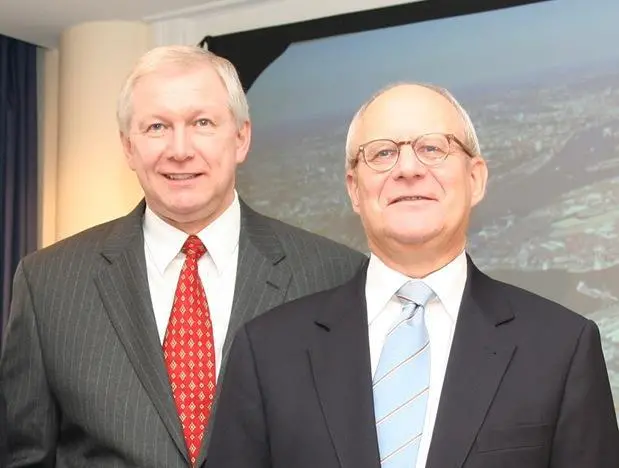
The port has partner ports at Kiel, Brunsbuttel, Lubeck and Cuxhaven, which help it stake a claim to operating in the North Sea and the Baltic. Port of Hamburg marketing board member Dr Jurgen Sorgenfrei says his port is well-positioned in the transport infrastructure. “Hamburg is benefiting from its role as a merchandise hub in global foreign trade, and particularly as a transhipment port for ocean-going shipping on the Far east/Asian axis and the Baltic Sea region. The Baltic Sea traffic links with Eastern European countries again managed to substantially outperform other transport links in 2007 with a growth rate of 21.6%.”
Volumes of trade with all continents significantly increased in all areas but one – North America, where almost 19% fewer containers were sent, partly because of the American economic situation at the moment, and partly because tightened US import controls made it easier to ship goods onto the continent through Canadian ports.
But all’s not quite rosy in Hamburg. The trend towards larger ships is making access a squeeze for bigger containerships and bulk carriers – anything with a draught of more than 12.8 metres can’t get in at all states of the tide. Says Mr Sorgenfrei: “Due to the lack of depth of the Elbe, their cargo space cannot be fully utilised. Deepening the fairway in the Lower and Outer Elbe to accommodate these ships is of primary importance to the Port of Hamburg.”
His urgent plea has been taken on board by the city’s politicians. The Senator for Economy and Labour is Gunnar Uldall, who recognises that help is needed to achieve projections for Port growth. He says: “Last year the Port created 2,000 new jobs and ¢900m ($1.4bn) in tax revenues for the City of Hamburg alone. It’s absolutely essential to continue to improve the terminal capacities and infrastructure the port has to offer. For this reason last year the Hamburg Senate launched the largest fairway upgrade programme in the Port’s history, with priority assigned to the Lower and Outer Elbe.
“Only once access to the port has been secured on a sustained basis will the forecast growth rates actually be achieved, and further jobs created.”
Related Articles
 PORT & TERMINAL NEWS
 EXPANSION & DEVELOPMENT
 PORT & TERMINAL NEWS