![PortStrategy[GreenPort]](https://www.portstrategy.com/wp-content/uploads/2026/09/PortStrategyGreenPort.svg)





SETBACKS SETUBAL
The Setubal Port Administration has embarked on a privatisation process that flies in the face of the widely anticipated benefits of a more competitive and lower cost operating environment.
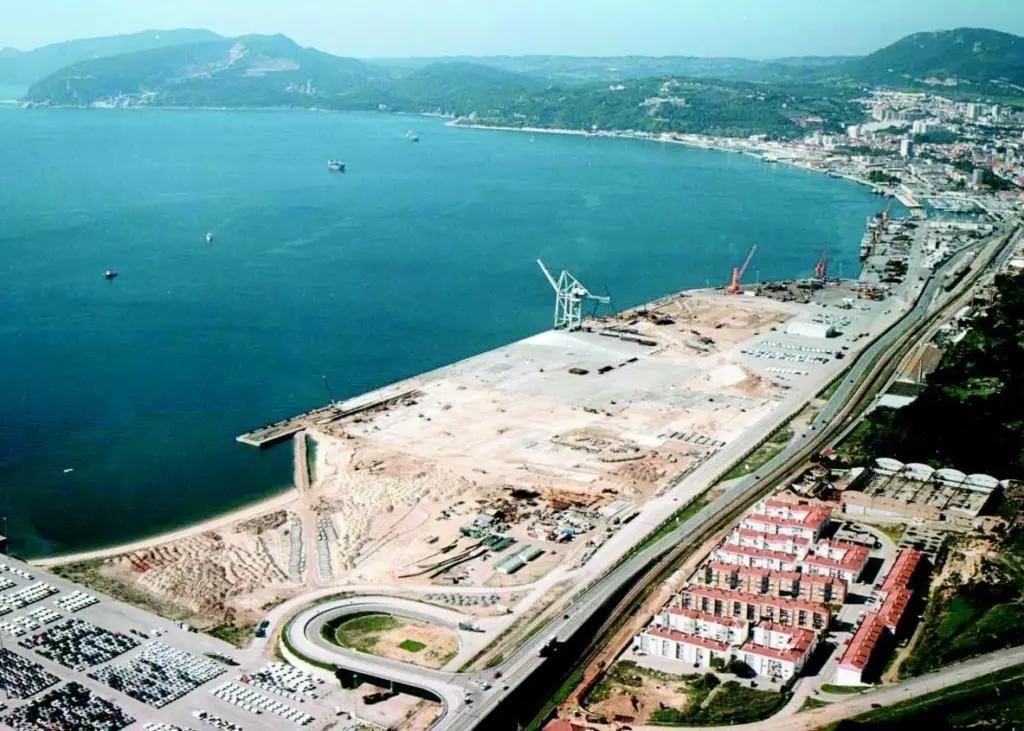
Mike Mundy examines the tragedy shaping up in Setubal.
The Port of Setubal, located approximately 40 kilometres south of Lisbon in Portugal, has run into a storm of criticism over the concessioning process for its multi-purpose terminal.
Just about everybody is pointing their respective fingers at the Setubal Port Administration – from the European Community Shipowners’ Associations and ANESUL the local ship agents’ and stevedoring companies association to major cargo shippers such as Corus Steel – and complaining bitterly that, in their view, the flawed concessioning process the port authority is pursuing can only lead to a major fall in the competitiveness of the terminal and substantially higher costs for the shipping companies and cargo shippers using it.
And, clearly, examination of the facts suggests that these parties have got a point, which is not only a disappointment for the Port of Setubal, which to a large extent has built its reputation on being a low cost but high quality cargo handling centre, but has to go down as a negative in the context of Portugal’s national port privatisation programme implemented over recent years.
SOURCE OF THE PROBLEMS
As indicated, it is the lack of competition and high costs that are expected to result that are seen as the main problems with the concessioning process now being pursued by the Setubal Port Administration.
Three main problem areas are seen as contributing to the lack of competition:
The port administration and its tender Evaluation Committee not following, in either detail or spirit, the concessioning process and structure – including the physical details of the areas to be concessioned – laid out in the Regulatory Determination of 22 June 1999 issued by the Undersecretary of State for Equipment, Planning and Territorial Administration. The alternative pursued resulted in the creation of two distinct operational zones for concessioning within the terminal but with Zone 1 offered at a significantly cheaper rate – around 25% less – than Zone 2.
The Evaluation Commission established by the port administration ignoring the proper operator selection criteria set out under the terms of the tender and the selection, out of two candidate operating consortiums, of the so-called ETE consortium, which, according to various sources, did not meet the bid criteria necessary to operate Zone 1.
The insistence of the Commission, made up of around six port authority personnel and one external party, to continue with the selection process despite the refusal of the other consortium, Navipor/Liscont, to agree to an extension of the validity of the tender. Navipor/Liscont believes the tender process deployed so far is now null and void – well and truly out of time – but the port authority has elected to continue negotiating with the ETE consortium for the whole terminal area, i. e. zones 1 and 2.
Essentially, therefore, it is willing to go along with a monopoly – a situation that has never before existed with the Port of Setubal’s multi-purpose cargo handling facilities. Practically speaking, around 90% of the overall multi-purpose capacity available in the port will in future be in the hands of one operator as opposed to the much more competitive situation that now exists.
The presence of just one major multi-purpose terminal operator is of course one of the factors that can be expected to lead to a much higher cost scenario. Much more significant than this, however, is the port administration’s proposed cost structure in terms of both running and one-off costs associated with the future allocation and operation of the terminal. Some huge increases are foreseen under the proposed new terminal occupancy regime.
Simply put, taking into account the proposed fixed rents, variable taxes handled per tonne of cargo as well as the amortisation of cranes then the future concessionaire will be paying an additional annual cost of approximately five million euros.
Exploding these costs out a little, the cost of Zone 2 of the multipurpose terminal is, for example, understood to be:
Fixed Costs for Zone 2 Per square metre of stacking area:
€8.4×220, 190m 2= €1,849,596.00 Warehousing:
€24.00 x 1209m 2= €29,016.00 Per running metre of quay:
€359.16 x 724.7m = €260,283.25 Total per year:
€2,138,895.25 These costs, the European Community Shipowners Association among others points out, are “approximately four times more than an equivalent area in some north European ports such as Antwerp.”
It also highlights the ridiculous aspect that the incoming concessionaire is expected to absorb a very high cost for the existing, very old, single container gantry that is on the terminal’s quay, namely some €4,160,000.
Further, from the perspective of the port user the European Community Shipowners Association makes the point that, “On top of this the port administration will continue to charge the same taxes as before to the vessel owners (Vessel Port-use-tax – previously harbour and quay dues) and to the cargo interests (via a variable fee per tonne unit).
Overall, according to the European Community Shipowners Association, the port user will basically be paying twice – i. e. , the current taxes imposed on them by the port administration and the high costs that the concessionaire will pass on.
Indeed, when an analysis of the potential increases that are likely to be applicable to different traffic types is undertaken it becomes clear that the additional costs that are likely to be passed on to the cargo shipper are in more than one instance in excess of 100 per cent.
Potential Handling Cost Increases by Traffic Type Wood pulp +724% Fruit on pallets +210% Steel coils +105% Fruit in containers +45% Ro-ro +33-61% Steel producer Corus for one, which in 2003 shipped 186,000mts of steel products from The Netherlands to Setubal on 55 vessels and another 100,000mts on 25 vessels from the UK to Setubal, sees the scale of the increases that are likely to apply as being so large that it will jeopardise the business overall. Corus serves local industries such as Lusosider and Autoeuropa.
WHY COLLISION COURSE?
So why has the Setubal Port Administration allowed this manifestly unsatisfactory situation to come about – a situation that promises to destroy the inherent competitiveness of multi-purpose operations in the port, the very operations that the Portuguese Government identified Setubal as most suitable for under its privatisation programme?
Clearly, there have been problems with the process the port administration has followed to “deliver” privatisation – to the extent that one of the bidders believes that the process is so technically deficient that it should be cancelled entirely. The time it has taken to advance the process is perhaps another symptom of these problems – it was initiated in 2001 and is still ongoing.
It is also interesting to note at a technical level that the Evaluation Committee is made up of virtually all port administration personnel and is not the arms’ length model now employed in most privatisations to ensure a clean, transparent and generally fair process.
It is perhaps, however, not at a technical level that the root cause of these problems is to be found but at a financial one.
It is a fact that the Setubal Port Administration is in debt to the tune of around ? 18 million and for the size of the overall traffic being handled in the public area of the port – 1,978,000 tonnes in 2003 – appears to be somewhat over-staffed with around 200 people in its employ. Indeed, while it now has around 200 employees, ten years ago it possessed only 90 staff inclusive of a significantly larger workforce of crane drivers than the one it possesses today. The crane driver function was rationalised as part of the port privatisation process and therefore in staff terms alone its running costs would appear to be very high and – speaking frankly – excessive.
It is an accepted international industry standard that a port administration managing a throughput of up to 20 million tonnes per annum will possess around 200 staff and on this basis it is very clear that the Setubal Port Administration is labouring under a heavy burden. Steps should be taken immediately to downsize and not to employ the very short-term policy of passing on increased costs to port operators and users. This flies in the face of logic, basic good business sense and certainly the spirit of the port privatisation programme implemented by central government.
It is additionally worth pointing out that the EU funded 73% of the original construction cost of the multi-purpose terminal and that it hardly seems good use of this funding to point the terminal down the route to becoming a very high cost facility operated on a virtual monopoly basis. Equally, a similar point can be made in conjunction with the ? 200 million spent by the Portuguese Government under the country’s port privatisation programme on rationalising the port workforce back in 1992/1993. In Setubal, this led to a 40% reduction in the cost of handling goods, and sometimes up to 60%, and now this favourable position seems set to be swung completely the other way in one swift blow!
MONOPOLY RATIONALE
Looked at against the above background, it no doubt raises questions in the observer’s mind as to why any company at all is prepared to take the multi-purpose terminal on under the terms proposed? This is certainly an interesting issue and one that is worth delving into here and by any truly objective concession evaluation committee.
It is a matter of record that the company concerned, ETE, through one of its consortium partners, Setefrete, in which it has an equity stake, has strong links to two large cement producers who as highly profitable organisations supplying cement to Portugal have a strong interest in exercising control over the gateways through which cement can be landed in Portugal. Further, it is interesting to note that ETE is strongly positioned in all the other major Portuguese ports, Lisbon, Leixoes and Sines and if it is allowed to put down roots in Setubal will have an unrivalled presence along the Portuguese coastline.
In short, therefore, there do appear to be broad-based strategic aspects to the ETE bid that underpin its willingness to run the Setubal concession at such a heavy price. Certainly, the latter monopoly issue is one that the European Community Shipowners Association has identified and has raised specifically with the Portuguese Government. Indeed, it is understood that the Association’s view is that if the ETE consortium is allowed to hold a monopoly position in Setubal then it is very hard to conceive of a free and healthy competitive environment in the collective Portuguese ports.
Overall, there appear to be if not a lot of black marks a lot of significant question marks against the privatisation process for the multi-user terminal in Setubal.
The history of port privatisation is on the whole a history of success but this doesn’t mean to say that there haven’t been failures and some of them fairly catastrophic in terms of impact in the port environment and in the economy as a whole at a macro level in terms of providing an efficient export/import gateway and at a micro level in terms of employment and so on.
The facts speak for themselves and it is clear that if the Setubal Port Administration continues on the path it is currently going along with the privatisation of the port’s multipurpose terminal, it will take a course that it is not in the interest of the port community, flies against the logic of the country’s port privatisation programme and that generally will be of little or no benefit to the country as a whole.
Multi-Purpose Terminal Concessioning: The Problems Summarised A shift away from the spirit of the original national port privatisation programme.
A concessioning process that is technically flawed.
The agenda from the Setubal Port Administration appears to be one designed to solve its own financial problems and not one focused on laying down the right architecture for the port to progress as a whole.
There are monopoly issues surrounding the selected bidder.
The selected bidder’s consortium has links to the cement industry where monopoly issues may also come into the picture.
The envisaged cost picture is one that is certain to dramatically reduce Setubal’s competitive edge.
Setubal’s market share is price determined – if low costs disappear then so does the market.
It is unrealistic to expect cargo shippers to absorb such a huge increase in costs.
The EU funded the major portion of the development of the multi-purpose terminal – does the intended privatisation represent good use of these funds?
The monopoly that will result is against EU policy.
Related Articles
 PORT & TERMINAL NEWS
 EXPANSION & DEVELOPMENT
 PORT & TERMINAL NEWS