![PortStrategy[GreenPort]](https://www.portstrategy.com/wp-content/uploads/2026/09/PortStrategyGreenPort.svg)





Space: the final frontier
Benelux ports are moving at top speed to take advantage of burgeoning world trade. Stuart Pearcey reports
The rush by shipping operators to invest in new vessels to the tune of $12bn a year for the last three years shows no sign of slowing, with a projection of $15bn for next year. The basis for this investment is a dramatic increase in maritime trade associated with the fast-growing emerging economies, which, according to David Appleton, president of APL Europe, are simply “sucking in cargo”.
But, to paraphrase the common saying, what goes in must come out. So many of the trappings of 21st-century life in Western Europe come from China, from iPods to TVs, trainers and T-shirts. And therein lies the rub: such goods flood into European ports in a rising tide of vessels jostling for space at the quay to unload their containers, where they’re met by others looking to discharge bulk cargoes and allow cars and lorries to roll on and off. All need space and time, and all are finding it harder and harder to get either.
Speaking at TOC Europe earlier this year, Mr Appleton highlighted industry predictions that container volumes of 2000 would double to almost 120m teu by 2010. “By the end of 2006 the volume was up 55%, so even sceptics would probably agree this prediction looks easily achievable.”
There’s no room for disagreement in the Benelux ports. Antwerp’s container traffic was up 72% over the period he was talking about (and 15% in the first six months of this year); Amsterdam put that into the shade with a staggering growth of more than 100% last year alone; Zeebrugge’s container volumes were up 18% for the first half of 2007; but Rotterdam, on the other hand, grew by only 54% in the first half of the decade.
The Benelux ports are hungry for growth, not just in containers, but all cargoes. Rotterdam, no longer the world’s largest after 40 years of domination, is working hard to achieve Maaslvakte 2. With it, the squeeze on growth will be removed; without it, market share will undoubtedly move elsewhere. Pressure from environmentalists, which has delayed the development already, means final approval must wait until at least the early part of next year. Even then it will be 2013 before the first phase, the Rotterdam World Gateway, opens, bringing with it space for a further 4m teu.
Room to breathe
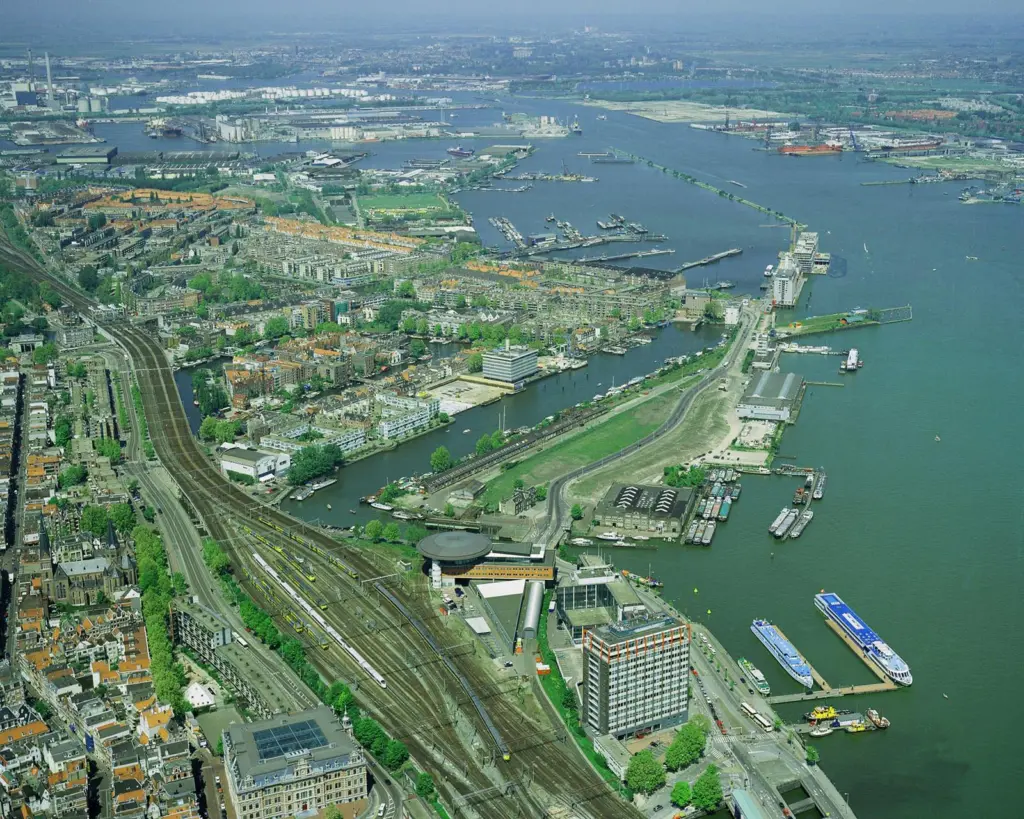
In spite of phenomenal growth – faster than China’s economy – there are as yet no such problems in Amsterdam, which is telling the Far East: “Bring it on.” In September, the city’s port hosted the first Amsterdam Forum for China, attended by about 200 politicians, government officials and business leaders from both countries. The message was clear: we want international co-operation with more Chinese companies. City Mayor Job Cohen spoke of a long-term strategy to strengthen Chinese ties, and in October went to China to further the cause by leading the city’s second major trade mission there.
The Chinese are receptive to such efforts. During a similar mission, the Port of Antwerp wooed representatives of major shipping lines operating between Asia and north-west Europe, and were pleased with the results. Their message was that Antwerp is fast-growing, reliable, congestion-free, and super-post-panamax friendly; the significance of their courtship was underlined by the presence of Belgium’s Crown Price Philippe.
Zeebrugge’s slant on development is towards further specialisiation on specific regular traffic, such as paper and pulp, agricultural products and new cars – imports and exports of the latter last year were almost double their 2000 levels.
To make specialisation possible the port has several space-related plans, among them an intention to create more space for ro-ro activities in the Albert II Dock and the outer port, and to build a third large container terminal in its outport. It also hopes to convert part of the current inner port to a tidal port, eliminating the Visart lock which, in the long term, could create an area of 340 hectares without locks and independent of tidal movement.
But for the ports to achieve success they need to work on congestion issues to a greater or lesser extent – both in the ports and on the hinterland transport infrastructure that supports them. It’s such a thorny issue that there’s a grudging acceptance of it. Co-operation is seen as a way through, against a background of congestion charges and increasing rates. ECT at Rotterdam is taking a tough line on container dwell time so container depots aren’t used as storage. Having limited the number of empties coming in earlier in the year – including banning them altogether at one point – from September 1 containers wouldn’t be accepted more than nine days before departure, and had to be removed within 14. From January 1 next year that time drops to a total of seven days. Jan Westerhound, president of ECT, says the restrictions will create more stack capacity, and allow the system to survive. “Every inch of space the port can gain makes a difference,” he says.
Playing catch-up
The World Gateway is to be a fully automated facility. No choice about that, according to Ron Widdows, chief executive of APL, given labour availability. But he’s also concerned about the ability of the hinterland to cope with a system that can lift 6 teu ashore in one hit. “Roads will simply not be able to handle the truck traffic,” he said. This is focusing minds sharply on rail, and Kevork Hekimian, executive vice-president of CMA CGM has urged that countries should think about a pan-European rail network, rather than working within national boundaries.
Here Rotterdam does score, with the Betuwe Line. Although not pan-European, it is nevertheless dedicated to freight traffic, and runs from Rotterdam to the German border. The port is a 35% shareholder in Keyrail, which operates it, along with Dutch rail company Prorail (50%), and the Port of Amsterdam holds the remainder.
There is keen interest in the line from transport companies, and in the near future it’s expected to carry 70 cargo trains a week, with projections for steep increases in the future. Amsterdam has plans to make the most of it, investing in more links to it, and new rail yards to feed them. It expects to increase rail traffic from last year’s 4.7m tonnes to 11m tonnes by 2020.
Antwerp’s Port Authority is part of a joint venture with cargo handling companies PSA HNN and P&O Ports. Supported by rail track operator Infrabel they have six new links between the port and Duisburg, Cologne and Germersheim (Germany), Strasbourg (France), Wolfort and Enns (Austria). Four existing rail links are to get extra services, carrying containers to and from Neuss and Ludwigshaven (Germany), Basel (Switzerland) and Lyons (France). And there’s growing interest being shown in connections with central Germany and Bavaria, which could go on to eastern Europe.
Freight congestion nevertheless remains, and needs the involvement of governments for its resolution. Dave Appleton again: “In Europe, there are many world-class companies who are increasingly affected by freight congestion. I would urge these companies to expand their dialogue with respective governments, and to engage with us on this side of the industry in developing solutions.”
He says the European Shippers’ Council needs to become involved on the issue, and called for efforts to overcome the general public’s apathy. “Supply chain congestion is not on many people’s radar screens. They don’t vote for bigger container terminals; quite rightly they vote for low taxes, schools, hospitals and jobs.
“It would be a shame if our industry finally impinged on public consciousness as a result of our failure to ‘deliver the goods’, rather than out of recognition for the way in which we have collectively facilitated this enormous surge in global trade, from which everyone in some way benefits.”
Related Articles
 PORT & TERMINAL NEWS
 EXPANSION & DEVELOPMENT
 PORT & TERMINAL NEWS