![PortStrategy[GreenPort]](https://www.portstrategy.com/wp-content/uploads/2026/09/PortStrategyGreenPort.svg)





TIGHTENING HIS GRIP ON THE VEHICLE SECTOR
Emanuele Grimaldi has been managing director of the Naples-based Grimaldi Group since 1986 having previously worked as line manager on the companys various international services. Alex Hughes talks to a shipowner who takes his terminal operations just as seriously.
The 48-year old Italian, who lives in Naples with his wife, had previously studied Economics and Commerce at Naples University, graduating in 1980 with the highest possible degree award (summa cum laude). This pursuit of excellence has stood him in good stead ever since, with the Grimaldi Group, under his leadership, having established itself as a quality provider of short sea shipping services out of its Mediterranean home base, not to mention the development of an ever-expanding deepsea business.
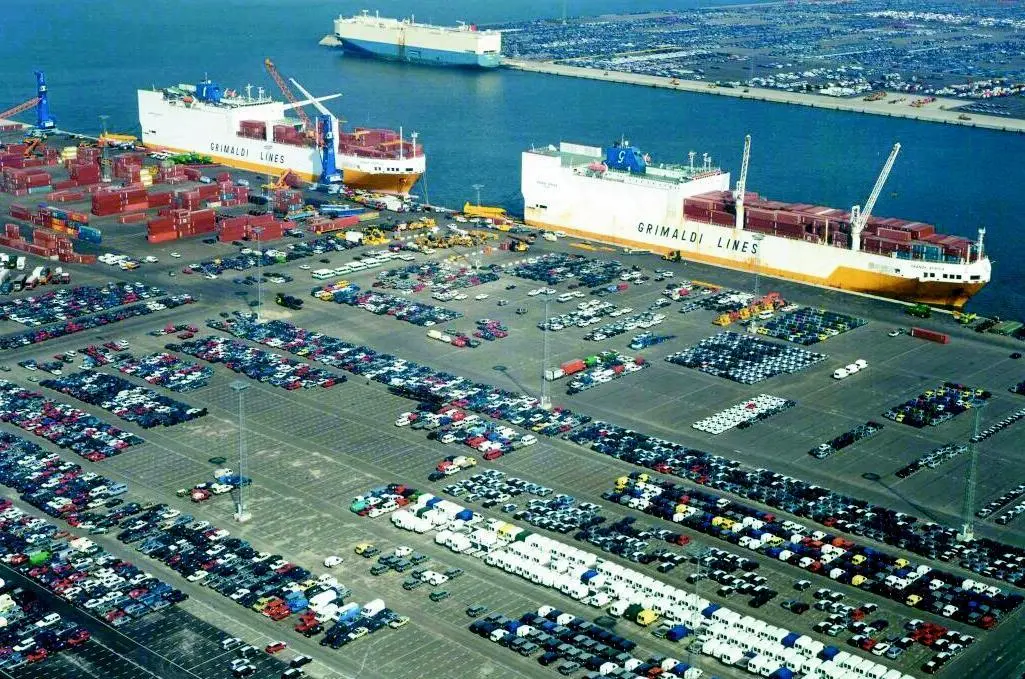
Nevertheless, it is the Grimaldi Group’s increasing dominance of new car business that is really beginning to make waves throughout Europe. By the end of 2004 the company expects to have transported about 1.6 million cars to and from ports on the continent, the majority being brand new vehicles. Compared to the previous year, this represents an increase of over 100,000 units, which Grimaldi attributes to a whole raft of reasons. Firstly, he points to a recovery in the European economy where the number of new car sales is always a good indicator of economic health. Furthermore, he notes that the accession of ten new countries to the EU is undoubtedly bringing about new trade opportunities. While, finally, there is an ongoing relocation of car production sites to peripheral areas of Europe, such as Turkey, which has brought about a concomitant need for fast transport links to major consumption areas.
“This final point has been key to explain the increase in vehicles traffic currently being experienced by short sea shipping providers, since this mode is by far the most competitive form of transport both in terms of price and performance compared to either rail or road, ” Grimaldi emphasises.
The company’s present fleet consists of 50 ro-ro/multipurpose vessels, car carriers and ferries, of which around 30 were built during 1998-2004. However, to reflect the current upsurge in business, another four new car carriers are to be delivered in 2004-2007 giving the fleet an average age per vessel of less than four years, with the majority capable of attaining speeds in excess of 20 knots.
“Our vessels are mainly deployed between North Europe and the Mediterranean on the Euro-Med Service, the Euro-Shuttle Service and the Euro-Aegean Service; between the western and the eastern Mediterranean, where we offer the East-West Med Service;
and between the Upper Adriatic and the Eastern Mediterranean, where we have the Adriatic Service. In addition, we have short sea services between Italy, Spain, Tunisia and Malta, ” he explains.
Indeed, within the motor industry, Grimaldi works with almost all the major manufacturers, including Fiat Auto, Ford, General Motors, Nissan, PSA-Citroen, Renault, Toyota, Volvo and VW. Challenged to explain the success in amassing such a high profile portfolio, Grimaldi speculates that it is probably a question of economic convenience and the quality of the logistics services offered.
“In fact, through the continuous upgrading of our fleet, which includes more and bigger vessels generating economies of scale, the creation of port terminals and the setting up of linked terrestrial transport companies, we are able to offer frequent, reliable, economically convenient and damage-free integrated logistics services, ” he stresses, pointing to a number of awards received from customers in recent years which would seem to reflect this assertion.
Nevertheless, Grimaldi is at pains to point out that the success of his company has come in the face of stiff competition from rival shipping lines, emphasising that sea transport-based logistics providers have to compete to offer the best service in terms of cost and quality in what has become a global market. In addition, short sea operators are also faced with competition from other modes of transport, some of which still receive state subsidies.
“In recent years, the main car manufacturers have been trying to cut down their logistics costs by pressurising their suppliers to offer the most economically convenient logistics solution, while at the same time keeping the same quality standards, ” Grimaldi mentions.
DEDICATED TERMINALS The company’s success can also doubtless be attributed to its policy of operating its own dedicated terminals wherever possible having established bases at Salerno, Palermo, Monfalcone, Antwerp, Cork, Esbjerg, Valencia and most recently in Sweden’s Wallhamn. These facilities cover a total surface area in excess of 1.5 million sq metres.
Company terminals are usually managed in partnership with local operators which Grimaldi says allows them to supply efficient, economically convenient and high quality cargo handling services linked to competitive door-to-door logistics services based around the core short sea shipping business.
“In the specific case of Antwerp we operate from our own 600,000 sq metre facility, where we handle cars, ro-ro cargo and containers with a quay length of 1,000 metres, a pre-delivery inspection (PDI) centre and a warehouse for general cargo. It is our hub in Northern Europe for cargo shipments between North America, West Africa and the Mediterranean.”
In general, the dedicated terminals function both as entry/exit points and distribution centres. They are usually equipped with PDI centres, where cars are treated before being delivered to the dealers. At some of them, fleets of car carrier trucks are also based to enable inland distribution to take place.
“Our aim is to make these terminals self-sustaining and efficient service providers along the whole logistics chain, ” Grimaldi explains.
“We have also heavily invested in IT in order to set up a tracking system for all the vehicles handled. Information is constantly exchanged with manufacturers via internet or via e-mail because we view the supply of information in our business as being of crucial importance.”
As for the organisation of terrestrial transport, Grimaldi deals with this through its logistics companies which, according to the agreement made with each car manufacturer, may transfer vehicles from the production sites to the loading terminals and/or from the discharging terminals to the dealers. In the specific case of Fiat Auto the group offers a door-to-door service for the transport of manufactured cars produced from various Fiat factories in Europe, to the dealers.
Asked whether a simple entry/exit port terminal handling new vehicles traffic can make money, Grimaldi observes: “Through sound management, a basic terminal such as this can be profitable.
Obviously, the profitability of a port terminal increases when addedvalued services are offered too.”
The Grimaldi Group does not exclusively operate from its own port terminals making use of common user facilities in many ports.
Nevertheless, this is not preferred policy as Grimadli explains: “What we are seeing is that in some terminals not operated by us the drive to maximise profit has a negative impact on users, especially short sea operators who may be penalised by high handling costs thus making it difficult to be competitive compared to other modes of transport.”
Quizzed as to new market opportunities, Grimaldi points to Russia as representing a large new vehicle market. “At present we do not have any development plans either in the Black Sea or in Russia, but we are closely monitoring the evolution of these emerging markets, ” he stresses, adding that in the Baltic Sea, Grimaldi is already cooperating with some Finnish operators to offer a combined service from Europe and South America to Finland and Russia via Antwerp.
“We are also paying a lot of attention to what is happening in Middle Eastern countries, a region that we have been serving for many years. Recently we introduced a new service that regularly calls at Tartous for the transport of second-hand cars from Europe to countries in that area, especially Iraq. This area of the world certainly has an enormous potential of growth, but this can only be achieved through a stable socio-political environment.”
North Africa is another region where great potential exists, he says, adding that this too depends on long-term stability. Grimaldi is already present in Egypt, Tunisia and Morocco. Alexandria for example is served by two weekly ro-ro and containers lines: the Euro-Med Service and the Adriatic Service. In 2003, the company started serving Tunisia too, with two weekly sailings from southern Italy and Spain for the transport of passengers, rolling cargo and containers.
Its new ro-pax vessels link Tunis directly to the ports of Salerno, Palermo, Trapani and Valencia. Moreover, cargo to and from North Europe is being transhipped in Salerno with origin/destination Tunisia.
At the beginning of 2004, the group also started serving Casablanca which is linked to North Europe with a frequency every nine days for the transport of rolling cargo and containers.
In the Near East and Mediterranean, therefore, the group has built up an enviable service network. It will be interesting to see how Emanuele Grimaldi’s strategy of operating his own terminals to gain control of the entire logistics chain, can best be implemented in these emerging markets.
Related Articles
 PORT & TERMINAL NEWS
 EXPANSION & DEVELOPMENT
 PORT & TERMINAL NEWS