![PortStrategy[GreenPort]](https://www.portstrategy.com/wp-content/uploads/2026/09/PortStrategyGreenPort.svg)






UK PORT PLANNING BLIND SPOTS?
Port Strategy (PS) continues its focus on the role of government in UK containerport expansion, which, sadly, continues to represent a master-class in how it shouldnt be done, writes Mike Mundy
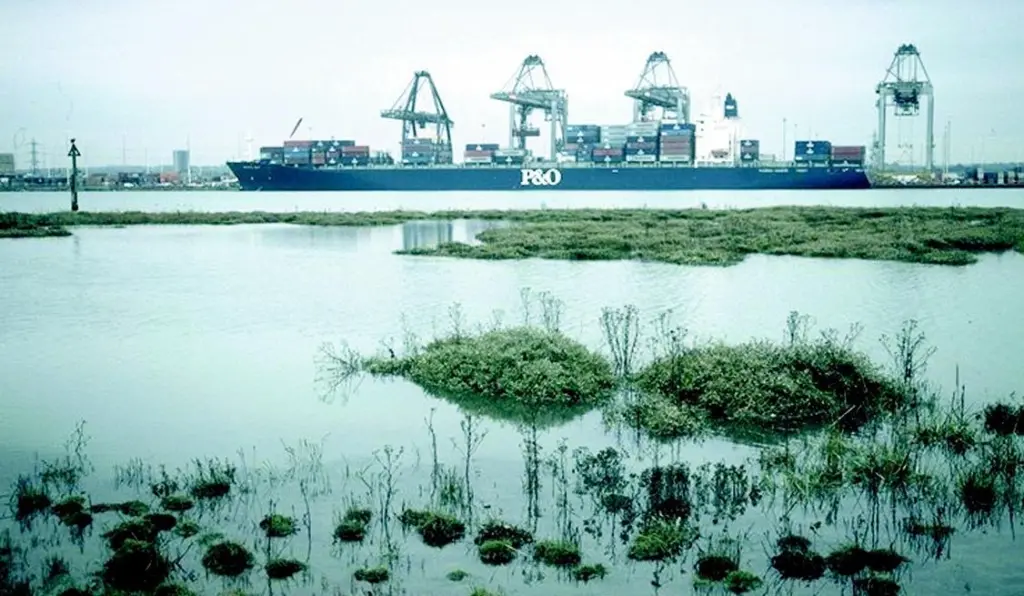
There are no short cuts in proper containerport planning but issues surrounding marine access in Southampton suggest the current UK approach has some major blind spots How can the UK Secretary of State for Transport fairly pass judgement on ABP’s Dibden Bay container port expansion project when he has no evidence in front of him of the effect of the scheme on access for vessels to Southampton Container Terminal’s (SCT) existing container facilities? If he has no such evidence it is painstakingly evident it will not enter into his calculations and therefore represents a major blind spot, a problem, as indicated, that has raised its head in other key areas of the planning “process.”
In PS’s view, the base line of the planning process applicable to the four port developments chasing the forecast need for additional deep sea container capacity has to be that the rules are applied fairly between all the competing interests and the prizes awarded accordingly!
In this particular instance, the applicable rules are those found in the EC’s Habitats Directive and the UK’s interpretation of them.
Essentially, these say that if there are alternative projects all seeking to meet the same end, then those with the least impact on an internationally important and therefore designated site of nature conservation, get the go-ahead to meet the forecast need over a reasonable planning horizon of say 10 years.
There is, though, another rule that can be found in the many pages of the directive that is equally important, namely, that the adverse impacts on the designated sites of the “whole plan or project” must be assessed . And it is this rule that poses big questions about the Dibden Bay scheme. Has this aspect fully and properly been taken into account with regard to vessel access to Dibden Bay?
PS has seen a Post Inquiry representation made on this aspect which strongly suggests the answer is a resounding no, although the presentation of the following facts on the issue enables interested parties to draw their own conclusions.
THE FACTS UNVEILED The current channel depth at Southampton is 12.7m as opposed to the existing 14.5m at Felixstowe and proposed 14.5m at London Gateway Port. The present channel restrictions at Southampton basically mean that any vessels over 12m draught can only navigate the channel during the high water tides that occur twice a day. A vessel with a 14m draught, for example, has a tidal window of approximately 4.5 hours and a vessel with a 14.5m draught around a three-hour tidal window.
As the current container vessel newbuilding order book proves, however, the percentage of ships within the container vessel fleet with more than 14m draught is on the increase especially in Far EastEurope services, SCT’s stock in trade.
A further insight into this trend is provided in Table 1. Against a throughput increase of eight per cent the number of vessel calls which were tidal constrained increased by 16% between 2002 and 2003.
Table 1 also indicates that SCT’s liner clients have already been influenced by the channel restrictions as the number of vessels with a draught in excess of 14m actually decreased between 2002 and 2003. The conclusion is that clients are adjusting their operations to manage the channel constraints and seeking to call with vessels possessing less than 14m draught so as to increase the tidal windows open to them. This tactic, however, is one that has significant cost and other negatives against it as well as being one that is becoming progressively limited for operators to deploy.
Table 2 considers the future situation, projecting forward on a linear basis the number of ship calls which will materialise if SCT expands to reach a 2mTEU/yr throughput level and Dibden Bay is at its stated 2.1mTEU full capacity. It is, so to speak, the far end of the envisaged new operational arrangements but nevertheless a real possibility over time.
The projection allows for an increased number of containers per vessel due to the continued rise in carrying capacity in terms of vessel size but it does not assess the increasing number of deeper draught calls or, to put it another way, the consequential shifts from one draught range to another. As such it is likely that the conclusions drawn from the projection will be under-stated.
Compared to Table 1, Table 2 clearly shows the significant increase in the number of shipping movements in the existing channel and, notably, the 160% increase in the number of vessel calls constrained by the channel depth.
Table 2 further makes the point that compared to 2003, when there were 350 constrained calls (Table 1) to SCT by vessels drawing 12m or more, that if SCT and Dibden were operating at capacity then the channel will have to accommodate over 900 draught constrained calls.
This, in turn, clearly tells us that there will be significant delays to the vessels calling at SCT and therefore knock-on problems with the operation of the existing container terminal if the planned new Dibden Bay terminal is built and operated without a capital dredge of the access channel to increase depth.
Further, if the channel remains the same, according to the Post Inquiry representation, the pattern of existing calls to SCT will inevitably be disrupted to the extent that this may lead to a reduction in throughput at the terminal. This latter important factor and the others referenced before it, as stated earlier, were, however, not referenced at all by ABP when formally presenting the case for Dibden.
How can this be and how can the UK Government nail its flag to a planning process that does not take into account such important facts in the provision of new deepwater container capacity? Further, this does appear to be a serious breach of the principle of assessing the adverse impact of the “whole plan or project.”
SCT UNDERMINED?
The Post Inquiry representation clearly states in the latter respect that if Dibden is approved that it will undermine the existing competitiveness and operational efficiency of SCT – ABP’s anchor tenant and an established premier container gateway port. Most significantly, however, it asks the question, why hasn’t ABP included the required channel dredge in its Harbour Revision Order (HRO)? And following on from this it begs the question that the combined ecological impacts of the terminal development and the dredge requirement would be simply too great to be contemplated?
It also has to be said, that this sort of approach – basically not tackling the access channel related issues – is not one that the other developers have opted for.
P&O Ports has applied the rules at London Gateway Port and have sought approval for the necessary capital access dredge to 14.5m as part of its Harbour Empowerment Order (HEO). In effect, they have agreed with the Regulators to provide the necessary mitigation and compensation for the whole plan or project in a manner that will ensure the cohesion of Natura 2000.
As for Hutchison, it is fortunate that its access for the Bathside Bay scheme is already dredged to 14.5m and that the proposed development will not constrain other facilities using that access.
FAIR APPLICATION OF THE RULES?
The word on the streets is that the UK Secretary of State for Transport will make a decision on Dibden Bay soon. However, in truth, how can he make such a decision unless he is fully informed of all the facts that allow him to assess whether or not the existing deep-sea port facilities, like SCT, are disadvantaged by the proposed new developments? If he doesn’t take this path then he cannot be applying the rules fairly and reasonably – and surely must be leaving the way open for opponents to Dibden Bay or any other scheme to formally raise objections and possibly push back the time frame in which new capacity will be introduced.
Is there a solution at this stage? It may sound a radical one but rather than pursue an inherently flawed planning process, the Secretary of State for Transport could re-open the Dibden Inquiry in order to receive up-to-date evidence relating to the proposed development generally and specifically, as demonstrated above, the most important facts relating to marine access issues. “Blind spots, ” he may wish to ponder on, have never shown themselves to be of benefit in any major infrastructure planning process – indeed is this not the reason why in other sectors such as airport capacity planning the government has opted for a most rigorous comprehensive approach rather than a piecemeal one?
Related Articles
 PORT & TERMINAL NEWS
 EXPANSION & DEVELOPMENT
 PORT & TERMINAL NEWS