![PortStrategy[GreenPort]](https://www.portstrategy.com/wp-content/uploads/2026/09/PortStrategyGreenPort.svg)





European congestion update
Congestion at the ports of Bremerhaven and Hamburg continues to climb despite the rest of Europe stabilising after Russia’s invasion of Ukraine in February.
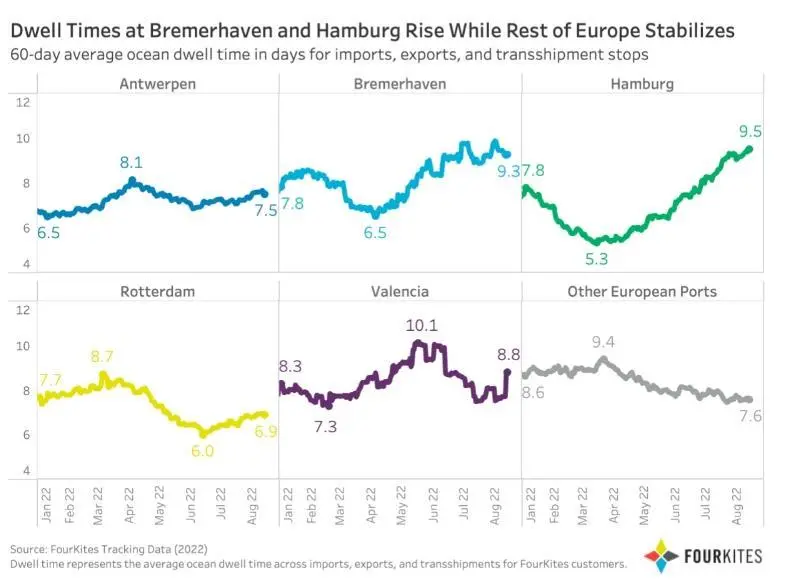
At Bremerhaven and Hamburg, the 60-day average ocean dwell times (across imports, exports, and transshipments) are now at 9.3 days and 9.5 days as of 13 August. For Bremerhaven, this is a 43% increase over the low seen in April, and a 19% increase over the start of the year. For Hamburg, this is a 79% increase since the low point in March, and a 22% increase over the start of the year.
At Antwerpen and Rotterdam, dwell times remain below the peaks seen in March and April, but have been increasing steadily over the past several weeks. At Antwerpen, the 60-day average ocean dwell time is now at 7.5 days. For Rotterdam, the 60-day average ocean dwell time is now at 6.9 days.
At Valencia, the 60-day average ocean dwell time is now at 8.8 days. This is 13% below the peak seen in May and June, but is still 6% above levels seen at the start of the year.
Across the rest of Europe, port congestion appears to have stabilised for now. The 60-day average ocean dwell time is now at 7.6 days, which is 19% below the peak seen in late March, and 12% below levels at the start of the year.
Congestion at the Port of Felixstowe was low up until last week but is expected to increase as a result of strike action. The 4-week average ocean dwell time at the Port of Felixstowe was at 8.8 days average across import, export, and transshipment stops, 20% lower than levels seen at the beginning of the year when the average was at 11 days.
Related Articles
 LEGAL, RISK & INSURANCE
 NEWS
NEWS
 PORT & TERMINAL NEWS