



Global container capacity
Global container port capacity looks set to increase as operators seek to deliver long-term growth through higher-risk greenfield projects, according to Drewry’s latest Global Container Terminal Operators Annual Review and Forecast report.
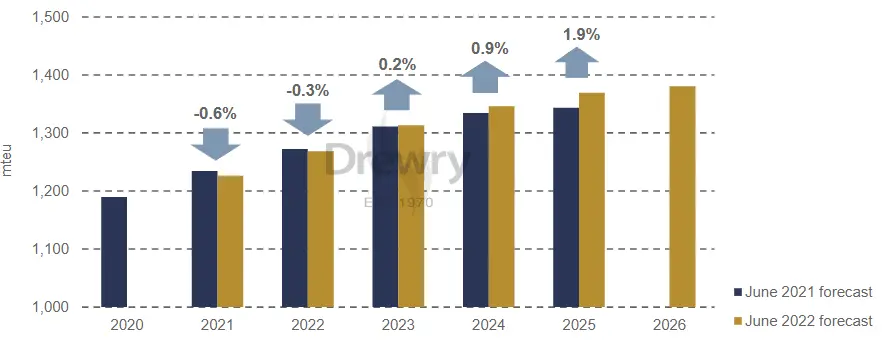
A recovery in trade following the easing of pandemic restrictions is helping capacity increase by a projected average annual rate of 2.4% to reach 1.38 billion teu by 2026. However, the current economic and geopolitical situation has led to a downgrading of the cargo demand outlook, with container port utilisation now expected to moderate to 70% in 2025 compared to last year’s projection of 75%, says Drewry.
While the majority (70%) of operators’ investment plans remain focused on existing assets, there has been a notable increase in the number of greenfield projects, with CMA Terminals, Hutchison and TIL all expected to add 4 mteu of additional greenfield capacity by 2026.
Eleanor Hadland, author of the report and Drewry’s senior analyst for ports and terminals said, “The renewed appetite for greenfield projects shows improved confidence in the market outlook.
“However, the ability of CMA Terminals and TIL to secure volume guarantees from CMA CGM and MSC gives these companies an advantage over non-carrier affiliated operators.”
Port congestion caused by supply chain disruption does not appear to have adversely impacted financial performance, despite the widespread decline in productivity levels.
Revenue raising mechanisms such as paid overtime and storage charges have so far proven to be sufficient to offset the additional congestion-related operating costs. Operators also cite cost control measures implemented in response to the pandemic as having a positive impact on margins.
Capital expenditure bounced back in 2021, rising 31% year-on-year, but operators now face the twin challenges of longer lead time for handling equipment and rapidly rising costs.
Drewry’s research also shows that the pace of fund raising has slowed since 2020, with rising interest rates putting a brake on the market.
Related Articles
 LEGAL, RISK & INSURANCE
 NEWS
NEWS
 PORT & TERMINAL NEWS