![PortStrategy[GreenPort]](https://www.portstrategy.com/wp-content/uploads/2026/09/PortStrategyGreenPort.svg)




Capacity crunch
Australia’s west coast iron ore ports are suffering from the sort of congestion normally associated with the nations east coast coal ports, reports Michael King
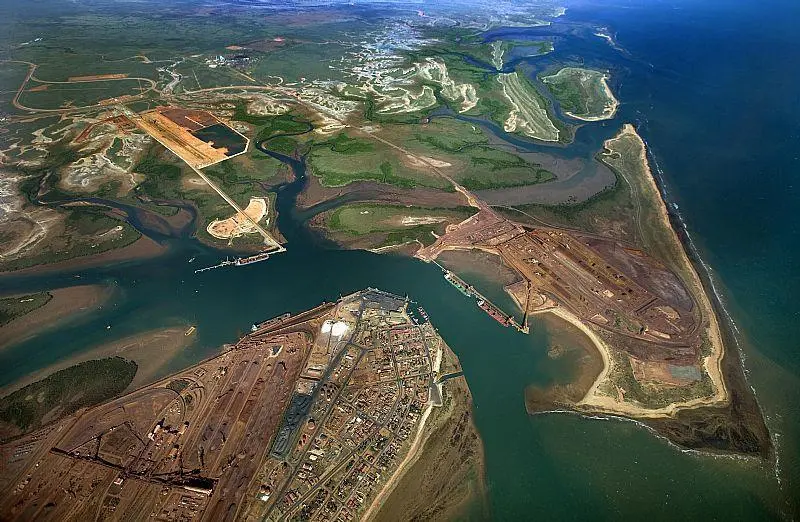
Very few port sectors have seen such rapid capacity expansion as Australia’s network of iron ore terminals. Last year alone Australian terminals handled some 381m tonnes of iron ore, up almost 60m tonnes compared with a year earlier. A similar hike is expected in 2010 with demand from China the main driver.
By and large, Australia’s export systems have coped impressively well with the trade expansion. But after such large annual volume increases it is little wonder that in recent years port congestion has blighted terminals on the west coast used by iron ore miners.
Broker Simpson, Spence & Young told Port Strategy the average waiting time off Australia’s leading iron ore ports in mid-March was four days. A year ago, when China’s iron ore imports suddenly spiked and cyclones impacted on shipping patterns and loading, the delay was some 12 days.
Although such delays are significant, they pale in comparison to waiting times elsewhere. Earlier this year, delays of nearly a month were reported at Queensland’s Dalyrymple Bay Coal Terminal, while sizeable queues of capesize vessels were evident at iron ore ports in Brazil and China.
Dampier and Port Hedland remain the largest bulk export complexes in the world, each handling more than 140m tonnes in financial year 2008-09. Indeed, Port Hedland handled 159.m tonnes in the period, up 21.9% compared with a year earlier, with 97% of the total constituting iron ore.
Port Hedland is used by BHP Billiton, Australia’s second-biggest iron ore producer, and Fortescue Metals Group (FMG), Australia’s third-largest iron ore exporter, while market leader Rio Tinto ships from the ports of Cape Lambert and Dampier.
Rio Tinto and BHP Billiton have long argued that their success in building up iron ore port and related infrastructure has been down to the freedom they have been granted to construct and operate dedicated, integrated transport systems from mine via railways to ports in Western Australia.
This contrasts, they say, to east coast coal infrastructure, which is more open access and where delays have been more apparent as port capacity has not kept pace with demand. Coal terminals at Newcastle, for example, have been beset by long vessel queues and loading restrictions for much of the last decade, such has been the shortfall between demand and the ability of the port and its rail links to manage extra volumes.
The commodity majors claim, however, that an on-going court case which pits BHP Billiton and Rio Tinto against FMG could threaten the future success of Australia’s iron ore export business by throwing open the door to third party access to port and rail infrastructure.
A senior Rio Tinto spokesman warned last year that if third-party access was granted, the investment logic of building up rail and port facilities in the first place would be fundamentally undermined. “Access is not about creating value but destroying value, destroying the efficiency and capacity of Australia’s single largest export business,” he added.
The outcome of the case should be finalised later in the year but, so far at least, the cloud it has cast has not prevented miners, local government and port authorities from making long-term investment commitments. Not least, this is because China’s iron ore imports are forecast to reach over 854m tonnes in 2015, up from 628m tonnes last year and Australian exporters are determined to win a sizeable share of the growing pie.
All of the leading iron ore miners in Australia have major investment plans to boost output, and Abare predicts exports will grow at an annual rate of some 7% to 2015 when Australia will be exporting around 552m tonnes, slightly more than second placed Brazil.
Ports are desperately trying to upgrade capacity. At Port Hedland the 18m tonnes per annum capacity multi-user Utah Point Berth Project is due to open later this year at a construction cost of A$225m (US$206m). BHP Billiton has also commenced dredging of two new berths at Harriet Point as part of its Rapid Growth Project 5.
Rio Tinto is expected to complete its expansion of Cape Lambert by 2015. The massive project would add 100m tonnes per annum of loading capacity.
Rio Tinto and BHP Billiton are also investing heavily in related railway links between their respective ports and mines in Western Australia.
Elsewhere, a new 5m-6m tonnes capacity expansion at Darwin is due to open in 2013 once a feasibility study is completed at a cost of US$300m. And in South Australia a new deep water port is under consideration at Bonython in the Upper Spencer Gulf. A feasibility study is underway and the terminal could potentially begin operations in 2012 offering some 20m tonnes per annum capacity.
The efforts of iron ore market entrants to find suitable port access can be frustrating, however. At Oakajee, 20 km north of Geraldton in Western Australia, Murchison Metals and Mitsubishi have been trying to build a new multi-user capesize port and rail system for a number of years.
Offering 35m tonnes of annual capacity, later rising to 100m tonnes, the project would cost some US$3.5bn and provide a new iron ore export path in Western Australia for miners in the mid-west region of the state.
Abare said the project is due to start shipping iron ore in 2014, but although numerous feasibility studies have been completed a spokeswoman at the port was unable to confirm a start date for construction telling Port Strategy that, “no, there’s still nothing built” and refusing to comment further.
In Australia, it seems, bridling at the mention of access is not the exclusive preserve of the commodity majors.
Related Articles
 EQUIPMENT
 WORLD
WORLD
 PORT & TERMINAL NEWS