![PortStrategy[GreenPort]](https://www.portstrategy.com/wp-content/uploads/2026/09/PortStrategyGreenPort.svg)





Greatest Legacy will be MetroPort
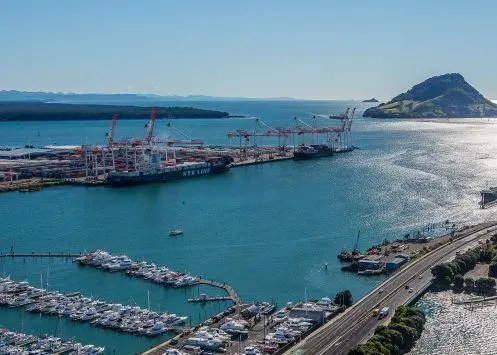
Undoubtedly however, Maysons greatest legacy will be MetroPort. Commencing with 60TEU capacity trains, the initial weekend-only service handled 32,000 TEUs and processed 18,000 trucks in its first 12 months of operation.
MetroPort has subsequently developed into a seven-day-a-week service, utilising trains of 90TEU capacity and annual throughput has grown to 145,000TEUs, with about 100,000 trucks being processed each year.
A US$2.2m upgrade completed in late 2004 has expanded MetroPort’s grid capacity by 50% and brought about a number of operational efficiencies. Two new 750 metre-long sidings now enable import and export trains to be worked concurrently for the first time, site traffic flows have been improved and container stacking heights have been lowered.
A 10-year extension to the Port of TaurangaToll NZ MetroPort agreement was signed in early 2004, and signalled the introduction next year of 120TEU trains. All these developments are intended to efficiently accommodate MetroPort’s current and predicted future volume growth.
These experiences of business partnerships lead Mayson to suggest the traditional attitude, whereby commercial organisations maintain cool relationships with their competition, must change. “My view is that it’s time we acknowledged this and lifted our strategic game right across the industry. Our ability to overcome these issues lies in the highest degree of cooperation, at a strategic level, between exporters and port business, and the creation of strategic partnerships between ports and their customers, including shipping lines.
“Port companies recognise their investment cycles are medium to long term and they accept a reasonable level of commercial risk in making the appropriate strategic decisions. The ongoing challenge for the future then, is continuing to develop win/win co-operative arrangements that will give both customers and supplier partners the level of security that justifies their investment.” PS
Related Articles
 WORLD
WORLD
 PORT & TERMINAL NEWS
 PORT & TERMINAL NEWS