



NZ port owners accused of holding back progress
While port rationalisation has long been mooted in New Zealand, the lack of progress in achieving it leads some critics to suggest that the ownership structure of ports – with local and regional authorities holding controlling power – is a hindrance.

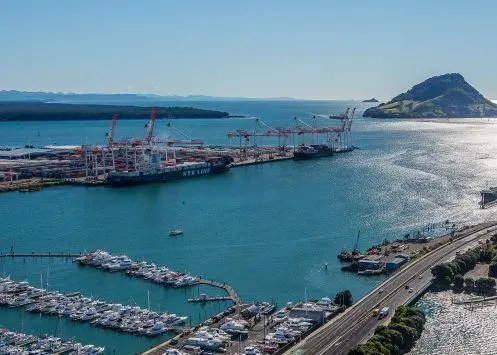
Port of Tauranga chairman John Parker says a natural hierarchy of ports will emerge as larger ships frequent New Zealand waters, and he observes this is happening despite any guiding hand from either local or national government.
“[National] Government has essentially said that it will remain neutral and allow economic forces to cause or force change. We have no objection to this but still believe some local body port owners resist economic logic at the expense of their long-suffering ratepayers.”
Until late 2010, merger talks were progressing between South Island rivals Lyttelton and Otago. However after the Canterbury earthquake an announcement was made that the merger was now on the back burner, leaving some with the feeling this was an opportunity to conveniently drop talks that were failing to find consensus between the two parties.
South Port chief executive Mark O’Connor wonders if this is indicative of the hand of local government ownership preventing progress.
“What is going to be the catalyst to trigger NZ port rationalisation now that the LPC/Otago process has fallen over? Is the LPC/Otago outcome a good example of the difficulties that will continue to be encountered as a result of the parochial conflicts which exist with local government ownership of ports?” he asks.
Tauranga chief executive Mark Cairns shares Mr O’Connor’s doubts about what will trigger rationalisation. “There were possibilities of rationalisation occurring through merger and acquisition — Hutchison/Lyttelton, Port of Tauranga/Ports of Auckland, Port Otago/Lyttelton. All three of these have been swamped and to be honest, I can’t really see them rising out of the ashes.
“There are a number of parties looking for government intervention to force port rationalisation and [Transport Minister] Stephen Joyce has been pretty consistent in saying he does not see the government having a role currently.
“Our thinking on port rationalisation is probably crystallising around a hierarchy of ports needing to emerge, not unlike a hierarchy of roads we have formally, viz. motorways, state highways, regional arterials, and local roads. Again we do not believe a heavy-handed interventionist approach would be required to achieve this.
“We maintain if ports simply priced and invested to ensure cost of capital return (as we consider they are mandated to do under section five of the Port Companies Act), a hierarchy of ports would emerge naturally and quite quickly.”
PrimePort Timaru chief executive Jeremy Boys has lobbied that planning for transport needs to be combined across all sectors and elevated in importance, to ensure return on investment so the country as a whole gains most benefit — “something we don’t believe has been achieved to date”, he says.
“We recognise the reluctance by government to be involved but suggest that as owner of two of the three modes that can consolidate cargo (road and rail versus coastal), that government at least needs to participate. However many investment decisions have already been committed.”
A presumed spur towards port rationalisation in the container sector was the report of the Shippers’ Council, representing major exporters, which suggested that there should be one container port in each of the two islands in order to encourage the introduction of larger container vessels — the pay off for exporters being more efficient container services to major markets.
Tauranga was picked in the North Island and Lyttelton in the South.
Related Articles
 WORLD
WORLD
 PORT & TERMINAL NEWS
 PORT & TERMINAL NEWS