![PortStrategy[GreenPort]](https://www.portstrategy.com/wp-content/uploads/2026/09/PortStrategyGreenPort.svg)





Playing Hardball
70+% price hikes, entirely new sources of supply being developed? Australian iron ore producers are enjoying a bull-run in meeting demand from China. The ports are coping but more pressure is building. Mike Mundy and Kevin Chinnery report.
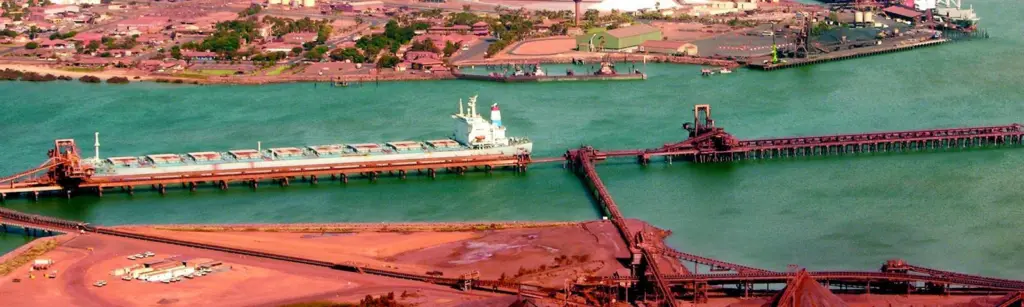
Extraordinary events are the order of the day in Australia’s iron ore export industry, right through from producer to the port export gateways with China – the trigger to them all.
Price is a remarkable story in itself. The latest chapter is the price hike of 71.5% agreed last month between China’s Shanghai Bao Steel Group, the country’s largest steel maker, and BHP Billiton. The latter had actually stuck out for an even larger increase arguing that as the Brazilian producers Rio Tinto (Anglo-Australian) and Companhia Vale Rio Doce had achieved a 71.5% price increase it should achieve an even higher one reflecting the shorter freight haul from Australia to China – an increase in the order of US$7.50 to 10.00 per tonne to give it parity in terms of landed price. In the end, common sense seemed to prevail – the Chinese getting their point over that 71.5% was enough after all!
The reality also has to be factored in that it is not only Chinese steel production that has to swallow such a price increase; there is a knock-on effect for other producers around the world. European producers are, for example, seen by analysts as also having to swallow such a price increase and overall the message is that the price rise reflects a catch-up in raw material prices to steel prices, which have more than doubled in the past two years.
PORT PRACTICALITIES Of course if the key export gateway doesn’t work – the maritime port interface – then the added earning power of the iron ore producers is effectively strangled. And going back just a little way, there were some grounds for concern about this – for instance, Port Hedland’s port planning studies in 2002 forecast the port achieving an annual throughput of 110m tonnes by 2011, a figure which it will now reach next year!
The advantage of hindsight though tells us that overall that Australia’s two major outlets of Port Hedland and Dampier/Cape Lambert appear to have recovered well since first confronting the major new demands placed upon them. When Rio Tinto clinched its 40m tonne a year deal with China last June – worth in excess of 200 extra Capesize loads annually – it already had US$1.5 billion of investments earmarked for its logistics chain including raising Dampier’s annual capacity from 74m to 116m tonnes, and Cape Lambert’s to 50m tonnes.
The scale of the demand from China coupled with other Asian demand has also meant that there has been more scope for other ports to engage in a stronger way with iron ore trade. A large number of Western Australia’s small to medium size ports, that in the past have been recognised due to their focus on grain and timber exports, are now hugely expanding their tonnages with mine-based shipments.
Geraldton was deepened last year to handle a Panamax-based iron ore trade, equivalent to around eight million tonnes per annum.
Esperance now handles around 20m tonnes a year for Portman mining and Albany is now actively investigating expansion to handle first Panamax and then Capesize shipments to Malaysia for Grange Resources.
Interestingly, Western Australia’s principal general cargo port of Fremantle is also now handling iron products for Rio Tinto’s Hi-smelt project. This entails shipping palletised iron processed with new technology from magnetite ores mined outside the traditional Pilbara region.
CHINESE RESISTANCE Whether it is prices or port capacity issues at the export gateway, interested Chinese parties are by no means passive participants.
Following the latest round of price hikes, as indicated above, there is a clear message coming out of China that further increases in the order of 70%, or anything near it, will not be acceptable.
Equally, Chinese interests are proving forceful in establishing new lines of iron ore supply from Australia, as the machinations taking place within the new joint venture between China and Fortescue Metals, an entity set up to challenge the old Pilbara monopoly of BHP Billiton and Rio Tinto, confirm.
Fortescue’s Chichester Ranges project is an enterprising plan in which Chinese companies will establish an iron ore mine, 345km railway and Capsize port facilities at Port Hedland to ship ore from Fortescue’s 1.13 billion tonne iron ore deposit. The Chinese will effectively bankroll the project upfront, against first deliveries on contracts which Fortescue has already agreed with Chinese mills.
In March, however, an interesting war of words broke out between the lead Chinese company involved and Fortescue. The Chinese questioned in the media the quality of Fortescue’s reserves and the binding strength of the contracts to both build the facilities and sell the ore. Fortescue has responded in kind, airing its contracts in public and suggesting that these moves by the Chinese are intended to spook Fortescue’s share price allowing them to grab more control of the venture.
Since the pioneering days of the 1960s and 1970s, however, the iron ore industry has learnt to roll with the punches and bounce back vigorously; it is nothing if not resilient. This includes the port export gateways which have avoided controversy of the scale and kind experienced in the New South Wales and Queensland coal terminals in recent months.
The latest assessment of the Reserve Bank of Australia appears to be a fair one when it says that the 19% increase in port capacity at iron ore ports since 2003 is “more than sufficient” to deal with recent export growth. It also has to be appreciated that in comparison to the New South Wales and Queensland coal sector, western Australian iron ore logistics are much more vertically integrated under just one mine. This facilitates a much better performance potential.
Related Articles
 WORLD
WORLD
 PORT & TERMINAL NEWS
 PORT & TERMINAL NEWS