![PortStrategy[GreenPort]](https://www.portstrategy.com/wp-content/uploads/2026/09/PortStrategyGreenPort.svg)






Box Loading Systemised
Custom cargo handling equipment supplier Smart TEH puts the case for automated container loading identifying multiple benefits.
Ports today are under pressure to move more cargo, faster, and with fewer delays. Trade volumes keep growing, labour isn’t always easy to secure, and turnaround times matter more than ever. All of this is pushing operators to rethink how things get done.
Container loading rarely gets much attention, but it’s often where port performance can encounter a significant bottleneck. When this important step slows, the supply chain feels the negative impact. As volumes grow and turnaround times tighten, even small delays here can affect the entire operation.
MANUAL LOADING LIMITS
Manual container loading has been widely employed for years, but its downsides become clear at scale. The process depends heavily on people, so results vary – some teams pack containers tightly, while others leave unused space. Over time, that variation directly affects how efficiently capacity is used.
There’s also the strain it puts on day-to-day operations. Handling heavy or awkward cargo in tight spaces increases the risk of injuries, while the loading time itself can be difficult to estimate. In high-volume environments, those uncertainties make planning harder and can quickly slow down the wider workflow.
PRESSURE BUILDING
At the same time, the environment around ports is changing. More cargo is moving through global supply chains, and expectations around speed and reliability are higher than ever.
As volumes grow, small inefficiencies start to matter a lot more. What might go unnoticed at a smaller scale quickly turns into a bottleneck when you’re handling hundreds of containers a day.
Ports are expected to keep cargo moving without delays and avoiding disruptions. That puts more focus on how smoothly each step runs – including container loading.
Automation helps bring that consistency. It makes the process easier to manage, keeps operations running steadily, and allows ports to handle higher volumes without the same level of disruption.
HOW AUTOMATED LOADING WORKS
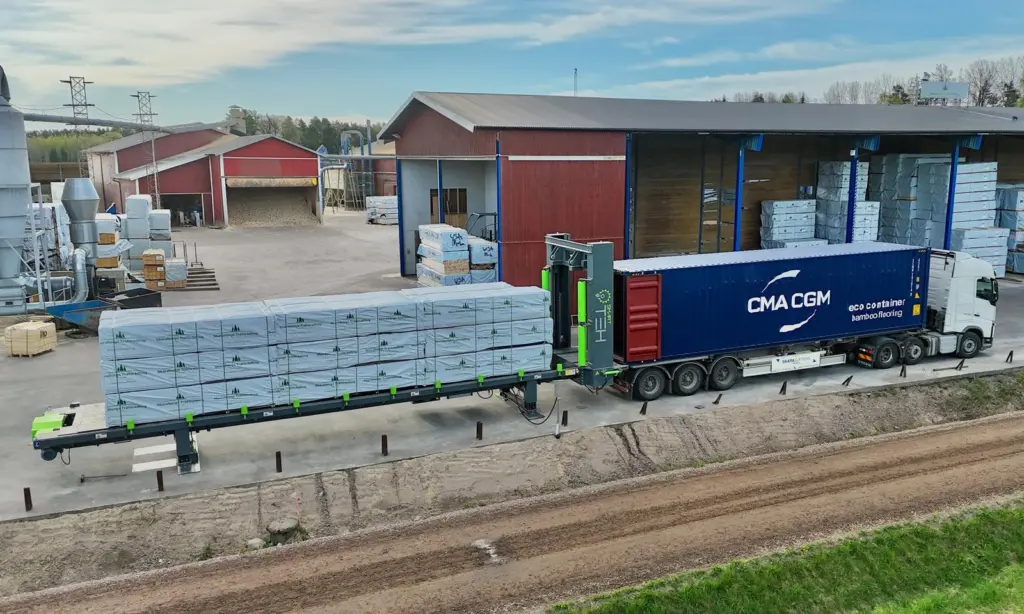
One of the most effective approaches with automated container loading is the “one-shot” loading method. Instead of handling cargo piece by piece inside the container, the full load is prepared and aligned in advance – on a loading plate. Once ready, the system pushes the entire load into the container in a single motion.
This removes a major source of delay. There’s no need to stop, reposition, or restack cargo inside the container. The load goes in quickly and evenly, improving stability, space usage, and reducing the risk of damage.
Compared to more complex robotic systems, this approach is simpler to integrate and works alongside standard equipment – making it a practical upgrade rather than a full operational overhaul.
POSITIVE IMPACT
The impact of loading automation shows up quickly in day-to-day operations. Key benefits comprise:
- Faster, more consistent loading
Containers move through the port with fewer delays, helping reduce backlogs and keeping cargo flowing. - Better cost control
Fewer manual errors mean less cargo damage, less rework, and fewer claims to manage. - Improved safety
Less need for workers to handle heavy or awkward loads inside containers reduces the risk of injuries. - More efficient use of space
Containers are filled more evenly, helping avoid partially loaded shipments. - Easier to scale operations
As volumes grow, ports can handle more cargo without needing to rapidly expand the workforce.
REAL VALUE
The real return shows up in how efficiently ports can use their existing capacity. More controlled loading allows higher volumes to move through the same infrastructure – without the need for yard expansion or extra staff.
It also helps cut avoidable costs across the operation. Less idle time, fewer disruptions, and fewer handling issues mean better use of equipment, labour, and time.
In practice, these gains add-up quickly. Many automated container loading systems achieve a return on investment in less than two years.
LOADING IS MORE PREDICTABLE
In high-volume port operations, performance is often decided by the smallest steps in the process. Container loading may seem routine, but in practice, it has a direct impact on speed, cost, and reliability across the entire workflow.
Improving that step doesn’t require a complete transformation. In many cases, it comes down to reducing variation and bringing more control into the process.
Automated container loading does exactly that. It turns a task that often depends on manual effort into a structured part of the operation – one that keeps cargo moving even as volumes continue to rise.
Related Articles
 EQUIPMENT
 OPERATIONS
 OPERATIONS