![PortStrategy[GreenPort]](https://www.portstrategy.com/wp-content/uploads/2026/09/PortStrategyGreenPort.svg)

Brazilian blight
Brazilian ports have been hit by a double weather whammy of both drought and flood, almost of Biblical proportions. Rob Ward charts events
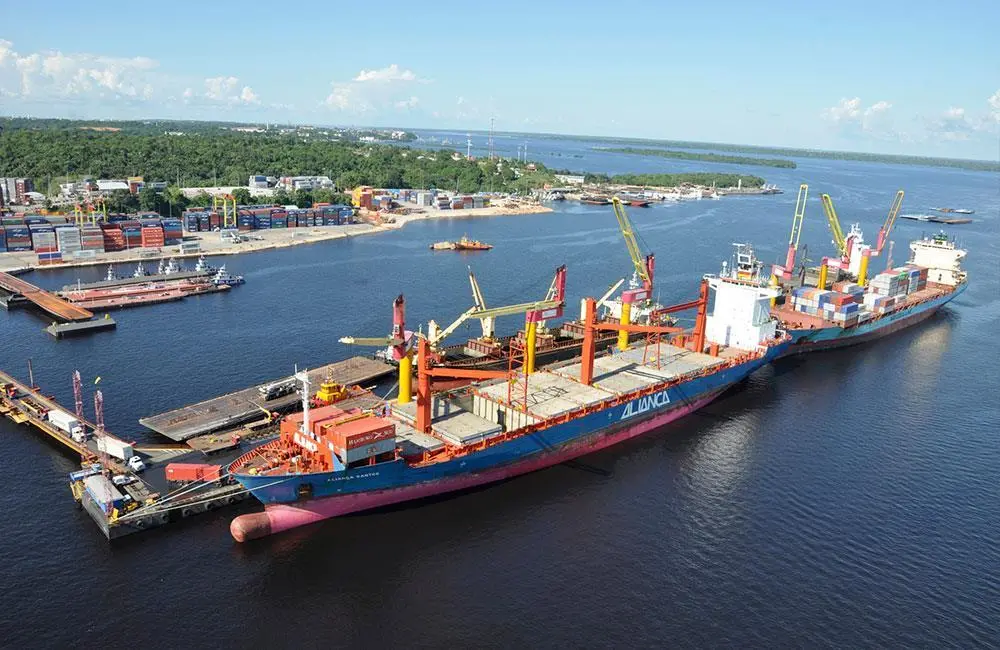
In the Amazonas region, in the far north of the South American country, the worst drought since records began, over 100 years ago, has caused essential container services, serving the Manaus box port terminals of Porto Chibatao and Superterminais, to be cancelled for close to two months.
Maersk Line (via the Aliança Navegação brand), CMA CGM (via Mercosul Line) and MSC (via Log-In Logistica), usually operate 20 or so cabotage calls per month into Manaus, a city of 2.2 million people which is 1500km away from the sea and does not even have roads connecting to the south of Brazil, so river-borne transport is an integral and essential part of the transport infrastructure. It is also crucial for the functioning of the Manaus Free Trade Zone, which maintains around 110,000 direct (and another 600,000 indirect) jobs and is home to some of the leading multi-nationals, including Samsung, Panasonic, Honda, Yamaha, Harley Davison, Coca-Cola, Nestle and Pfizer. Sixty out of 62 municipalities in Amazonas state have declared a state of emergency.
Although the rainy season has begun again now up high up in the Peruvian Andes, the recent huge reduction in unloaded/loaded boxes – with cabotage inbound down from an average of 56,000TEU per month, to just 12,000TEU – has wrecked many shippers’ Black Friday plans, and is expected to have a heavy impact on Christmas as well. Federal and state governments have combined to invest Reais100 million (US$20.5 million) on Emergency Dredging at two choke points, but port operators and shippers worry that it might not be enough.
In contrast, in the far south of the country all operations at the Itajai Port Complex (IPC) were suspended from October 4 to October 21 due to flooding and heavy rainfall upriver causing the current to race at speeds not conducive to berthing vessels. Even after cautiously re-opening, the authorities were forced to close again twice, including the first weekend of November. At one point more than 30 vessels were waiting in the lanes or delayed, and losses to shipowners are running into the millions of dollars due to the upsets.
PERFECT STORM
Mark Juzwiak, the Director for Institutional Relations for Maersk Line in Brazil, commenting on the low water level problems notes that the situation in the Amazon had been “problematic” for some time but, for a while, Aliança Navegação had worked around those obstacles by imposing draft restrictions as the water level (at certain choke points) fell from 12 metres to 10, and down to 9, but after that operations were impossible.
“We suspended our direct services at the beginning of October because of these low water levels,” said Juzwiak, “but a lot of our customers realised what was coming and so prepared early for Black Friday. Now, following some heavy rains in Peru [the source of many of the Amazon tributaries] the water should be rising but we certainly welcome the arrival of the dredgers.”
Since the suspension Aliança and the other two cabotage carriers have been deploying the barge systems (some short and some long) that have been the mainstay of cargo movement in the Amazon region for decades.
“We fixed a few shipments to be transferred to barges, but of course they can only carry between 250 and 300 containers compared to 2000 plus by ship, so its leading to a logistics log-jam.
“Since the suspension we have been transhipping into Manaus from ports such as Vila do Conde [close to the city of Belem and operated by Santos Brasil] as well as Pecem [near Fortaleza, where APM Terminals has a facility] and we are also looking at other options as those terminals are becoming very congested,” explains Juzwiak, who expressed relief that dredging had finally been started.
The “other options” included the river ports of Macapa and Santarem, but, according to the Maersk and Hamburg Sud stalwart, “it’s tough as there is very little or no infrastructure at those ports”.
And Ramesh Thadani, the new Business Manager for Grupo Simoes, a leading Manaus-based company, said that a “Perfect Storm” had created this unprecedented drought problem this year and that it might be, partially, repeated again this time next year.
“This is the worst drought in more than a hundred years and is in fact a perfect storm of two phenomena,” he explained to Port Strategy. “Firstly, the El Nino weather system [which causes the Pacific jet stream to move south from its neutral position] has caused a longer dry season, with record temperatures all over Brazil, and secondly a massive system of hot air and High Pressure has been sitting over central Brazil preventing rain systems from moving into the Amazon Basin in the north.”
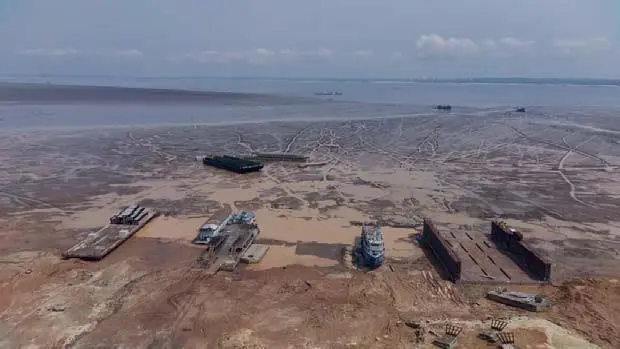
And despite the rains in Peru filling the source of the Amazon, the next two months might not be the end of the problems for Brazilian ports.
“Quite often El Nino is a 16-month phenomenon and so we are expecting similar problems will affect our port terminals around this time next year,” he told Port Strategy.
Thadani and other port users are arguing for the beefed-up dredging of the two areas of sandbanks which are causing most of the problems. They argue they need to be maintained for months to come, in order to try and avoid future crippling stoppages. As Manaus is the “No 1 destination for cabotage in Brazil” with the Santos to Manaus route alone accounting for 15 per cent of all Brazilian cabotage, it is vitally important that these ports are kept open throughout the year, no matter what the water level, contend Thadani and Juzwiak.
The National Department for Infrastructure in Brazil (DNIT), has stumped up Reais100 million (US$20.5 million) to deal with the two “problem sandbanks”, one at Tabocal (some 41km downriver from Manaus) and the other at Boca da Madeira (a further 69km downriver and close to the river port of Itacoatiara). Dredging was due to start in mid-November and works will begin simultaneously, with local dredgers, and will take up to 45 days to complete.
A manager at Chibatao, the largest box operator in Manaus with around 460,000TEU last year, said that the boxes which have been moved through the terminal through the drought period were “very few” and were loaded/unloaded via barges, some from the Bertolini company which brought older, laid up barges back into the fray to help deal with the “emergency backlog”. Chibatao also has a sister company which operates barge systems (which can usually accommodate between 70-140TEU) across the Amazonas region, and it is also plugging some of the gaps. He adds that the problem was not at Porto Chibatao, which maintained a depth of at least 16m alongside its floating piers, but at the “two choke points”, which regularly “create problems” but rarely “lead to total blockages”.
“This is the worst drought for more than 100 years,” said the manager, “and although barges have allowed some containers to get through it is difficult and time consuming to handle them via this system; this drought has really hurt our operations and bottom line.”
And its costly too, with shippers telling us that it now costs Reais42,000 (US$8,540) to move a container from Santos/Sao Paulo to Manaus (about 4200km) via the barge plus containership, compared to between Reais11,000 and Reais15,000 via container vessels for the entire voyage from the south.
Over at Super Terminais, the second terminal for boxes in Manaus (with 240,00TEU handled last year, out of the Manaus total of 702,097TEU, with Porto Chibatao handling the remainder), one vessel has been received since the drought began, MSC’s Izmir, which docked (on October 21) with only 10 per cent of its cargo capacity, and with 140 “urgent” containers for the MFTZ, and then departed with just 110. It was the first berthing since September 19 and was only possible because it was 184m long instead of the usual 220m.
FLOODS IN THE SOUTH
Meanwhile in the south of Brazil, at the Itajai Port Complex (IPC, which includes Itajai port and Portonave), the opposite meteorological obstacle to port operations has raised its ugly head; namely, flooding and currents that are too strong for ships to berth.
At the start of October heavy rains and flooding upriver, near the Germanic town of Blumenau (some 55km from Itajai), led to a sharp increase in the speed of the current in the River Itajai-Acu, making it impossible for tugs to safely berth vessels at Brazil’s second-biggest port for boxes; with around 1.35 million TEU forecast for this year.
“It has been very bad and caused the port to be closed for several weeks,” said Robert Grantham, a director of Solve Shipping consultancy and a former Commercial Director of the Itajai Port Authority. “But at least it hasn’t been as bad as November 2008 when the port itself flooded, and sections of the quay collapsed into the river.”
That led to millions of dollars of damage and weeks of inaction for the port, which was closed for several months.
Shipping lines are using other southern ports, such as Porto Itapoa to the north (near Sao Francisco do Sul) and Imbituba, to the south, but these are now becoming very congested and are not keen to take any more of the overflow as it ruins schedule integrity for the carriers.
Related Articles
 EQUIPMENT
 OPERATIONS
 OPERATIONS