![PortStrategy[GreenPort]](https://www.portstrategy.com/wp-content/uploads/2026/09/PortStrategyGreenPort.svg)


Congestion looms
The West Mediterranean port region is seeing a surge in container demand in 2024. AJ Keyes assesses the position and asks what, or indeed where, the solution might be moving forward

Container transshipment hubs in the Western Mediterranean are currently seeing a surge in throughput demand. As a result, there are growing concerns that operational congestion may soon be faced. But what has been the cause and, more importantly, what is the solution?
Despite 2023 being a challenging year for some of the major ports in this region, there was also clear momentum gained as the year progressed. Mar Chao, President of Valenciaport (PAV), stated that there was a recovery in Q4 2023, with growth of 13.1% recorded for December 2023, 18.7% in November 2023, and almost 4.4% for October 2023 against comparable months of 2022.
This upward trajectory continued into Q1 2024. According to PAV, for example, Asian traffic handled in the first three months of this current year reflected a rise of 23.3% over Q1 2023, with China the major commercial partner (with activity up by 36.4%).
Overall, Valencia’s total container port growth improved by 18% for Q1 2024 over Q1 2023. Further, if this level of activity is maintained as 2024 progresses then the total throughput for 2023 of 4.8 million TEU, will be surpassed and could then place the port perilously close to current capacity levels of around 5.9 million TEU.
Valencia is currently developing a new €2.5bn container terminal, which will be operated by Terminal Investment Ltd (TiL), the terminal arm of MSC. With a capacity of five million TEU planned, this facility will bring much needed additional space to the port, but the issue remains that it is not a solution coming in the near term – at least not soon enough if current growth levels are maintained.
Algeciras is unlikely to have space. The port has recorded an uptick of seven per cent over Q1 2023, which if continues will see potential for five million TEU being reached, placing utilisation at the port towards 90%.
Tanger Med continues to rapidly increase its total throughput, the majority of which is transshipment. At the end of 2023, AP Moller Maersk completed phase two of its one million TEU expansion at APM Terminals (APMT) MedPort Tangier, Morocco. The 18ha project brings 400m of berthing and four new remote-controlled, ship-to-shore (STS) cranes.
A timely Phase 3 of this project will reportedly be fully operational at the start of 2025 and increase total terminal capacity by a further one million TEU. So, while it offers more space, it is only valid if the capacity is not fully utilised by Maersk Line and other shipping lines are also comfortable using this facility.
QUICKLY FORGETTING 2023
Clearly there are challenges on the horizon for ports in the West Mediterranean region. Following a return to growth in the opening months of 2024, the threat of prolonged continuation of the Red Sea crisis brings challenges that need to be resolved.
However, the longer issues continue to impact the sailing routes via the Red Sea, the fear of dwindling breathing space for both shipping lines and port capacity will increase – especially for the West Mediterranean region where the ocean carriers are undertaking more transshipment to offset supply chain disruption.
To add further context, the Gibraltar Port Authority (GPA) states that around 60,000 vessels transit the straits on an annual, typical, basis. Of this vast total, GPA says that 20% of this activity are container vessels.
So, it is already a region seeing substantial shipping activity. Transshipment is by far the dominant activity at the ports of Tanger-Med and Algeciras, (i.e. in excess of 95% of total container traffic) whereas Valenica (traditionally around 55%) and Barcelona (typically 40%) are involved in hinterland traffic, but also serve a key role supporting transshipment.
Figure 1 provides an overview of the longer-term development of the key ports included in the West Mediterranean region, namely Algeciras, Barcelona and Valencia (Spain), Tanger-Med (Morocco) and Marseilles-Fos (France).
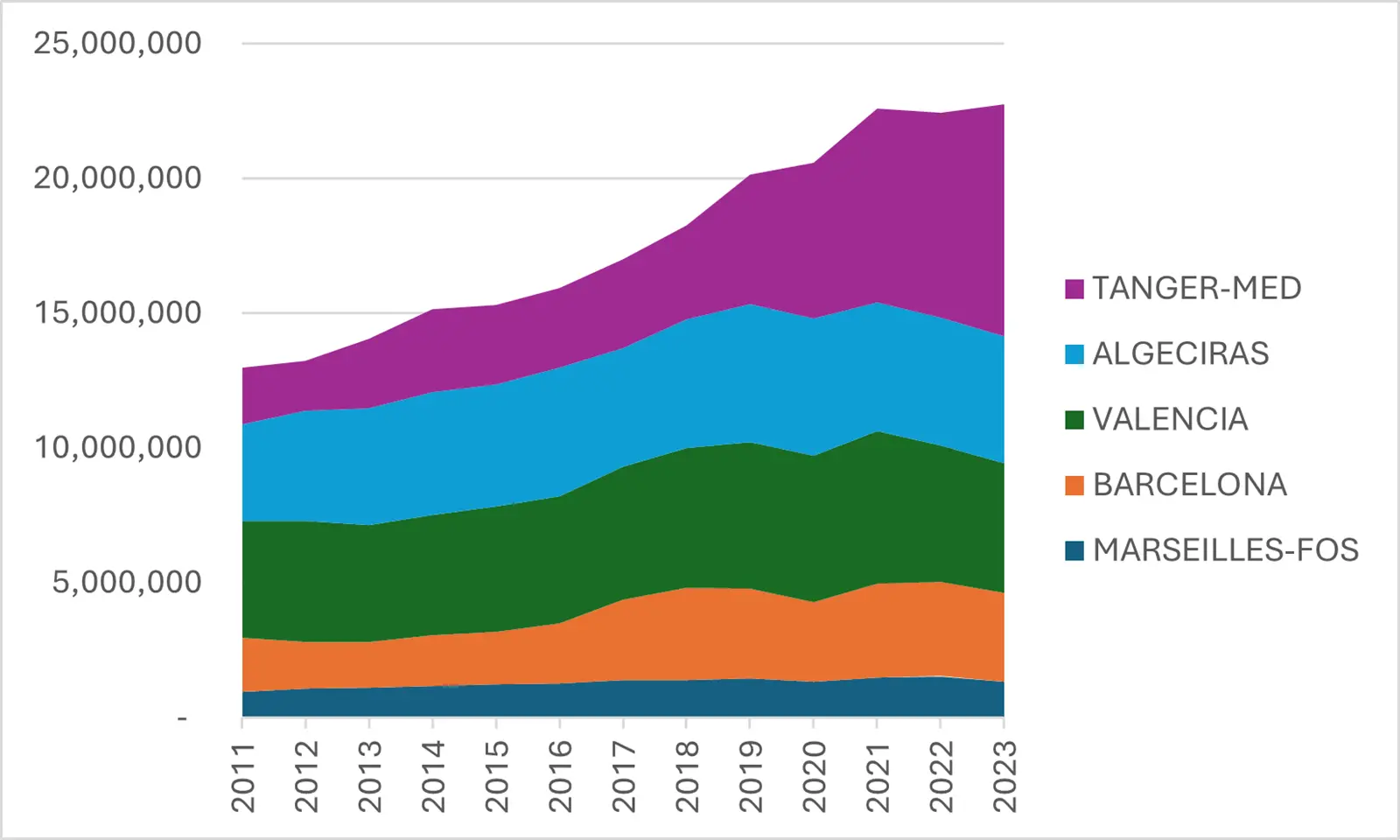
Collectively, these ports have seen total growth of 4.8% per annum, rising from 12.99 million TEU in 2011 to 27.66 million TEU by the end of 2023.
On an individual port basis, there has been widespread long-term growth amongst these listed facilities. Tanger-Med has generated growth of 12.5% per annum, rising from 2.09 million TEU (2011) to 8.62 million TEU (2023). This makes the Moroccan port not only the fastest growing container facility in the West Mediterranean area, but also the largest in terms of volumes handled – and by some considerable margin in 2023. Increases at the other facilities ranged from 0.9% per annum (Valencia) to 4.1% (Barcelona), showing that every port continues to increase volumes.
For 2023, Tanger Med reported that growth over 2022 was up by 13.4% (to 8.62 million TEU) and was “equivalent to 95% of the port’s nominal capacity……accomplished four years ahead of targets.”
In its annual performance summary, the port adds: “The outstanding performance is attributed to the successful operations of terminals TC1 and TC4, managed by Maersk-APM, and the continuous development of terminal TC3, operated by Tanger Alliance (A joint venture owned by Marsa Maroc with a 50% stake, in partnership with Eurogate holding 40% and Hapag Lloyd holding 10%).”
UNFAVOURABLE COMPARISON?
So, Tanger Med has had a strong 2023 compared to other regional facilities. Container throughput at the Port of Barcelona reached 3.3 million TEU in 2023, representing a drop of seven per cent compared to 2022.
However, José Alberto Carbonell, General Manager of the Port of Barcelona, feels that there is a need to better understand the unique circumstances when explaining performance last year: “The Port of Barcelona’s throughput (in 2023) was a result of a complex international context, with an increasing number of geopolitical conflicts, low European demand and a significant cooling down of exports, in addition to the unfavourable comparison with 2022, during which we broke traffic records.”
This is a valid point, especially in the wake of transshipment activity rebounding for the port in Q1 2024. For example, in February and March 2024, Barcelona has seen container volumes of this type increase by more than 60% compared to the comparable months of 2023. This level of growth being maintained during 2024 will place pressure on existing capacity at the port, with as much as 500,000 TEU of capacity potentially needed before the end of the current year.
Clearly, things have changed very quickly in the West Mediterranean port region.
HISTORY REPEATING ITSELF?
With a potential capacity crunch looming in the near future, and before known expansion projections come to fruition, is a return to using the Port of Malaga an option, or indeed the short-term solution?
The port has the space available; it has infrastructure and deep water because it was originally developed as a regional transshipment option, handling almost 550,000 TEU in 2008.
The port was also used by Maersk Line, until Tanger Med became an option and the shipping line gained access to its own facilities in a location immediately on major shipping routes.
How long will the Red Sea crisis last? Who knows. When the situation first occurred, sailing around Africa was an opportunity for some of the major container shipping lines to deploy available tonnage, but now the challenge is more one of finding spare container port capacity, especially for transshipment activities. For the short-term, at least, Malaga may be the congestion buster.
Related Articles
 EQUIPMENT
 OPERATIONS
 OPERATIONS