![PortStrategy[GreenPort]](https://www.portstrategy.com/wp-content/uploads/2026/09/PortStrategyGreenPort.svg)






Electric and green goals
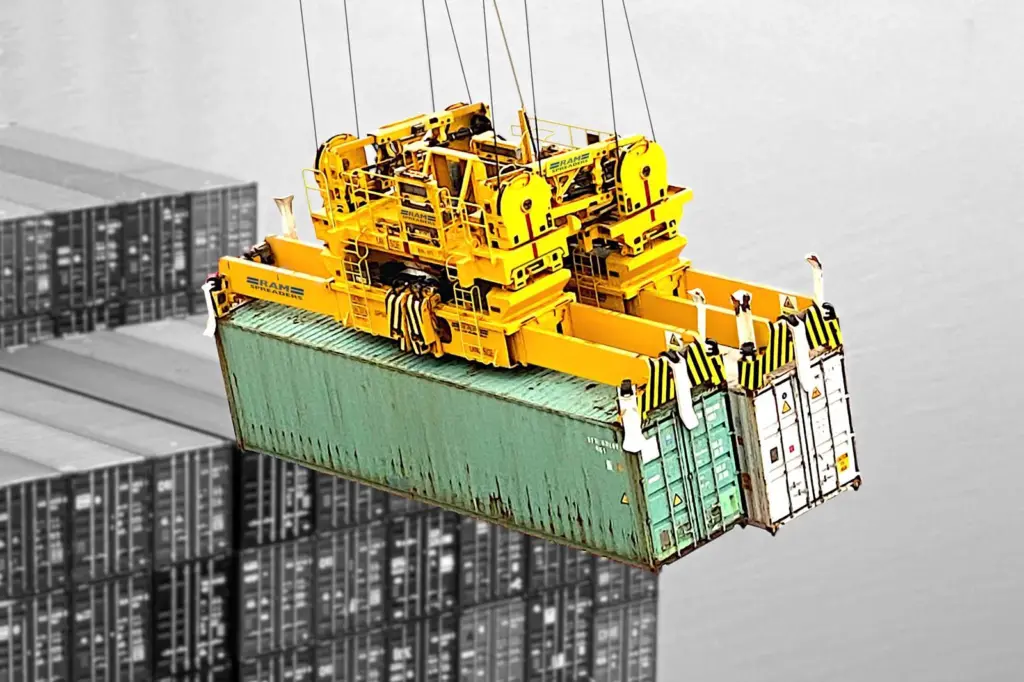
SECTOR ANALYSIS: ENERGY EFFICIENCY AND PRODUCTIVITY DRIVE TELESCOPIC SPREADER DEVELOPMENT
Increasing energy efficiency and being more environmentally friendly are key drivers behind recent developments in the telescopic spreader market.
Pieter Verdonschot, Product Manager, VDL Container Systems, highlights: We see ports looking for more energy efficiency as well as more environmentally friendly solutions. This results in more purchases of electric spreaders and hybrid spreaders but also in replacement of old equipment which is not fulfilling the latest standards when it comes to energy efficiency”.
The use of electric and hybrid spreaders also helps meet the aim of boosting terminal productivity, with less downtime and maintenance required. Other innovations, identified in the company reviews below, including the reduction of spreader weight and increased telescoping and twin separating speeds, also aim to increase productivity.
Meanwhile, the trend to use tandem spreaders has gained momentum due to the iof 40ft containers. RAM Spreaders notes: “The transition from single to twin and now twin to tandem is taking off.” With many major terminals having ordered or planning to order such systems, RAM says this is a “clear indication that tandem lift will soon become the new norm in container handling.”
ELECTRIFICATION, NEW MODELS, DESIGN INNOVATION
ELME Spreader: ELME has launched its new generation of spreaders under the umbrella title of ‘Innovation’ – they are aimed at adapting to what the manufacturer calls the ‘harsh’ conditions of container handling. The company’s latest models in this range include the ELME Spreader Model 857 INNOVATION, announced in May this year. This top lift spreader for the handling of laden ISO containers and trailers weighing up to 45 tonnes is designed for use with reach stackers. Two parallel telescopic beams assure maximum overlap. Telescoping is powered by one hydraulic cylinder for each end beam and side-shift is executed by one hydraulic cylinder. Rotation is done by a slewing ring with double transmissions for turning and brakes for holding. ELME also unveiled its 818 INNOVATION model in April this year, which is designed for use under a gantry at the front of a lift truck. The company states that: “Gantry mounting is used for lift trucks, dedicated to container handling only.” And that: “Compared to fork mounting, the system increases the residual capacity of the truck and is thus a more economical solution.” Four telescopic hangers connect the spreader to the gantry. Gravity assures the level position of the spreader. The hangers will allow the spreader to automatically adapt to containers on trailers or on uneven ground. Telescoping is powered by one hydraulic cylinder for each end beam. At the heart of both models is increased structural strength and reduced weight, with an estimated increased life expectancy of 30 per cent related to fatigue resistance and standard load case conditions. For the 857 model, the reduced weight of the spreader makes it possible to increase the lifting capacity in second and third container row operations.
Bromma: Bromma has launched an all-electric ship to shore (STS) spreader, which aims to assist terminal operators reach environmental goals as well as boost productivity, efficiency and flexibility. The company says that its STS45E G2 PLUS all-electric spreader, released in 2022, is the fastest in the market. “Our spreader easily achieves accurate positioning when telescoping due to increased telescoping and twin separating speed,” Bromma says. Further, the company says that eliminating spreader hydraulics reduces power consumption by up to 90 per cent. The company says that when comparing an all-electric STS spreader to its hydraulic alternative, it consumes less energy during its operation. When idling, it consumes almost no energy at all. Bromma has launched more solutions this year, including its Bromma Height Indication System (HIS). Based on ultrasonic sensors, the system measures the distance between the spreader and the container, providing real-time signals to the crane operator to decelerate and avoid hard landings on containers.
Recent take-up: Bromma has supplied Long Beach Container Terminal with six units of its all-electric twin lift STS spreaders as the terminal aims to hit its environmental targets.
VDL Container Systems: Having delivered its first fully electric telescopic spreaders around 15 years ago, VDL Container Systems has boosted the development of its hybrid and electric powered solutions. This includes its Hybrid Piggyback Spreader in Künz cranes. On such a spreader the telescopic movement, twistlocks and flippers are powered electrically and only the piggyback system is powered hydraulically. Pieter Verdonschot, Product Manager, VDL Container Systems, notes: “When in container mode all benefits of an electric spreader are applicable (less energy consumption, noise production, wear and tear and maintenance required).” In total four such spreaders have been supplied to several terminals in Austria and Germany. Elsewhere, the company has developed its Hybrid Flipper to combat the vulnerability of flippers on fully electric telescopic spreaders. Pieter Verdonschot explains: “To absorb the high impacts flippers have to withstand without using hydraulics has proven to be very difficult.” Therefore, the company launched a Hybrid Flipper, where an electric motor powers a closed loop hydraulic system. The amount of hydraulic oil is similar or less compared to the gearbox oil in a mechanical gearbox, but the torque it can produce and withstand is far more than a mechanical gearbox can withstand. Since the first delivery five years ago, some further improvements have been made to the patented design.
Recent take-up: VDL Container Systems has recently delivered a range of new and replacement spreaders. Its fully electric rotating spreaders have recently been delivered to Chemion Dormagen and Klumpp & Müller in Germany in Künz cranes.
RAM Spreaders: RAM Spreaders has seen more tandem headblock systems on its orderbook from existing European customers wishing to expand their container handling operations. It notes that 190 of its single hoist tandem units are either on order or have been delivered. The RAM SingFlex tandem system, with its clever docking station, enables the crane operator to change between spreaders in less than two minutes without manual intervention. RAM says: “Its versatility in adjusting skew, longitudinal offset, and the gap between containers makes it an ideal choice for container terminals wanting to expand without the need to invest in dual hoist cranes.” The growing trend for tandem operations has been driven by the container trade increasingly shifting from 20ft to 40ft containers, which has reduced crane rates in terminals. Tandem systems combat this issue, with RAM noting these operations can reduce vessel stays by up to 40 per cent, with average loading rates of upwards of 150 TEUs an hour being achieved by customers.
RAM has recently launched its Universal Pipe Handling Spreader. This specialised telescopic spreader can handle up to three pipes between 11.8 to 12.7 metres in length using telescopic beams that latch onto the pipes. The telescopic beams also adjust transversely to accommodate different diameter pipes. All functions of the pipe spreader are done by remote control, with a diagnostic panel on the spreader providing spreader status, fault-finding and troubleshooting information.
Recent take-up: Port of Massawa in Eritrea, East Africa, has invested in RAM’s twinlift telescopic mobile harbour crane spreaders. RAM says that this is because its MHC spreader can withstand the rigours of a dusty and harsh environment, with ease of maintenance and minimal lubrication required. It uses fewer moving parts than a conventional sliding pyramid system.
Barlow Technolog/Inamer: DP World Southampton has started trialling Flexi-Flippers on its STS cranes – with initial reports said to be very encouraging. Barlow Technology, which supplied the Inamer-manufactured product, predicts that the “success of the problem-solving solution shall pave the way for a time-saving, cost-efficient, high performance product for the UK’s ports industry”. The product is already in use in a number of terminals throughout Europe. Barlow Technology says that by replacing traditional spreader flipper arms on cranes, the Flexi-Flipper can be easily adapted to achieve the correct combination of rigidity and cushioning. Advantages include reducing the number of fins that need to be repaired annually, while the structure of the spreader is preserved with the flexi-flipper’s adaptability to varying load requirements, saving on lost hours and down-time, while also being safer for crane operators.
Stinis: Stinis has launched a version of its Long Twin spreader for STS cranes and straddle carrier operations, for mobile harbour cranes. The company’s Long Twin Spreader has a telescoping system for adjusting the gap between two 20ft containers. Stinis explains: “The new spreader combines the proven concept of the separating STS Long-Twin with a new centre of gravity adjustment system.” In the new design, the tower slides atop the spreader and in this way compensates for a weight difference of up to 15 tonnes between the two containers. The company adds that the height of the total two-piece system is not more than 100mm higher than a normal twin mobile harbour crane spreader.
Recent take-up: The first unit was delivered to Montecon S.A., in Montevideo in Uruguay in September 2021. It is estimated that the Stinis Long-Twin brings a 10 per cent productivity increase to operations, due to various positive factors including the separating long-twin mechanism and the high torque flippers.
Related Articles
 EQUIPMENT
 OPERATIONS
 OPERATIONS