![PortStrategy[GreenPort]](https://www.portstrategy.com/wp-content/uploads/2026/09/PortStrategyGreenPort.svg)

Energy transition ambitions
With the green light given to the Acorn carbon capture, usage and storage project and with opportunities building in conjunction with offshore wind Peterhead Port plans to be a key player in energy transition. Felicity Landon sets the scene
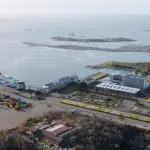
Half a century ago, the north-east Scotland Port of Peterhead responded quickly to the emergence of the North Sea oil & gas industry – and it has been a vital offshore support hub ever since.
However, notwithstanding UK Prime Minister Rishi Sunak’s announcement of 100 new drilling licences, it’s clear that the drive for Net Zero together with economic viability questions around extracting from some remaining reserves means that production in the North Sea is set to decline.
Peterhead remains the UK’s largest fishing port and market – stocks have recovered, and landings and sales are at record highs. Fishing accounts for more than half of the port’s business. North Sea oil & gas production is not disappearing overnight but increasingly, something else will have to fill the oil & gas gap. And so, Peterhead Port Authority is set in a new direction – energy transition.
The port authority commissioned Royal HaskoningDHV to carry out a study into how Peterhead can be adapted and scaled up as a multi-sector port.
In April this year, more than 200 people attended ‘Peterhead Port: Embracing the Energy Transition Opportunity’, a day of presentations and discussions that focused on oil & gas decommissioning, offshore wind and renewables, carbon capture and storage, green hydrogen, and skills and employability.
REBOOTED
The Peterhead Energy Transition Forum was rebooted as a result – pulling together 12 local supply chain companies, it is coordinated by the port authority’s Keith Mackie, Head of Business Development – Energy Transition.
“Peterhead certainly has a role to play in the UK’s decarbonisation,” says Simon Brebner, CEO, Peterhead Port Authority. “Aberdeenshire Council is 100 per cent supportive of the road we are forging and is a very close and valued partner.”
Welcoming government approval of the carbon capture project, he states: “We’re delighted that, finally, after many false dawns and a significant time delay, the Acorn project and the wider Scottish Cluster will now be able to get to work and help the country reach Net Zero.
“This is the opportunity for the north-east of Scotland – including the critical facilities at Peterhead Port – to lead the world in this new and innovative technology. Others have been catching up fast, but we have the skills, expertise and ingenuity to lead the field globally.”
Based at St Fergus, the Acorn CCUS scheme will be critical if the UK is to reach its net zero targets by 2050, he underlines.
Part of a Scottish-wide cluster, the scheme would take emissions from the industrial heartland around Scotland’s Central Belt, including petrochemicals in Grangemouth, and from Peterhead Power Station, recognised as the biggest industrial polluter in Scotland.
When the St Fergus facility has been built, it will be able to receive CO2 by land, pipeline or sea – opening access to industrial clusters elsewhere. The plan sees the Port of Peterhead handling shipments of CO2 from around the UK coast and also mainland Europe. From St Fergus, CO2 will be pumped permanently into depleted reservoirs 1.5 miles under the North Sea, making use of redundant oil & gas pipelines and equipment. The scheme includes proposals for local production of hydrogen and other low-carbon technologies.
At Peterhead, the project is expected to make use of the former oil jetty on the southern side of the harbour, to accommodate CO2 vessels of up to 250 metres in length.
OFFSHORE WIND BOOM
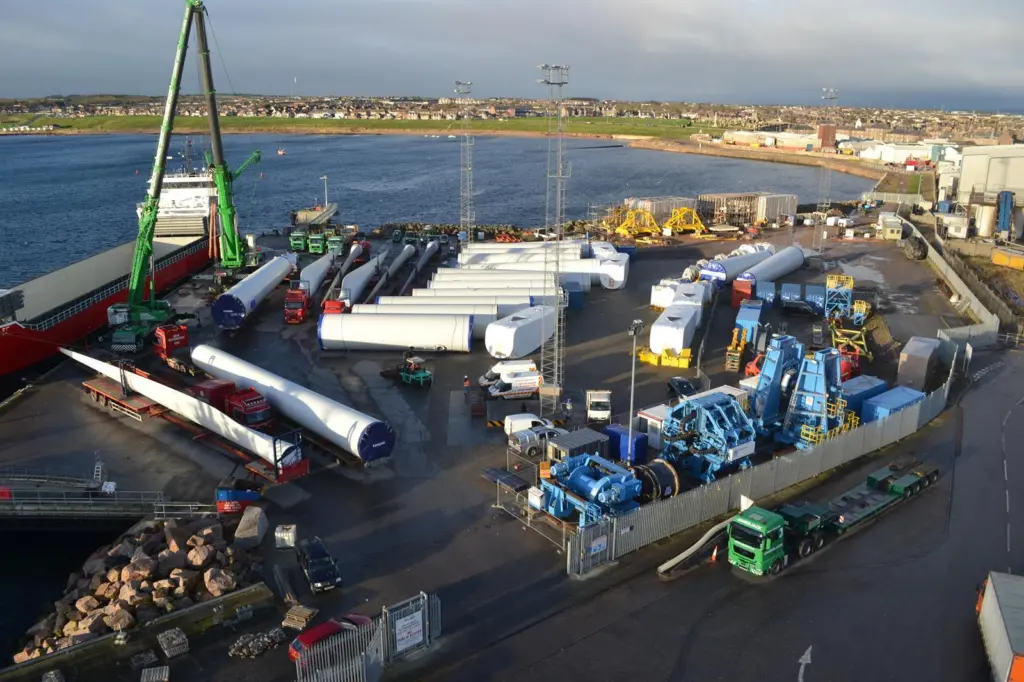
Meanwhile, the port is preparing for an offshore wind farm construction boom. The port has already built its experience supporting Equinor’s Hywind project, the first floating wind farm in the world, as well as the Moray East offshore wind farm. Many of the skills built up in serving the oil & gas sector are readily transferable to renewables.
Scotland’s latest round of INTOG (Innovation and Targeted Oil and Gas) offshore wind leases offers huge opportunities.
“When you look at the map for INTOG, for construction and O&M in the future, our ideal location is obvious,” points out Stephen Paterson, Chief financial officer, Peterhead Port Authority. “It is the same reasons that Peterhead developed to serve the oil & gas industry – our strategic location is worth a lot in terms of saving time, fuel, vessel costs and promoting overall efficiency.”
Peterhead has pushed hard to get to this point. In July, Brebner was among a delegation of energy sector leaders who attended a business summit hosted by local MP David Duguid in the House of Commons to discuss the challenges and opportunities that the energy transition can bring to the north-east of Scotland. Also attending was Stuart Payne, CEO of the North Sea Transition Authority, who noted: the scale of the prize with the energy transition is huge, and Peterhead can help to deliver it.
Related Articles
 EQUIPMENT
 OPERATIONS
 OPERATIONS