![PortStrategy[GreenPort]](https://www.portstrategy.com/wp-content/uploads/2026/09/PortStrategyGreenPort.svg)





EXCLUSIVE: How 5G is transforming port connectivity
The rapid growth in global trade has put increased pressure on ports to operate more efficiently and effectively. With the emergence of 5G technology, there is now a solution that promises to revolutionise optimise connectivity, streamline cargo handling and enhance port automation.
A recent webinar hosted by Mercator Media, featuring experts from Nokia and Verizon, delved into how 5G could reshape port operations and help port operators face the complex challenges of modern shipping.
The session provided critical insights into the future of port connectivity and automation, showcasing real-world examples and lessons for industry professionals.
5G to transform business
The webinar featured two key speakers: Myriam Fatene, Segment Specialist Director at Nokia and Mehdi Quraishi, director of 5G, Edge Solutions, and Innovation at Verizon Business Group.
Both experts spoke in detail about the opportunities 5G technology presents, especially in simplifying and optimizing port operations for what is now being called ‘Port 4.0’.
One of the key takeaways from the webinar was the importance of a measured approach when adopting 5G. The speakers emphasised that although 5G technology has the potential to transform port operations, it’s crucial to start with small projects and scale them up as needed, rather than attempting a full-scale transformation all at once.
“Start small and build on it rather than going for a ’Big Bang’ approach,” said Myriam, who explained that digital transformation should be tailored to each port’s specific needs, allowing for flexibility and growth.
Myriam highlighted the complexities of terminal operations, describing ports as highly mobile and often dangerous environments.
“Today’s supply chains demand greater agility and faster turnaround times,” she noted, which is why there is an increasing need for improved connectivity and automation.
She explained that 5G technology, when paired with private wireless networks, has the capacity to deliver the high-reliability, low-latency connectivity essential for port operations.
Myriam also elaborated on the wide range of digital applications that can benefit from a robust 5G network, including augmented and mixed reality for workers, drone-based surveillance of terminal operations and enhanced asset tracking capabilities.
The loss of visibility over assets, such as containers with valuable or hazardous contents, is a significant challenge for port operators. 5G-enabled asset tracking solutions can provide real-time visibility, preventing costly delays and improving productivity.
Myriam further discussed how digital transformation can be simplified by consolidating multiple digital applications into a single secure wireless network. This “digital foundation,” as she termed it, allows for productivity gains and the introduction of new technologies, such as drones for surveillance and automated container management systems, all running smoothly on a 5G-enabled network.
Case Study: ABP Southampton
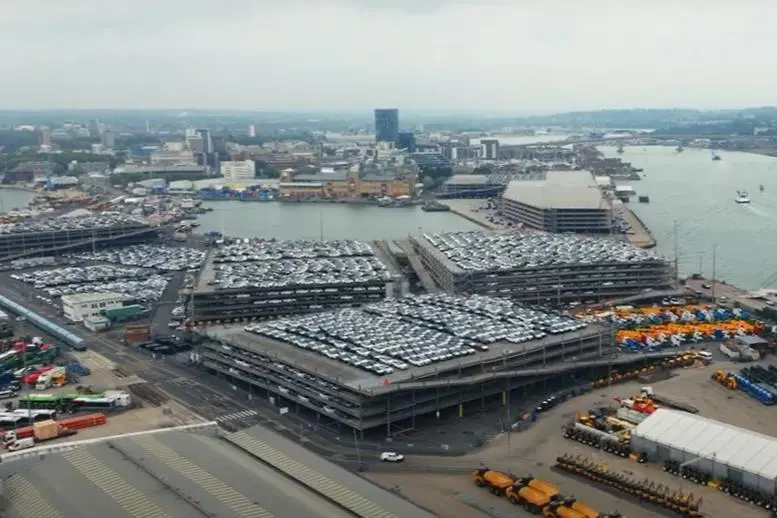
The discussion was brought to life with a case study of the Associated British Ports (ABP) at Southampton, where 5G technology has been instrumental in addressing connectivity challenges and improving operational efficiency.
Mehdi Quraishi from Verizon Business Group shared how ABP, one of the busiest ports in the UK, faced issues with limited connectivity in remote areas, making it difficult to implement automated data capture and processing. Moreover, as a high-volume port, ABP needed to enhance its agility and implement semi-automated processes to address supply chain bottlenecks.
Verizon worked closely with ABP to deploy a private 5G network that provided faster, more reliable, and secure connectivity across key operational areas.
According to Mehdi, “As ports become increasingly vital in the global supply chain, the need for faster, more reliable and secure connectivity is more important than ever.”
He explained that the private 5G network offered ABP the control and flexibility it needed to integrate advanced technologies like computer vision, drones, and AI, all of which play a key role in port automation and cargo handling.
By using 5G, ABP Southampton was able to improve its processes across transportation, logistics and supply chain management, resulting in significant productivity boosts. The reduction in the number of access points required to maintain network connectivity also resulted in substantial cost savings for the port.
Wi-Fi vs 5G
One of the key questions during the webinar focused on the pros and cons of 5G versus Wi-Fi.
While Wi-Fi is commonly used in ports today, it presents numerous challenges when it comes to scalability and mobility. As Mehdi pointed out, Wi-Fi networks require a much larger number of access points to cover the same area as a private 5G network and Wi-Fi often experiences interference that can lead to unreliable connections.
For ports starting out with digitalisation, Wi-Fi might be sufficient for small-scale use cases, but as operations expand, the need for a more robust and scalable solution becomes apparent.
Mehdi explained that 5G’s low latency and high reliability make it an ideal choice for critical port operations, particularly those involving automated equipment like cranes and drones, which cannot function efficiently on Wi-Fi networks due to frequent signal handovers and the risk of connection drops.
He cited an example of a UK port that had over 200 Wi-Fi access points, which were replaced by just seven 5G access points, significantly reducing costs and improving network performance.
This transition also allowed the port to explore new automation technologies such as computer vision and machine learning, which are essential for optimising cargo handling and meeting sustainability goals.
As ports evolve towards more automated and data-driven operations, the role of 5G technology becomes even more crucial. Both speakers emphasised the importance of 5G in enabling automation and improving situational awareness, which in turn leads to more efficient cargo handling and improved safety.
Mehdi discussed how 5G allows for the real-time collection and analysis of data, which can be used to enhance decision-making processes and minimise accidents.
In terms of sustainability, 5G plays a key role in reducing emissions by improving operational efficiency and minimizing idle times. With more ports aiming to meet ambitious sustainability targets, 5G enables the deployment of automation technologies that help reduce energy consumption and lower emissions across the supply chain.
Start Small, scale smart
One of the concluding messages from both speakers was the importance of starting small and scaling smartly. For port operators looking to embrace 5G and digital transformation, it’s essential to identify the key areas where connectivity and automation will have the most impact and then build on that foundation.
“You need to start small,” said Myriam, “and have an infrastructure that can scale.” By focusing on a few critical use cases and demonstrating quick wins, ports can build a strong foundation for future innovation.
Ports of all sizes can benefit from 5G technology, but it’s important to adopt a phased approach to digital transformation. By leveraging 5G’s high-speed connectivity and scalability, ports can gradually expand their automation capabilities and integrate new technologies like AI, IoT and drones.
As the webinar demonstrated, 5G technology holds the key to unlocking the full potential of port automation and optimising cargo handling for the future.
For ports around the world, the path forward is clear: Start small, focus on key use cases and scale up as needed. The future of port connectivity is 5G and the time to start preparing for it is now.
Related Articles
 EQUIPMENT
 OPERATIONS
 OPERATIONS