![PortStrategy[GreenPort]](https://www.portstrategy.com/wp-content/uploads/2026/09/PortStrategyGreenPort.svg)




Humber hosts Coastlink
May this year will see the Coastlink Conference staged in conjunction with Associated British Ports, in the dynamic environment of the Humber on the UK’s East Coast
Associated British Ports (ABP), the UK’s largest port operator, is balancing two parallel development priorities: maintaining the efficient flow of goods through its gateways while preparing the infrastructure required for decarbonised energy systems and cleaner shipping.
Across the Humber cluster, these objectives are underpinning new terminal development, alternative fuel capability, shore power provision and promoting supply chain efficiency.
“ABP has two clear missions now. Historically it was one mission to keep Britain trading, but now we’re playing a large role in supporting and enabling the energy transition,” says Andrew Dawes, Regional Director, Humber, ABP.
“Ninety per cent of UK trade travels by sea and the Humber alone represents 17% of UK seaborne trade, so we have a significant impact on critical infrastructure nationally,” he emphasises.
The Humber region, centred around the Humber estuary in Northern England, is a major industrial and logistics hub which over the years has progressively extended its hinterland reach in the UK and grown its maritime connections. Associated British Ports (ABP) owns and operates four main ports in the Humber region – Hull, Immingham, Grimsby, and Goole—which together form the UK’s busiest trading estuary. ABP’s Humber facilities are a major hub for energy, containers, and roll-on/roll-off (ro-ro) cargo, supporting 34,900 jobs and handling 52 million tonnes of cargo annually.
ABP will host the acclaimed Coastlink Conference which will take place May 6 to 7, 2026 in Hull. The conference promotes debate on the challenges and opportunities shaping the industry, whilst enabling conference delegates and participants to establish and build on relationships through the networking opportunities on offer. It is a place for industry professionals to meet and discuss future innovation, economic and environmental considerations in shipping, port and logistics operations– and develop partnerships that will help build a sustainable future.
The Humber location has been chosen because of its dynamic recent and planned investment environment which will present many interesting lessons and opportunities to the delegate body
FORWARD-THINKING
The Humber’s role in handling everything from hydrocarbons and biomass to foodstuffs, timber and construction materials provides the foundation on which new initiatives are being built, ensuring both continuity and transformation across ABP’s port estates and operations.
Historically, the Humber developed around shortsea links with northern Europe, particularly Scandinavia and those routes continue to shape its commercial profile. Timber, agricultural products and unitised cargo remain central to daily operations.
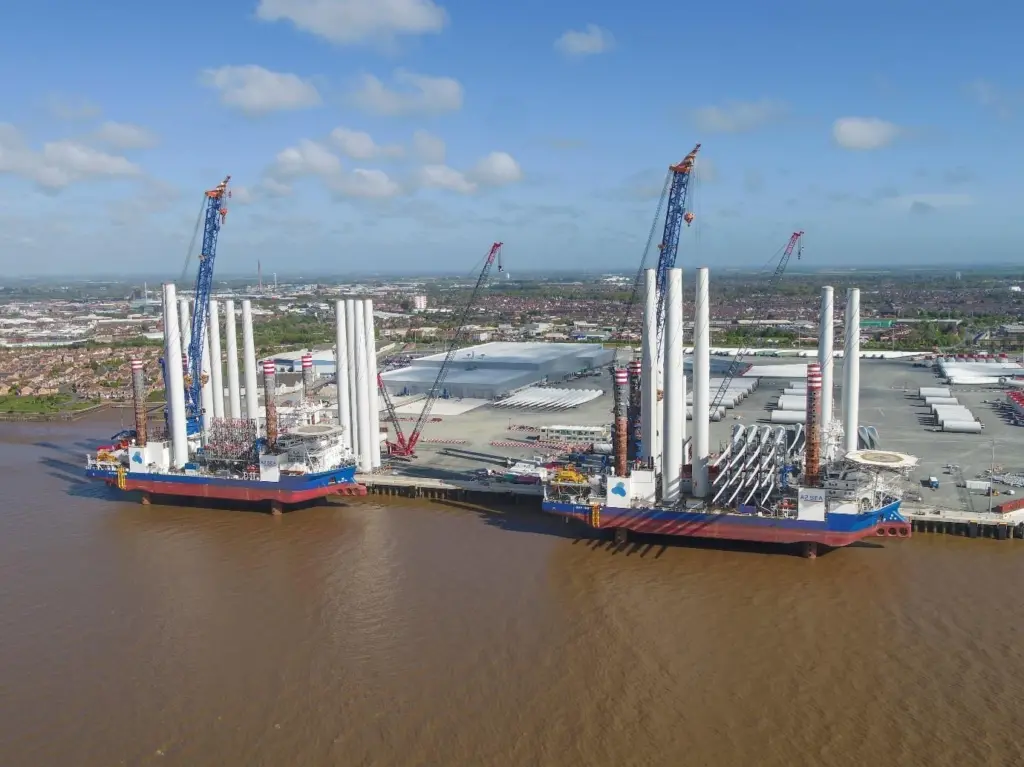
ABP’s ports have become increasingly involved in supporting Britain’s future energy requirements, including biomass for power generation and offshore wind system manufacturing.
Dawes notes that the energy transition is already embedded in port activity rather than simply being a future objective.
“People often say to me ‘that’s a future thing that’s not happening’, but we work with our partners and all stakeholders to accelerate the transition.” Green Port Hull,” for example, “was successfully established and Siemens has become one of the leading offshore blade manufacturers.”
“Overall,” explains Dawes, “the Humber serves eight operational offshore wind farms supplying 4.9GW of clean energy to British homes and businesses and a pipeline of projects including the wind farms Hornsea 3 and 4.
The Humber strategy mirrors ABP’s national position: maintain Britain’s trading capacity while creating the conditions needed for new, lower-carbon industries.
CLEAN ENERGY INFRASTRUCTURE
Preparing for shipping’s energy transition is a big factor in ABP Humber’s planning activity.
The ports are examining how best to provide shore-based infrastructure that supports fleet decarbonisation, including shore power connections, alternative bunkering and facilities to receive and distribute new fuels such as hydrogen and ammonia.
“As shipping routes look to decarbonise we are supporting enablement on site, so shore-based support for electrification and shore power, bunkering of new fuel types and the receival and distribution of these new fuels,” says Dawes.
“We need to be ahead of the game,” he continues “and be at the forefront of creating new infrastructure for these requirements with third-party providers working alongside us.”
In parallel, the Humber is positioning itself for emerging carbon capture and storage opportunities, including the potential for captured carbon imports and storage beneath the North Sea.
These projects, Dawes suggests, could create entirely new cargo categories while strengthening the UK’s industrial decarbonisation pathway.
INDUSTRIAL CLUSTER FOCUS
The Humber’s concentration of heavy industry makes it central to national emissions reduction targets.
Dawes describes the Humber as the UK’s largest carbon-emitting industrial cluster and argues that meaningful progress in dacarbonisation cannot occur without transformation there first.
“If we’re going to support the UK’s ambition to decarbonise industry, we can’t decarbonise the UK without focusing on the Humber area. Carbon capture and storage with partners will enable that step change of carbon reduction, with carbon being piped and stored under the North Sea,” he says.
Current projects for ABP include working with Air Products on infrastructure to import green ammonia for hydrogen production and distribution, alongside the Viking CCS pipeline initiative.
At the same time, the port manager and operator is reducing its own operational footprint through additional solar installations, wind turbine usage and targeted investment in cleaner energy across its facilities.

SHORTSEA IS CORE
While energy transition projects are in growth mode, shortsea shipping continues to anchor the Humber’s commercial model.
Services linking the UK with continental Europe handle large volumes of roll-on/roll-off traffic, containers and other unitised cargo. These trades have long formed the backbone of the Humber ports’ activity and remain a major source of growth.
Dawes emphasises the scale of these operations, noting that throughput in the area can rival that of larger deep-sea gateways.
“We’ve serviced this market for hundreds of years. Shortsea services are a predominant market for us, whether it be timber or ro-ro and we also have container vessels that are typically shortsea,” says Dawes.
“Just one of our customers here handles a million TEU equivalents and if we add that to the figure for unitised cargo, we handle a significant part of European shortsea trade.”
Changing trade agreements and shifting cargo flows are expected to create further opportunities for these routes.
The Humber ports are seen as an enabling platform, providing the infrastructure that allows operators to adjust capacity and services quickly to cater for future needs.
SUPPLY CHAIN EMPHASIS
Improving supply chain efficiency is central to ABP Humber’s shortsea strategy.
Terminal upgrades, berth enhancements and landside improvements are being developed in partnership with operators including Stena and DFDS, enabling larger vessels and smoother cargo handling.
“When we look to upgrade and drive efficiency and facilitate larger ship calls, we have investment plans alongside our partners for new rail-road terminals that will facilitate them bringing in bigger vessels, delivering supply chain efficiency to stakeholders and to the market overall,” Dawes says. The focus is on reducing system friction points, shortening dwell times and strengthening reliability across the logistics chain.
By expanding capacity and modernising assets, ABP aims to ensure the Humber remains competitive as vessel sizes increase and operators seek greater economies of scale.
PORT-CENTRIC LOGISTICS
Complementing shortsea quay infrastructure development, the strategy extends into the development of adjacent land and logistics space.
ABP is working to attract processing, storage and distribution activities directly onto port estates, particularly within the food and cold chain sectors where ageing infrastructure elsewhere in the UK presents opportunities for business development.
“If we can do that in a tax efficient zone, achieve consolidation and economies of scale at a port location with access to green energy, we would look to further decarbonise that supply chain, notably with food processing and construction on a tax efficient site at the location where the goods are entering and exiting the UK,” notes Dawes.
Co-location reduces inland transport, improves energy performance and shortens supply chains, creating efficiencies for both operators and cargo owners.
The approach also reinforces the Humber’s role as an integrated logistics hub rather than simply a maritime gateway.
SHOWCASING THE HUMBER
Humber related developments and key international issues and projects will be in the spotlight when ABP hosts the Coastlink Conference, May 6-7, Port developments, operations, logistics, road and rail operations, shipping developments and so on will all be discussed in-depth as well the key activities and opportunities associated with shaping an environmentally friendly future.
Dawes states the event offers an opportunity to highlight both the Humber ports’ heritage and their ongoing transformation.
“We’ve got a lot to showcase, both from our historic ability to service and our upcoming uplift of infrastructure. We’re deploying hundreds of millions in new infrastructure that will drive supply chain efficiency and it’s not just for UK goods.”
“We’re geographically blessed by our location and our serviceable market and we’re looking to share that,” he says.
The conference will provide a platform to engage with partners and identify further opportunities for collaboration.
“We’re not only investing for ABP, we are investing as part of our role in supporting Britain’s trade, ensuring our UK exports get to market cost effectively working with our trading partners around the world,” he adds.
Generally, Dawes, sees the Humber’s future as combining dependable trade handling with forward-looking investment.
“The Humber’s history is rich, but that forward-looking part of port development is the most exciting. It’s a great opportunity to have this chance to showcase what we’re doing and where our investments are supporting Britain’s efficient trade and equally important the energy transformation.”
Full programme and other details are available from https//www.portstrategy.com/coastlink – A 15% discount Early Bird rate is currently available -Use code CLKEARLYPREM for a premium delegate place or, CLKEARLY for a standard delegate place.
Related Articles
 EQUIPMENT
 OPERATIONS
 OPERATIONS