![PortStrategy[GreenPort]](https://www.portstrategy.com/wp-content/uploads/2026/09/PortStrategyGreenPort.svg)



OCR: The ‘science fiction’ age
The adoption of Optical Character Recognition (OCR) technology in ports continues to grow…
SECTOR ANALYSIS: OCR GETS SOPHISTICATED
The adoption of Optical Character Recognition (OCR) technology in ports continues to grow – expanding way beyond basic, obvious applications such as container recognition at the gate. Increasingly being deployed as part of far more sophisticated solutions, across a far wider range of port equipment, and in tandem with AI, machine learning and automation, OCR is playing a key role in speed and efficiency of container handling operations, tracking and tracing of boxes, and damage detection and reporting. The companies referenced below all responded to a recent PS sector survey. Felicity Landon reports
ABB Ports
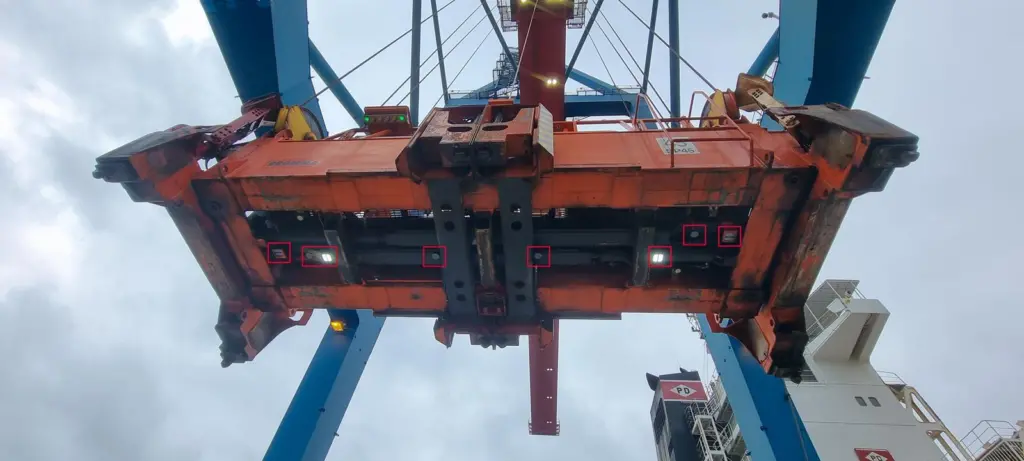
OCR is used in gate, crane and rail applications to capture the ID numbers on containers, trailers, chassis plates and truck licence plates, in associated container terminal operations at gates and during load and discharge operations. “Together with advanced imaging processing capabilities, ABB’s OCR systems also enable automated identification of container features such as bolt seal detection, IMDG labels and classification, door direction, twist locks and damage detection,” says Shalev Cohen.
“Automation provides terminals with insights in near real-time, so they can detect and manage exceptions immediately. This allows them to process trucks and ships faster and improve productivity throughout the terminal. Automating manual processes also allows the relocation of personnel from the gate lanes, quay and yards into the safety and comfort of a centralised, remote office workspace.”
ABB says the use of AI technology makes its OCR systems even more powerful; its AI technology-enabled systems are more robust to different conditions, providing higher accuracy more rapidly, leading to less manual intervention and higher performance for the terminal. The system also keeps records of data which can be analysed to improve operations over time.
A recent addition to ABB’s portfolio is the QuayPro module, which confirms the stowage position of containers on a vessel during vessel loading and discharge operations, allowing the terminal to streamline the stowage process automatically. Complementing the automation of container ID and features recognition, QuayPro provides a concurrent dashboard view of vessel operation and highlights any deviations from the load/discharge plan. “The ability to provide a real-time display of dynamic work instructions to the crane driver, updated based on pre-determined swap load rules to automate loading locations of out-of-sequence containers, is a key to increasing productivity and results in less crane stoppage time and unnecessary crane moves.”
CERTUS Automation
The adoption of OCR technology in ports continues to grow, says Chantal Mooij, Marketing Department, Certus and points out the company has recently seen an increase in the application of OCR on yard cranes such as RTGs and RMGs.
“OCR is still the only technology that visually validates container details. There is no other technology capable of documenting the condition of a container; this requires cameras and at the moment no alternative technology can achieve this.”
Beyond its established OCR solutions like the Gate OCR portal, STS crane OCR, Yard Crane OCR and Rail OCR portal, CERTUS is extending its OCR applications to mobile harbour cranes and container handling equipment such as reach stackers, empty handlers and forklifts.
Mooij says that through AI, “the vast amount of image data we have accumulated allows us to perform extensive data labelling, further finetuning the accuracy of our systems. However, despite these advancements, the fundamental image capturing system remains unchanged, serving as the essential component that guarantees the unparalleled quality of our OCR systems.”
Rain, fog, dust and other conditions can impact the performance of OCR systems. CERTUS has implemented measures to mitigate these effects, such as vibrating cameras that shake off water droplets from the lens during rain. It is also introducing cameras fitted with wipers to ensure clear visibility even in poor weather conditions.
CERTUS is currently deploying its OCR solution on empty handlers; by recognising the container number and combining it with the location provided by the PDS on the empty handler, the yard map of the terminal can be updated automatically, reducing the time needed to search for lost containers.
Among recent contracts, CERTUS has equipped 17 existing and 10 new STS cranes with OCR technology at the Port of Salalah Container Terminal; installed a comprehensive automated gate solution at Pasha Hawaii, which also uses the Crane OCR solutions on five STS cranes; and supplied an automated gate system to Ferrovalle, an intermodal terminal in the Valley of Mexico City.
The company emphasises OCR has become increasingly essential in ports due to its ability to enhance operational efficiency, safety and data accuracy. “As ports face growing demands for faster and more precise container processing, OCR systems offer a reliable solution for automating data capture and minimising manual errors,” states Mooij, and highlighting “Automation and AI are pivotal to our OCR systems. By embedding AI into our OCR algorithms, we have significantly elevated both the speed and precision of data processing. This advancement has made it easier to recognise shapes, improving our ability to detect elements such as damage, rust or dent.”
All new container terminals are adopting OCR as a standard, she says, and all existing terminals will implement OCR sooner or later – “it is merely a matter of time”.
Supplai
Rotterdam-based supplai, which develops AI-based products for the supply chain and logistics industries, developed its gate automation system based on AI and OCR, incorporating a high-quality IP (Internet Protocol) camera and using AI to analyse each frame, recognising and classifying everything from container number to ISO code.
“The ‘big guys’ still do traditional photo stitching and sensors-based capturing. They do AI but it’s still on ‘just one picture’,” says Koen de Jong, Founder & CEO. “We do it on video and thus there are exponential amounts of OCR per wagon rail or container rail/road/crane OCR. Our portal is now mobile, on concrete blocks, showing the versatility and flexibility of our product being so ‘hardware light’.”
Supplai has expanded to PKN Orlen in Poland, ProRail and Port of Moerdijk, now capturing all trains going to the major industrial areas in the Netherlands – Moerdijk, Europort, Botlek and Maasvlakte, he says. The company also claims to be a leader in supplying mobile crane OCR. Supplai’s systems and solutions are mainly installed at shortsea, inland, intermodal and bulk terminals; it is pushing hard to get its solutions into the deep sea terminal sector.
Visy Oy
Visy Oy talks about ‘vision technology.’ John Lund, Global Sales and Marketing Director, says: “Camera systems have changed so much over the last few years, thanks to Deep Learning. This new approach has transformed OCR to ‘vision technology’ and created possibilities that until recently seemed like science fiction. Our technology,” underlines Lund, “is more critical than ever as terminals are looking for software solutions to save time and money on every move that give them a competitive advantage in the market. A serendipitous benefit of digitalisation and process automation is also that it makes the terminal a greener operation. Our systems eliminate operational waste, which in turn reduces the terminal’s carbon footprint.”
Visy ADDS uses AI to create a ‘hot zone’ based on any damage it detects in the image, giving a damage score. The output for the customer is a picture with the damage clearly circled. This can be used by a terminal to contest a damage claim from a shipping line but also to be proactive in notifying shipping lines if a severely damaged box arrives – with the option of holding back and repairing, or letting it go into the stack.
Visy Area track and trace system uses geofencing and AI to track trucks, trailers and boxes through the facility, automatically updating terminal systems and eliminating the need to drive around a yard manually looking for assets.
All of these systems connect into the Visy Access Gate platform, ‘a single source of truth for data collecting and sharing processes from the gate, yard, quay and rail areas’.
Related Articles
 EQUIPMENT
 OPERATIONS
 OPERATIONS