![PortStrategy[GreenPort]](https://www.portstrategy.com/wp-content/uploads/2026/09/PortStrategyGreenPort.svg)


Port automation pays off – with the right training
Port automation is no longer a distant vision – it’s an evolving reality demanding strategy, digitisation and skilled people at its core.
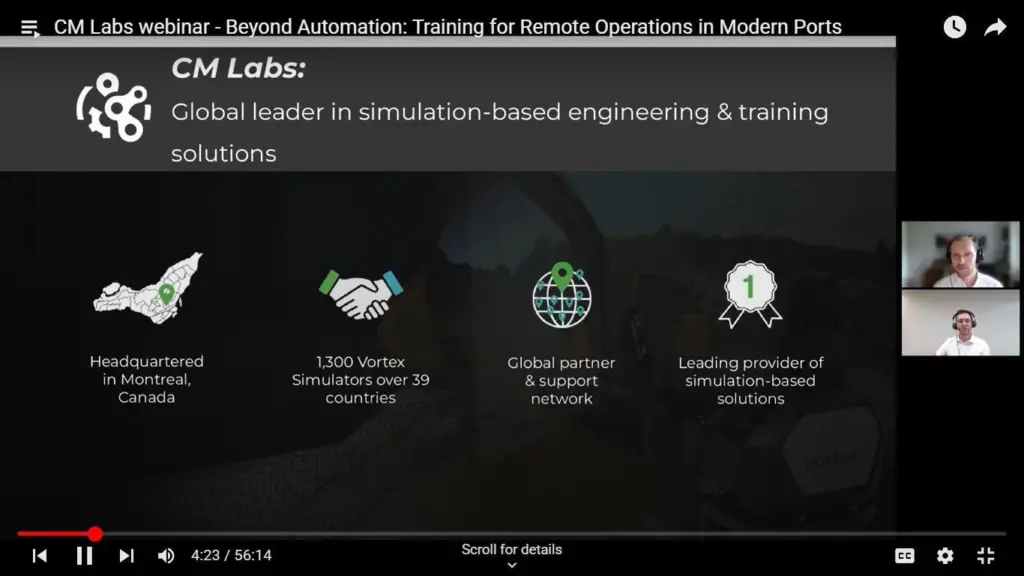
In the CM Labs-hosted webinar, ’Beyond Automation: Training for Remote Operations in Modern Ports’, key voices from the industry examined the state of automation and the essential role of training in this transformation.
The session featured Devon Van de Kletersteeg, product growth manager at CM Labs and Nikola Radisavljevic, co-founder of Zaga Advisory, moderated by Anne-Marie Causer, of Port Strategy and GreenPort magazines.
“Success isn’t just about deploying new technology. It’s really about aligning strategy, systems, and people,” said Mr Van de Kletersteeg, setting the tone for a discussion that emphasised a people-first approach to automation training.
State of play
Mr Radisavljevic, an automation expert with over a decade of experience, described the current state of port automation as the “Wild West,” with no clear standards and highly varied implementations.
“Most container terminals are either not automated or only minimally so,” he noted, adding, “Every successful automated terminal today has had to navigate its own path,” he said.
This lack of standardisation creates major barriers to automation scalability, particularly in brownfield ports.
Despite widespread availability of automation technology, Mr Radisavljevic asserted that the real obstacles lie within organisations themselves: “Technology is not the challenge. The challenge is people – communication, alignment and mindset.”
Digitisation is a critical prerequisite. Without it, the automation journey stalls. “We’ve seen ports with thousands of data points generated every millisecond that go unused,” said Mr Radisavljevic.
“There’s a gold mine of data nobody is touching. We need to unlock that potential.”
Training key
Simulation-based training is emerging as a crucial enabler in this shift. Mr Van de Kletersteeg highlighted CM Labs’ global simulator deployments and a new remote operator training station aimed at preparing workers for the transition to ergonomic, screen-based control rooms.
“It’s an evolution of roles,” he explained, “and training must evolve too – whether ports are fully automated or not.”
Mr Radisavljevic echoed that training is vital not just for onboarding but for continuous improvement and process testing.
“These simulator environments can act like digital twins,” he said. “You can trial new systems, adjust TOS integration and retrain staff without disrupting live operations.”
A recurring theme throughout the webinar was the importance of a clear vision and internal alignment before investing in automation.
Many terminal operators make the mistake of expecting system vendors to integrate complex solutions seamlessly without sufficient internal planning.
“You can’t expect a plug-and-play solution. There is no off-the-shelf product that will do everything out of the box,” warned Mr Radisavljevic. “You need to actively drive integration and know exactly what you want to achieve.”
Process-first approach
The discussion also acknowledged that full automation isn’t the answer for every port.
“Some manual terminals are still outperforming automated ones,” said Mr Van de Kletersteeg.
“But without automation, the ceiling of performance will soon be hit.” Mr Radisavljevic agreed, stressing the need for a case-by-case, process-first approach rather than blindly chasing technology.
The evolving role of the remote operator was another focus. With automation enabling operators to manage multiple cranes from a control room, ports can become more attractive workplaces while improving safety and efficiency.
“This shift not only modernises the job – it turns operators into supervisors, giving them more responsibility and oversight,” Mr Radisavljevic noted.
The key takeaways from the session are clear. First, port automation isn’t about technology alone – human factors, organisational alignment and process understanding are far more critical.
Second, digitisation is the foundation; without robust data systems, automation cannot succeed.
Third, simulator-based automation training bridges the gap between equipment, software and human capability.
And finally, successful automation demands strategic planning, cross-departmental collaboration and an ongoing commitment to training and process optimisation.
The speakers both agreed that with ports under pressure to increase throughput and efficiency in a competitive global trade environment, the smart integration of port digitisation, remote operations and automation training will help define the business leaders of the next era.
Related Articles
 EQUIPMENT
 OPERATIONS
 OPERATIONS