![PortStrategy[GreenPort]](https://www.portstrategy.com/wp-content/uploads/2026/09/PortStrategyGreenPort.svg)




Pros and cons of autonomous horizontal transport
The adoption of autonomous horizontal transport in container terminals is gaining momentum as a promising solution to improve safety, efficiency and labour optimisation, say port experts.
Haskoning port consultants Daan van de Ven and Henry Forgan have explored autonomous transport in container terminals, uncovering potential benefits, key challenges and how this emerging technology can be used.
Autonomous horizontal transport enables driverless vehicles to move containers between the quay and yard by using onboard sensors to navigate and avoid collisions. Unlike traditional automated systems, these autonomous vehicles promise to safely operate alongside manned trucks, giving terminals greater flexibility and reducing costly infrastructure changes.
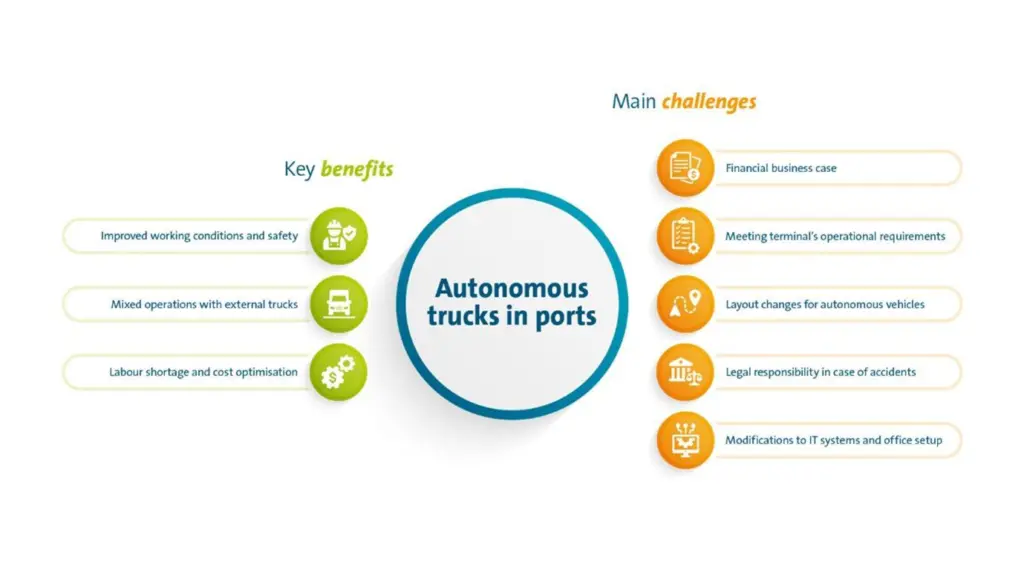
Among the major potential benefits of autonomous horizontal transport are improved working conditions and enhanced safety for workers. Additionally, automation can lower labour costs and alleviate shortages by reducing the number of operators needed per vehicle.
Challenges
However, despite these advantages, several significant challenges remain before autonomous horizontal transport can be widely implemented. One critical hurdle is establishing a clear financial business case that balances upfront capital expenditures such as vehicle costs, software licences and potential terminal modifications with operational savings and safety improvements.
Performance is another concern, as autonomous vehicles often operate cautiously at slower speeds to maintain safety, which can impact productivity.
With regards to safety, there is a large variety in the development trajectory chosen by autonomous vehicle manufacturers, as well as the degree to which these vehicles have been objectively evaluated by relevant safety certification institutes.
Terminals may also face spatial constraints due to layout changes required for safe vehicle operation, such as dedicated lanes or segregation infrastructure like some early-adopting terminals have applied.
Legal responsibilities in the event of accidents need to be thoroughly reviewed, whilst integrating autonomous systems with existing terminal IT platforms adds complexity to implementation.
Given the diverse technological maturity among suppliers and the novelty of the technology, the consultants are urging terminals to seek impartial expert partners to advise on supplier selection, tender evaluation and strategic planning, ensuring the benefits can be fully realised and that any investment decisions are based on a comprehensive review of both benefits and challenges.
Related Articles
 EQUIPMENT
 OPERATIONS
 OPERATIONS