![PortStrategy[GreenPort]](https://www.portstrategy.com/wp-content/uploads/2026/09/PortStrategyGreenPort.svg)



R. STACKER: ELECTRIC PRESENCE
John Bensalhia examines the rising interest in the electric reach stacker and charts how the concept is evolving
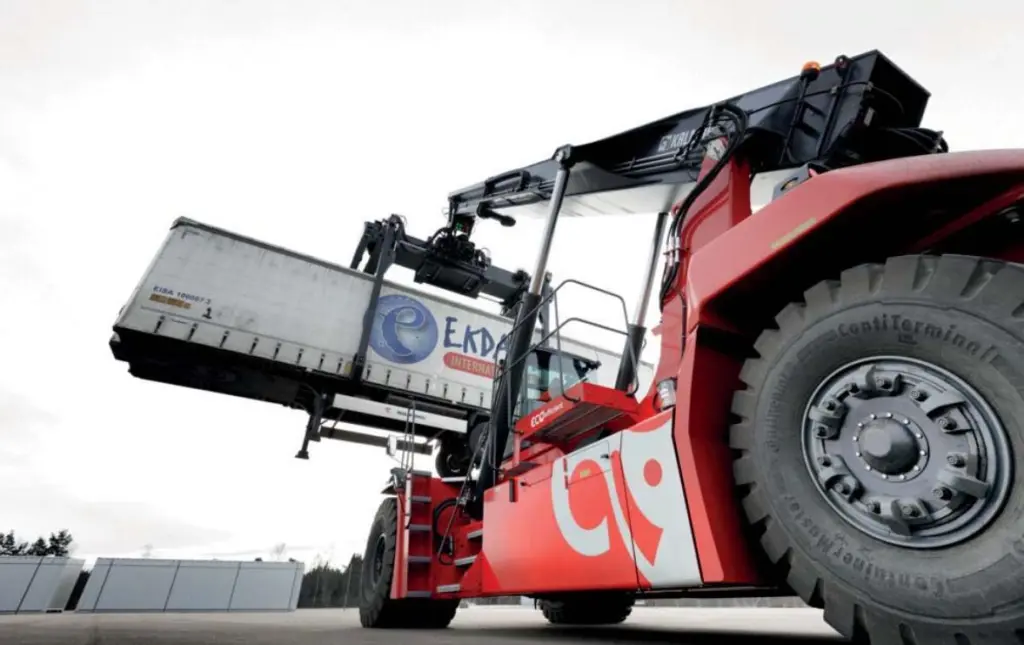
Adopting zero emission technology is a common goal for port and terminal operators around the world. With a growing number of regulations to follow and other factors to consider, such as cost reduction and maximising safety, more operators are turning to electricity as a suitable alternative power source to traditional fuel-run machines.
“Europe is the market leader regarding zero emission technology adaptation with especially the Nordic countries taking the lead – similar to what can be seen with electric passenger vehicles,” says Mette Kjems Baerentzen, Product Portfolio Manager, Counterbalanced Container Handlers, Kalmar. “Countries with ‘green’ incentives and high fuel prices in combination with reasonable electricity costs are the front runners. However, there are customers globally that have local incentives or requirements from the local municipalities that request the electric option,” she explains.
RELATIVE INFANCY
But while ports are buying into environmentally-friendly technology, the concept of the electric reach stacker is still in its relative infancy. As an insight to this, in 2020, Hyster Europe published some thoughts on challenges facing ports looking to use electric reach stacker technology.
While battery power is an admirably emission-free solution, size and scale are problems. At the time of setting out its thoughts, Hyster Europe said that technology dictated that the size of the battery would have to be nearly as big as the truck, just to work on one shift.
Charging time is also a potential logistical challenge for operators. Recharging means that the electric reach stacker is out of action for a certain amount of time, thus holding up operations. Recharging during the day requires meticulous planning on the part of the operator, who also has to consider the vast quantities of power needed for more than one electric reach stacker.
Hydrogen fuel cells are, however, a worthy alternative, converting hydrogen into electricity. Hyster Europe is developing a zero-emission reach stacker featuring a hydrogen fuel cell for the Port of Valencia, Spain as part of the European Horizon 2020 programme and H2Ports project. The port will be the first in Europe to incorporate hydrogen energy into its cargo handling operations.
Jan Willem van den Brand, Director Big Truck Product Strategy and Solutions, Hyster, explains the process: “An on-board Hydrogen fuel cell will charge the battery on the fully electric Hyster ReachStacker during operation, which is expected to support continuous operation while providing zero emissions and achieving comparable full shift performance to a conventional IC reachstacker.
The truck architecture incorporates electricity as the main energy source at high voltage to power fully electric motors. We plan to maximise uptime, minimise refuelling requirements and help applications to manage power consumption while complying with relevant environmental regulations and incentives.”
Another dilemma for ports is the cost side of considering an electric reach stacker in comparison to a conventional diesel-powered machine. Mette Kjems Baerentzen, Product Portfolio Manager, Kalmar, says that while the electric reach stacker will be more expensive to buy than a traditional reach stacker, it still offers a better total cost of ownership in most countries (depending on the cost difference between diesel and electricity). “Part of the better total cost of ownership is also that it will be cheaper to service and maintain.”
Hyster Europe adds that there isn’t a one-size-fits-all solution for each port using an electric reachstacker. Operational outcomes depend on a number of factors, including the level of demand and intensity, available charging facilities, and also geographical position – i.e: some energy options are more affordable in some countries than others, making this more of a viable solution to terminals who can afford these costs.
GAINING ACCEPTANCE
However, with progress in technological innovation, electric reach stackers are beginning to make their mark. China-based XCMG, for example, launched its XCS45-EV in 2020, with its first client, Shanghai Harbour Bureau, aiming to achieve environmental benefits but with comparable performance to conventional machines.
The XCS45-EV runs on a 235 kWh maintenance-free battery that is capable of a constant eight-hour operation after just two hours charging time. An advantage of the XCS45-EV is that it can be adapted to 220V and 380V for stationary and mobile charging stations.
Kalmar officially launched its electric reach stacker range in December 2021, and since then, it has seen big interest with many customers visiting the company at its Innovation Center in Ljungby, Sweden, for test drivies and specific operational analysis on transitioning from existing equipment to an electric fleet. “The change is big since you need to invest in infrastructure before you can accept and use the new technology,” explains Mette Kjems Baerentzen.
Commenting on the Kalmar design Baerentzen says: “In general, it’s an electric vehicle and a similar design to other electric vehicles we design and produce, but obviously on a different scale, including larger components, batteries, drive motors etc.”
“The main technological innovations are in the optimisation of energy efficiency and the balancing between machine systems for drive and load handling.
“We entered into a whole new category in the market of heavy lifting, offering the customers a more sustainable solution with the electrification of reach stackers.”
In terms of performance, Baerentzen notes that as a minimum the capability of the electric reach stacker matches that of a diesel reach stacker. “However, the focus is on energy-efficiency and maximising operating time between charging.” The driver of the electric reach stacker also has a lot to gain from its smooth operation. “For the driver, the machine is a dream come true: quiet, smooth and very responsive,” he says.
Sany’s 45t electric reach stacker is also designed with the requirements of today’s and tomorrow’s terminal operations in mind. With respect to charging, the Sany model can work continuously for five hours after one charge. When it is not – or cannot be charged, a range extender is turned on, meaning that it can meet 20 hours operation in one day.
Sany says that the reach stacker has been “greatly optimised in dynamic performance” with extra protection for both engine and gearbox boosting longevity. It features intelligent control technology, using automatic adjustments in dangerous conditions to prevent any possible rollovers or accidents. Also, the control of the position of the reach stacker spreader and boom prevents the risk of collision and accidents during port operations. Sany reach stackers in general have been used in diverse locations around the world, including Florida, South Korea and Australia.
Considering the high voltage level employed with this equipment type, operators must make special arrangements for electric reach stacker system maintenance – with dedicated, knowledgable and experienced teams performing the necessary checks. “Since the electric reach stacker is high voltage equipment, service and maintenance related to the battery needs to be performed by a certified electric vehicle technician,” underlines Baerentzen.
MORE TO COME

While the electric reach stacker system is still in its early years and doubtless will be the subject of further refinement it is the focus of growing interest and step by step positive acceptance.
Hyster particularly points out that its energy recovery systems are eliminating the problem of operational delays, boosting uptime and also lowering energy costs.
“These patented Hyster energy recovery systems recover and store energy from lowering loads and braking,” says Jan Willem van den Brand. “They help to increase uptime through longer periods between charges or refills, while also helping to reduce the overall energy costs.”
“The use of hydrogen also has potential to reduce planning complexity or charging. Continuous operation is possible as long as hydrogen is available from the on-board hydrogen tanks. Even when refilling is required as this is fast.
”At a market level, Kalmar points to the enthusiasm of customers to adopt the system highlighting the example of Westport AS. The company took delivery of a Kalmar electric reach stacker in the early quarter of 2022 with Kurt A. Ommundsen, CEO, Westport, noting: “The fact that we are the first in the world to use a new and innovative technology from Kalmar speaks volumes about our ambition to be at the forefront of the green shift. Our investments in electrification, hybrid solutions and biodiesel will enable us to reduce our emissions by 56 per cent in 2022.”
Also a positive market indicator, Kalmar reports a one-year agreement signed with Norwegian rail operator CargoNet covering the field-testing of a Kalmar electric reach stacker. CargoNet is Norway’s leading rail-freight operator, focused on intermodal services between Norway and Sweden, and the unit to be field tested with it will have a wheelbase of 7.5m and stacking capability up to six high. The maximum lifting capacity of 45 – 35 – 34 – 23 tons in the 1st, 2nd, 3rd and 4th rows respectively is, according to Kalmar, a world first for an electric reach stacker.
Related Articles
 EQUIPMENT
 OPERATIONS
 OPERATIONS