![PortStrategy[GreenPort]](https://www.portstrategy.com/wp-content/uploads/2026/09/PortStrategyGreenPort.svg)

Safety first, says Steele
More than 70 years on from its foundation, safety still comes first, says Richard Steele, CEO, ICHCA. Felicity Landon talks one on one
Technologies evolve, operations become smarter, new cargoes and equipment emerge, new risks appear. How does the International Cargo Handling Coordination Association (ICHCA), set up in 1952, fit into the picture?
Richard Steele, who took over as CEO in 2021, says the fundamentals haven’t changed – but he is driving a renewed focus on the safety aspect of the organisation’s work.
“ICHCA has always been about cargo handling and coordination – it has always had an interest in doing that smartly, efficiently and safely,” he says. “It has also had an interest in good environmental behaviour. But when I came into the role, it seemed that there was only so much you can do on any one of those topics and it is really difficult to deliver successfully with a relatively small organisation. It seemed to me important to bring the focus back to the key element – which is health & safety.”
Ensuring that people go to work and return home at the end of the day in the same condition is the passion of ICHCA’s technical panel and members, says Steele. “So the focus is very much on ICHCA as THE safety organisation for cargo handling and coordination.”
The smart and efficient elements of cargo handling are still there, “but the plan is not to dilute the message – it is about getting at the core subject of safety of operations”.
Historically there has been a tendency to see safety as a separate topic but Steele is adamant: “Safe operations are well-managed operations. It is not ‘here’s safety’ and ‘here are good operations’. It is the way you work. If you are in control of safety, you are in control of the efficiency, organisation, speed, reliability and sustainability of your operation.”
In March (2023), ICHCA was one of five organisations to sign an MoU to cooperate on crucial safety issues by coordinating data, research and best practices across the international movement of cargo. Collaboration with other organisations has always been an important part of ICHCA’s work and this continues, says Steele.
Recently this has included a project looking into the safety of alternative/future fuels. “This is an opportunity to understand what the risks and challenges are in the safety of handling ammonia and hydrogen, and in cold ironing, etc. IAPH has done a lot of work in that area, so there is no sense in reinventing that. So, it is very much about working with other stakeholders.”
SHARING KNOWLEDGE
Similarly, ICHCA is one of several organisations, led by the Cargo Incident Notification System Network (CINS), that produced new guidelines for the safe transport of lithium-ion batteries in containers; these cover the properties of the batteries and their potential to explode, initiate fires and emit toxic gases, and provide suggestions for identifying risks to help ensure a safer supply chain.
“There is an aspiration to share knowledge,” says Steele. “For example, the CINS database has a lot of information about incidents in maritime transport. We should be data- driven, focused on where we can get the most improvement, reduce the most significant risks. Working with others, we can build up a clear picture of where the major risks are throughout the world of cargo handling. It is my aspiration that we are able to explore the data that is held in all sorts of locations and find ways to share that, always being focused on learning.”
He believes that by identifying where, how, with which cargoes and in which circumstances the most common incidents occur, the data can be used in a proactive, productive way. “This is not about ‘name and shame’ – we are not talking about blame or apportioning responsibility, but we want to learn lessons fast and make sure those lessons lead to continuous improvement.
“This is an ongoing process; it is about using the knowledge, expertise and success of the best to raise the standards throughout the industry.”
Another recent publication is ICHCA’s new guide for shipping ammonium nitrate, outlining best practice and guidance for fire prevention and mitigation.
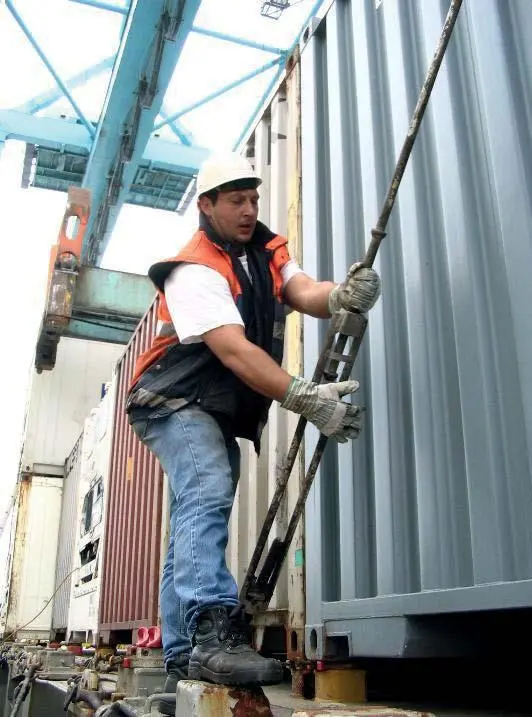
Steele says that port operators must never lose focus on the core stuff – and that starts with the wearing of hard hats, the not-wearing of flipflops. There are still places around the world where standards are not as strong as the best, he says diplomatically. “There is room for improvement.”
However, while PPE is one of the very visible things – “you get your MPs visiting your port and wearing a hard hat” – Steele describes PPE as ‘the lowest level of hierarchy of controls’. He wants to see the thought processes around safety pushed back up to “the top of the hierarchy” – i.e., can you eliminate this risk altogether, or can you control it? “Eventually, you come down to the least reliable method, which is telling people ‘it is slippery out there, be careful’. That is not as good as making sure it is not slippery out there in the first place – giving people a safe, reasonably practical workplace.”
Automation can eliminate some risks but also raises other issues, he says. “Still the most significant consequence for people, if we get it wrong, is people coming into contact with moving cargo, plant and equipment, whether that is working at height or working on/near the water. With the right kind of automation, you can reduce those risks to people. But automation is also challenging because you can create other potential risks. If you have someone operating a crane remotely from a comfortable operating station, you have to do a number of things to ensure they can respond and control the crane in a way that is safe for the vessels or others around it.”
As a recognised NGO at the International Maritime Organization, ICHCA contributes to the development of new regulations and updating of old ones. Ongoing topics range from the transport of lithium-ion batteries, as well as charcoal, to the safety of lashing and the prevention of the unintended transport of pests.
ICHCA also collaborates with the TT Club to run the Innovation in Safety Awards. “This is a really important part of the work we are doing; it is saying there are opportunities out there to learn and improve. We don’t have to keep doing things the way we have always done them; if we do, we will get the same results we always got. This is about thinking of new ways of using existing technology or bringing new technology in to achieve very positive outcomes.”

An example is the use of AI to review video footage from around the terminal and identify behaviours that could lead to a risk of injury. “You don’t have to have someone sitting watching hours of CCTV footage. AI will pick up a failure to stop, speeding, crossing in unsafe areas or proximity to cargoes when they are being raised or lowered. These opportunities are out there, and we are trying to bring these innovative ideas to the industry.”
In summary, Steele compares safety to riding a bicycle. “If you stop peddling, you fall off. Always focus on basic safety. It is possible to lose focus if you are not really proactive. We absolutely need to continue the messaging about the hierarchy of controls. You are not going to succeed if all you do is tell people to be careful. You have to put in place the controls and management of those risks.”
Related Articles
 EQUIPMENT
 OPERATIONS
 OPERATIONS