![PortStrategy[GreenPort]](https://www.portstrategy.com/wp-content/uploads/2026/09/PortStrategyGreenPort.svg)





Tackling lithium-ion battery fires
The fire onboard the Fremantle Highway, off the Dutch coast in July, focused minds once again on the risks around the transport, handling and storage of lithium-ion batteries. Felicity Landon reports.
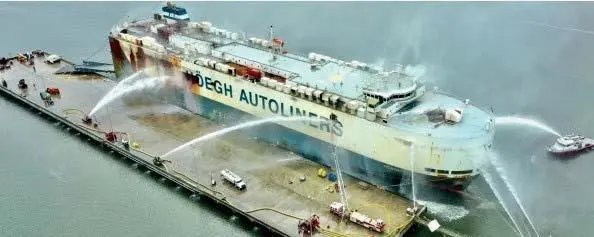
In March this year, the European Maritime Safety Agency (EMSA) noted that lithium-ion batteries had been identified as one of the main cargo types responsible for ‘a large share of cargo fire accidents’. And, as it also noted, there is expected to be an exponential increase in the volumes of lithium-ion batteries being transported.
The Fremantle Highway fire claimed the life of one seafarer and forced at least seven others to jump overboard, to drop 30 metres into the sea below. In escaping, seafarers suffered burns, broken bones and breathing problems. Early indications were that the fire was caused by one of nearly 500 EVs on board.
Inevitably, such a horrendous car carrier fire at sea takes the headlines. But the concerns around lithium-ion batteries and their risks extend way beyond cars – think laptop and other electronics. The risks also extend throughout the supply chain, including ports, terminals, storage areas and warehousing. In the push for decarbonisation, port equipment is also being electrified, with associated risks.
“Certainly the risks associated with lithium-ion batteries are on our radar,” says Richard Steele, CEO. ICHCA. “We are trying to understand the risks associated with transporting them. We also know there are cases of fires on land – for example, instances of fatal fires where people were charging e-scooters in halls or apartments.”
Earlier this year, Dirk Van de Velde, Deputy Chair of the Cargo Incident Notification System Network (CINS) and a Board Member of ICHCA, urged all stakeholders in the production, supply, transport, handling and sale of lithium-ion batteries, whether as individual components or integrated into an electronic device, vehicle or other product, to ‘recognise their responsibilities in maximising safety when in transit’.
CINS has produced guidelines for the safe transport of lithium-ion batteries in containers, and these include container packing, landside storage, stowage on board, incident detection and fire suppression.
LASH FIRE PROJECT
LASH FIRE, a research project aiming to reduce the risk of fires on board ro-ro vessels, is one of a number of international initiatives considering the issues. As Steele says, there are varying opinions on the risks of EV fires, how controllable they are and how best to tackle them. What is known is that a lithium-ion battery fire can reach 2000 degrees within minutes, and that extremely toxic gases are released.
“If you are attempting to fight or control the fire, you have got the temperature, the flames and the potential for explosion,” says Steele. “This creates a real challenge to fight the fire, even in a managed safe way. The risks are significant.”
In addition, because a battery fire can continue to burn for a long time, and also reignite after it appeared to be suppressed, there is a huge risk of fire spreading to other EVs or internal combustion engine (ICE) vehicles nearby. “It is important that we are looking at this in a way to provide safety for crew, shoreside workers and fire/emergency responders,” he says.
“However, it’s important to emphasise that we are not anti-EV. This is about acknowledging the reality of cargoes and what’s being manufactured and transported, being smart and joined up, and continuously improving safety. The industry as a whole needs to push forward with a common understanding.”
If a lithium-ion/EV fire breaks out within a port setting, Steele says a risk assessment should be carried out to decide whether it is safe for operators to go into a compound and drive other vehicles away.
“LASH FIRE demonstrations showed a fire being controlled in a car park – using fire blankets, long-range water spray into the vehicle, for example. That’s all doable. In the case of port handling equipment running on batteries, it may be possible to create a safe cordon around it.”
Peregrine Storrs-Fox, Risk Management Director at the TT Club, emphasises that when thermal runaway happens, the result is the release of toxic gases such as carbon monoxide and hydrogen cyanide, along with a very high temperature fire that can spread very fast. There have been reports that EVs do not catch fire any more often than ICE cars – but, as he points out: “When you have a lithium-ion battery fire, it is an awful lot nastier than a normal ICE car fire.
“Ports, terminals and warehouses are involved in this – and we are running to catch up with the risks,” he says. “Lithium-ion batteries are being moved through ports, stored in port areas and being used in port equipment. There is a lot of focus on understanding how to deal with the variety of risks – and even some of the early adopters [of electric equipment) are already reviewing whether they adopted too early.
“There is an evolving understanding of practicalities such as how best to go about charging, and the distances between charging points and buildings.”
He laments the fact that manufacturers and OEMs are not engaging sufficiently with the transport and logistics industry and emergency responders. Indeed, industry conferences seem to focus on ‘making things faster, bigger, better, more successful form the battery technology perspective’, he says: “But they are not focusing on the risks and they need to engage with others as part of a broader ecosystem.”
Johan Kahlmeter, Claims Director at The Swedish Club, says it is rare that the industry faces dealing with totally new cargoes in significant quantities. “And yet that is the unique challenge that we face with the carriage of electric vehicles onboard ships. These vehicles are tightly loaded, large values are at stake, and a safe haven might be far away. It is essential that all those onboard are given access to the latest safety and loss prevention advice.”
RISKS AND READINESS
The Swedish Club ran two webinars examining the risks of EV fires and how to be prepared.
During one of these, Martin Carlsson, Naval Architect and Fire Safety Project Manager at Stena Teknik, outlined some of the steps taken by Stena Line in response to the increasing number of EVs being shipped.
For example, at booking and check-in stages, Stena confirms it has a registration onboard for the fuel type of each vehicle, as part of the cargo manifest connected to the licence plate. “If there is a situation on board, we will have fast access to information on what fuel type a certain vehicle has. We will update the fire patrol instructions, what signs of malfunction [there are], and the emerging risk situation that we can expect from electric cars.”
Carlsson said that the onboard drencher system performance is equivalent for both EVs and ICE cars and would be sufficient for suppressing fire on these cars equally. “This was proved by testing done by LASH FIRE. The drencher system will then prevent the fire spreading to the next car and has even seemed to slow down the thermal runaway in the electric car. This is basically due to the fact that the drencher will suppress or even extinguish the fire in the remains of the vehicle and thereby reduce the heat impact and the heating of the battery.”
He stressed the need for crew training in the theories around the lithium-ion battery, the firefighting methodology and the particular hazards to be aware of.
Wallenius Wilhelmsen also ensures that all alternative fuel vehicles are clearly marked on the loading plan so that crew onboard know exactly there why are stored. Also speaking at The Swedish Club webinar, Filip Svensson, Senior Safety, Quality and Security Manager said WW does not believe the transport of EVs presents a bigger fire risk, but it does have a restriction that EVs being loaded must have a maximum 30 per cent state of charge. “We firmly believe that the lower state of charge you have, the longer time it will take before a battery goes into thermal runaway.”
Also, WW is not allowing the transport of second-hand EVs as the risk is considered much higher.
Richard Steele says: “There is a lower risk with brand new, well-manufactured vehicles with good quality batteries in them; but one of the issues with lithium-ion batteries is that if they get damaged, it gives an increased chance of fire. When moving to second-hand vehicles, you don’t know what their history might be.”
In parallel, the adoption of new fuels in the drive for decarbonisation adds another layer of risk. As Peregrine Storrs-Fox says, ports need to consider terminal infrastructure, bunkering facilities and charging points. Ports must carry out very thorough risk assessments to manage a variety of new risks and also the potential interface, he says. Put bluntly – don’t have your EV charging station next to a hydrogen tank.
There is much thought and effort going into the issues around lithium-ion batteries, he says, but there are too many silos. “The maritime industry needs to work with the OEMs, manufacturers and responders to assess the risks and how to address them”.
Related Articles
 EQUIPMENT
 OPERATIONS
 OPERATIONS