![PortStrategy[GreenPort]](https://www.portstrategy.com/wp-content/uploads/2026/09/PortStrategyGreenPort.svg)



Tapping driverless technology
Haskoning provides a route map of the dos and don’ts of adopting autonomous horizontal transport in container terminal operations
Haskoning, the international engineering consultancy, sets out its perspective on the application of autonomous transport for container terminals. The two authors* discuss the potential benefits, key challenges, industry complexities, and how this emerging technology can be leveraged.
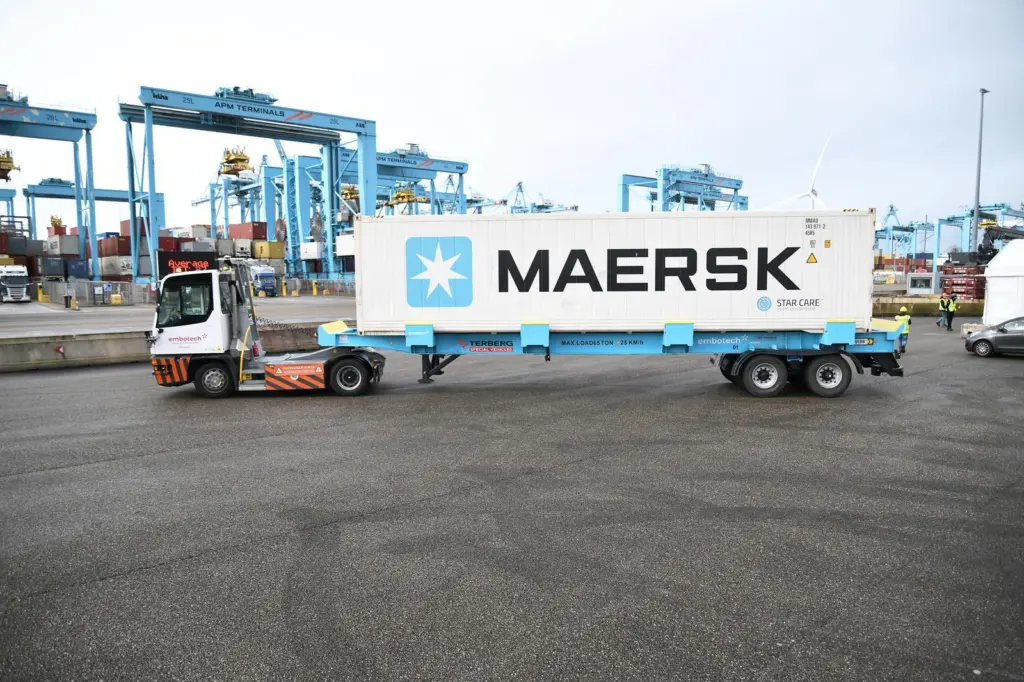
Imagine your terminal’s horizontal transport between quay and yard being handled by autonomous vehicles. These vehicles use on-board intelligence to determine routes and sensors to avoid collisions, all without manual drivers. They can safely operate alongside manned external trucks.
Autonomous vehicles can be categorised as Autonomous Terminal Trucks (ATTs) or Intelligent Guided Vehicles (IGVs). A number of terminals have already adopted one of these options.
POTENTIAL BENEFITS
Autonomous horizontal transport offers potentially interesting benefits for terminals.
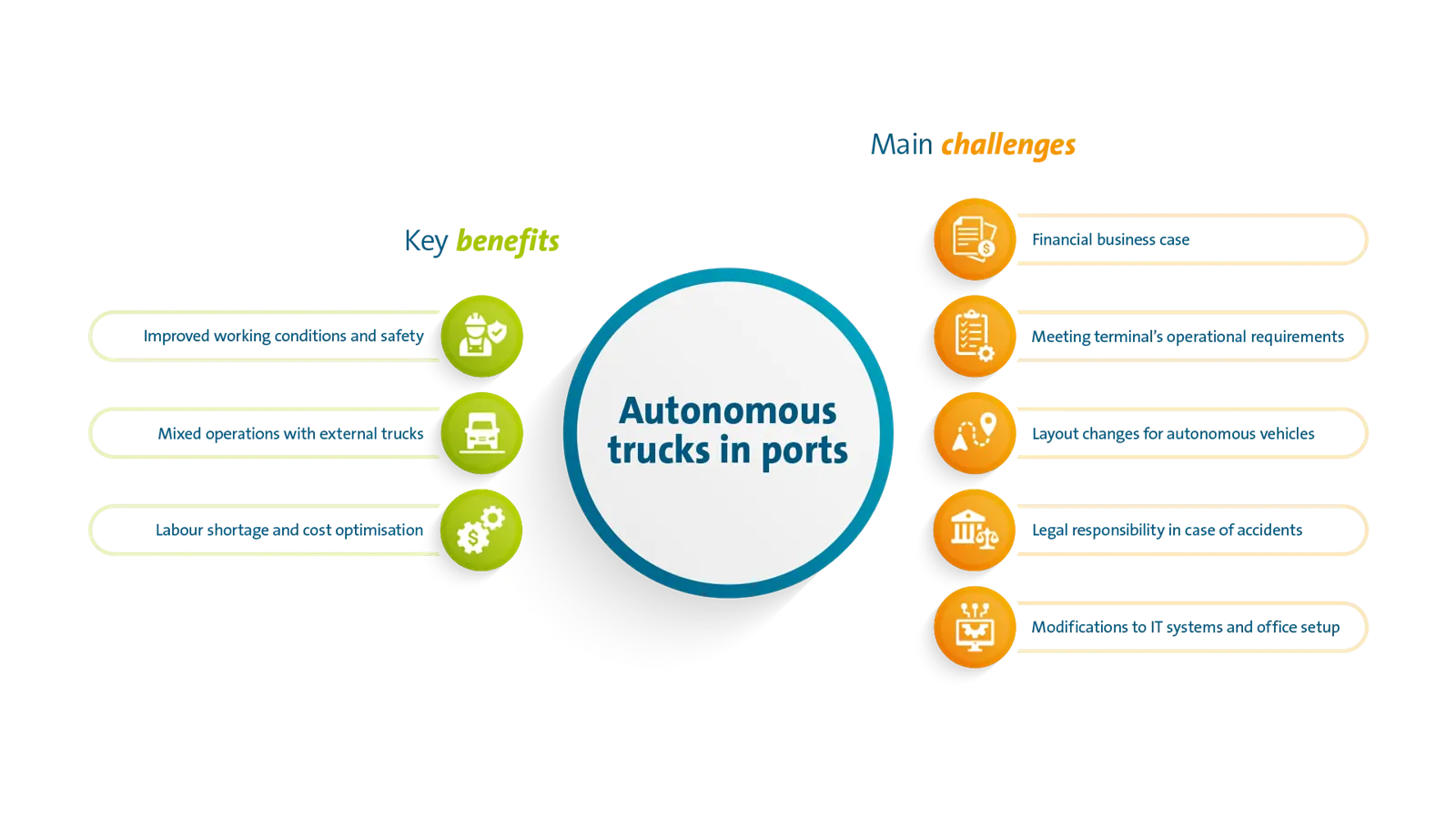
Three key benefits are identified:
1. Improved working conditions and safety. The employee role will transition from working with heavy equipment in varying weather conditions to air-conditioned, ergonomically designed workspaces. This change reduces the chances and impact of accidents as there are no human drivers prone to fatigue and errors present in vehicles.
2. Autonomous vehicles claim to operate in mixed operations with external trucks in the same area, unlike conventional horizontal transport automation using Automated Guided Vehicles (AGVs) in areas fenced off from external trucks. This results in fewer layout changes and increases operational flexibility when converting your brownfield terminal with terminal trucks to autonomous vehicles.
Implementing autonomous horizontal transport is expected to reduce the number of operators needed per vehicle, reducing potential labour shortages and optimising labour costs.
However, it also has to be acknowledged that like any other (emerging) technology, several challenges such as financial and performance factors need to be solved to implement autonomous horizontal transport effectively and efficiently.
SOLVING MULTIPLE CHALLENGES
In this section we identify five major challenges regarding the implementation of autonomous horizontal transport:
1. The financial business case should balance CAPEX (e.g. increased autonomous vs. manual vehicle CAPEX, extra software, and potential civil adjustments), OPEX savings (e.g. labour and fuel) and non-financial improvements (e.g. safety and labour conditions). Given the novelty of the technology, obtaining clear and accurate CAPEX & OPEX data (e.g. vehicle cost, software license fees, vehicle maintenance) to make this financial business case can be challenging
2. It is currently uncertain if the operational performance of autonomous horizontal transport meets your terminal’s requirements. Autonomous vehicles typically take a conservative approach in interactions with other equipment types and drive at reduced speeds due to safety considerations. This can reduce productivity, especially when operating in congested areas. It is essential to also review if all necessary functionality, such as sequencing at STS cranes, can be provided by autonomous horizontal transport.
3. Application of autonomous vehicles could require layout changes that take up valuable terminal space. Multiple early adopters are applying dedicated lanes for external trucks or autonomous vehicles, sometimes combined with segregation infrastructure and traffic lights at junctions. Terminals like to limit this space usage, but this can only be accommodated safely if autonomous vehicle technology is sufficiently mature.
4. Legal responsibility in case of accidents is currently unknown. Is the terminal operator, the autonomous vehicle supplier, or another involved party (e.g. security or system integration supplier) responsible? This legal risk needs to be managed by clearly defining the Operational Design Domain (ODD) and co-developing the autonomous horizontal transport solution with suppliers to fit the terminal’s needs.
5. Implementing autonomous transport in your terminal requires changes to your IT systems and office setup. The control system of autonomous vehicles must interact with other systems, such as the Terminal Operating System or Equipment Control System, to receive transport jobs and line up with yard or quayside equipment. On top of this, remote operator stations are required for exception handling.
These challenges can point to the need for an impartial and experienced partner to assist you in implementing autonomous horizontal transport.
COMPLEX LANDSCAPE
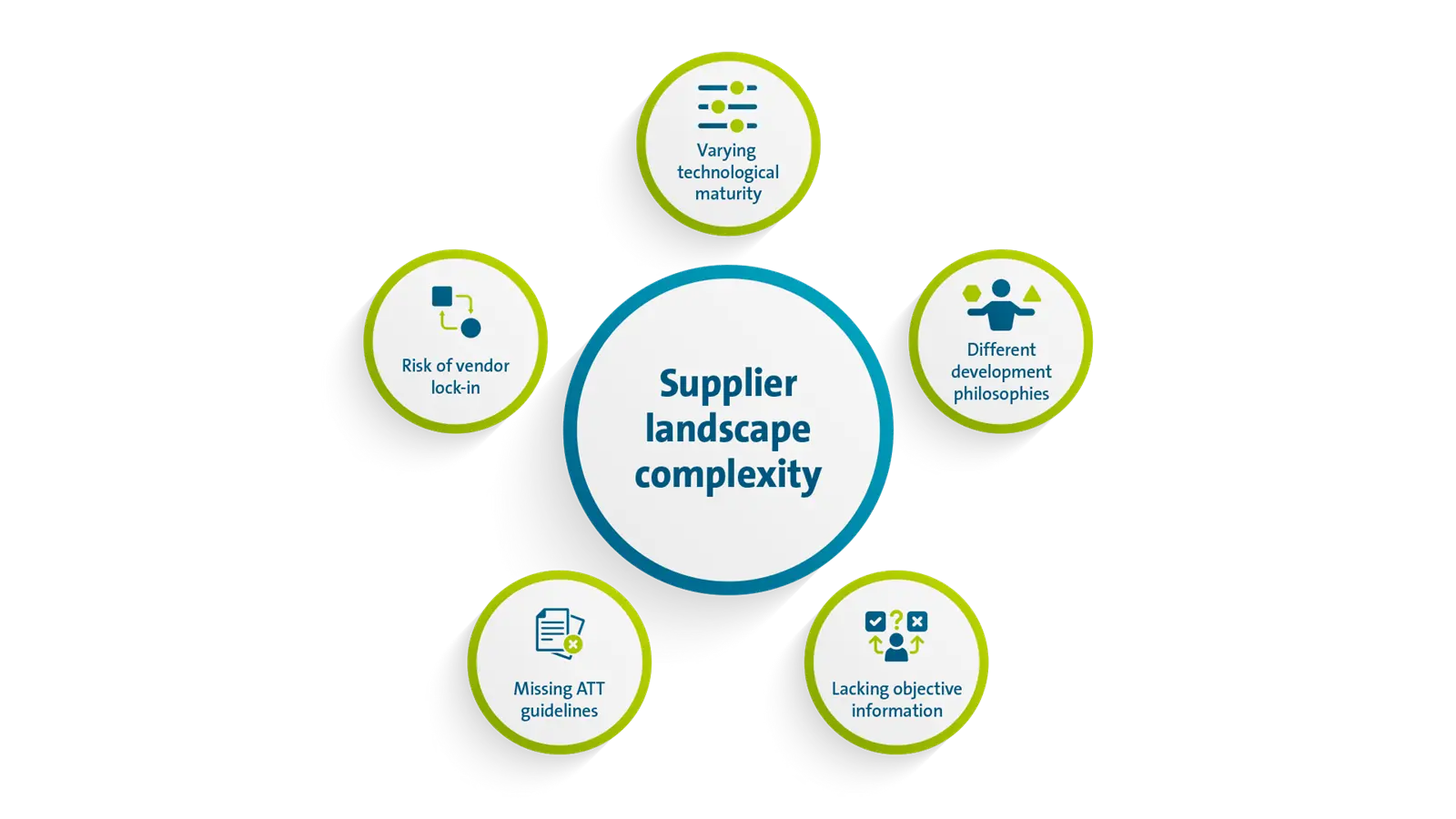
To implement this type of autonomous transport effectively and efficiently, selecting the right supplier is crucial. However, comparing potential suppliers can be difficult due to the following complexities:
- Suppliers are currently at different levels of technological maturity, with most having limited portfolios and operational experience.
- Different development philosophies or practices are applied.
- Objective, publicly available information about key aspects like performance, exception handling, and maintenance is often lacking.
- Clear guidelines for autonomous horizontal transport are currently unavailable and will likely only be established once technology has further matured.
- Novelty of the technology and the specific requirements of your port or terminal may necessitate custom development. Custom development will likely require significant development, testing and training efforts from both the terminal operator and supplier. This introduces the risk of vendor lock-in, where only one vendor can supply the solution you need and can therefore charge premium prices.
- Business continuity risks of suppliers, with parties like Gaussin going bankrupt or Fernride recently shifting strategic focus away from container terminals.
TAILORED APPROACH
As the work environment is complex, with different interests of e.g. container terminal, developers, legislator, clients and employees, this requires a tailored approach. To help navigate this having an impartial party with the relevant experience that can mediate between potential suppliers can prove most beneficial.
It can, for example, prove most beneficial in conjunction with:
- Building an overview of the choices and changes possible in terminal layouting and interaction with equipment types vis-à-vis the resulting required ODD for autonomous vehicles and how this can be optimised.
- Conducting interviews with autonomous horizontal transport suppliers.
- Providing tender support and evaluation of bids for this type of autonomous transport, and
- Assessing the financial business case.
Such steps build a wider perspective: global instead of only one terminal, more suppliers instead of just one, a long term/strategic view looking at forecast growth and terminal development.
The accompanying article is authored by
Daan van de Ven is a Port Consultant for Haskoning where he specialises in Container Terminal and Smart Port studies. He has delivered a number of commercial studies for ports on autonomous horizontal transport. He holds an M.Sc. and B.Sc. from Erasmus University Rotterdam, NL.
Henry Forgan is a Port Consultant for Haskoning where he specialises in Container Terminal and Smart Port studies. He has delivered a number of commercial studies for ports on autonomous horizontal transport. He holds an MEng from the University of Plymouth, UK.
Related Articles
 EQUIPMENT
 OPERATIONS
 OPERATIONS