![PortStrategy[GreenPort]](https://www.portstrategy.com/wp-content/uploads/2026/09/PortStrategyGreenPort.svg)


The Digital Nervous System
Digital transition is a core pillar of development for the port industry. Dean Davison assesses projects and approaches currently underway in several North European ports and the rationale for the strategy.
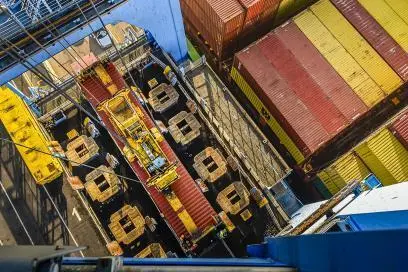
Talk to any port and the subject of digitalisation often comes to the fore. The position is no different in North Europe. Jacques Vandermeiren, outgoing CEO, Port of Antwerp-Bruges, sums up the importance of digital transition to a port very succinctly citing the process being adopted at this leading North European facility: “Port of Antwerp-Bruges is aiming to build a digital nervous system to fully manage the port remotely. By working with innovative partners and opening up the port as an innovation platform, we are making our port smarter, safer and more efficient.”
So, what exactly is Antwerp-Bruges doing to create this digital nervous system?
A major step is to establish itself as a smart port, which the Antwerp-Bruges explains as: “A smart port is one that brings together economy, climate and people. Smart technologies and digitisation play a key role in a smart port. We have opened up our port as an innovation platform for these new technologies and are working with public and private players to create the port of the future.”
One of this port’s key initiatives is NxtPort. Tineke van Ginneken, Key Account Manager Consumer Goods, Beverages and Forwarders, Port of Antwerp-Bruges explains the background to this product: “All the players in the logistics chain have information that they exchange with each other. NxtPort, a subsidiary of Port of Antwerp-Bruges, makes sharing data easier and more transparent. That way, all the players in the logistics chain get the right information at the right time.”
RIGHT INFORMATION AT THE RIGHT TIME
Therein lies an important point – the flow of the right information at the right time. Factors that remain at the centre of many digitalisation processes.
“We have launched, together with the Belgian customs, IRP (Inbound Release Process), a digital platform powered by NxtPort, that enables the new European customs legislation. But it does not only help the users with the customs flow, it also provides more visibility during the whole import process, which helps customers to optimise their supply chain. Less corrections in documents, less waiting hours, more predictiveness and more visibility,” confirms van Ginneken.
There is a similar strategy in Hamburg, with the focus on the flow of data amongst relevant stakeholders crucial. “The Port of Hamburg is actively driving digitalization forward, for example through platforms developed by the Hamburg-based company DAKOSY, which enable efficient and transparent data exchange between all stakeholders in the logistics chain,” says Axel Mattern, CEO, Port of Hamburg Marketing.
INTEGRAL COMPONENT
The Port of Rotterdam regards digitalisation as an integral component to its overall strategy, as a spokesperson explains: “We see the port as a complete entity. Our approach is based on three pillars: seamless, sustainable and connected. A seamless port is defined as a port with short turnaround and berthing times for vessels, smooth procedures and a high level of customer satisfaction. Together with a number of market parties, we are developing the digital tools to support this. At the same time, these help us reduce CO2 emissions in the port and transform our facility into a sustainable port.”
HAROPA Port also regards digitalisation as a supporting tool to its future objectives, as Kris Danaradjou, Deputy Director of Development, HAROPA PORT explains: “Digitalisation is supporting our transformation. Tools such as My ETA, which combines AI with data from SOGET’s S ONE Port Community System and HAROPA PORT, allows for improved ETA predictions.”
According to HAROPA Port, this digital tool means that the “players in the logistics chain now have a perfect knowledge of the merchandise route from beginning to end,” thereby helping to ensure better planning and management of port and transport operations and supply chain efficiency – or simply put, predict with precision, as the port’s tagline states.
Danaradjou adds that other initiatives such as the development of a digital twin (“Passage Plan”) and the deployment of a private 5G network are expected to enhance visibility, reliability, security, and overall supply chain performance. “These priorities will be further reinforced in our 2026–2030 roadmap, with a clear ambition: to become a leading decarbonized energy and logistics hub in Europe,” Danaradjou predicts.
Mattern confirms that a similar strategy, of digital expansion, is also being followed in Hamburg: “Ongoing projects focus on the further automation of terminal operations and the expansion of digital interfaces, improving planning reliability and process efficiency.”
Clearly, the port industry in North Europe remains committed to a digital transition, with more to come from many facilities as they continue to seek this move to more widespread use of technologies.
Related Articles
 EQUIPMENT
 OPERATIONS
 OPERATIONS