![PortStrategy[GreenPort]](https://www.portstrategy.com/wp-content/uploads/2026/09/PortStrategyGreenPort.svg)



Transshipment crucial
German ports have battled through a difficult period but continue to maintain a surprisingly strong presence in the transshipment theatre of operations. A J Keyes reviews recent performance.
Hamburg is a key port serving German hinterlands and as a hub port for the Baltic region, while Bremen/Bremerhaven is an established transshipment hub port, and Wilhelmshaven offers deep water and largescale infrastructure but lacks access to import-export hinterlands. Quite a mixed bag.
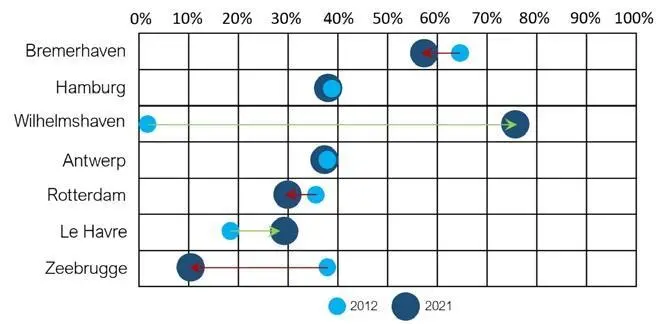
Transshipment is a crucial activity for German ports. Figure 1 compares this activity at ports in Germany in 2012 and 2021 to other facilities in the North Continent region – clearly, German ports are more reliant on transshipment activity than their competitors. This remains the case despite the cessation of container traffic to/from Russia in early 2022 in compliance with sanctions.
Bremerhaven has seen transshipment reduce from 65 per cent to under 60 per cent, Hamburg has maintained a consistent 40 per cent, while at Wilhelmshaven transshipment accounts for around 75 per cent of annual volume. By comparison, transshipment incidence has remained lower at under 40 per cent in Antwerp and fallen from around 35 per cent to 30 per cent in Rotterdam, leaving German ports more exposed to volatile hubbing activities.
PERFORMANCE – CHALLENGES – STRATEGIES
So, in this highly competitive regional port market, especially for transshipment, how are German ports faring and are there any specific strategies in place that might alter the status quo?
Despite a combination of regional and international challenges, Hamburger Hafen und Logistik AG (HHLA) has announced that the total container volume handled at its three Hamburg container terminals was up by 3.1 per cent for the year as of end of June 2022, compared to the same period in 2021, with 3.17 million TEU handled.
The company states that demand from China was the driving factor here. This position has been helped by Cosco Shipping Ports Limited (CSPL) acquiring a 35 per cent stake in HHLA Container Terminal Tollerort (CTT) in late 2021, marking the first investment by a non-German operator into the country’s main container port. CTT now operates as a preferred hub location for the major liner operator Cosco Shipping, although this may change as German government officials are reportedly now reassessing the deal’s approval.
Yet, challenges in Hamburg remain. The 2M Alliance has recently had to switch calls at Hamburg to Bremerhaven on its AE7/Condor service due to what it describes as “severe congestion issues” at Hamburg Eurogate Terminal. The problem continues at the time of writing, particularly due to recent strikes and although this situation has now been resolved allied congestion issues remain ongoing
Wilhelmshaven continues to service unscheduled ship calls caused by temporary route changes from other northern European ports. During 2021 nearly 713,000TEU were handled, which compares to 423,000TEU in 2020 and exceeded the best pre-crisis result of almost 656,000TEU in 2018.
Moving forward, prospects for this port remain positive, according to Bernd Althusmann, Minister of Economic Affairs, Lower Saxony: “Hapag-Lloyd has now gained a stake in Jade Weser Port, and the terminal operator Eurogate has also announced that it will invest around €150 million over the next three years. Our deep-water port has very good growth prospects in the coming years due to the trend towards ever larger container ships,” he says.
Related Articles
 EQUIPMENT
 OPERATIONS
 OPERATIONS