![PortStrategy[GreenPort]](https://www.portstrategy.com/wp-content/uploads/2026/09/PortStrategyGreenPort.svg)


Port preparations
The UN reports India has overtaken China as the world’s most populous country. With its potential to be a tiger economy, are India’s ports purring? AJ Keyes looks at current developments
According to the Ministry of Ports, Shipping and Waterways in India, the country has 12 major ports (and 200 non-major facilities) and over 95 per cent of its trade (and 65 per cent of value) needs maritime transport access to serve its 1.43bn inhabitants.
The need for container ports to be efficient and for capacity to keep pace with cargo demand is undeniable, but as Andrew Penfold confirms, the country lacks three things: overall container handling capacity, handling capacity correctly formatted to the needs of the largest vessels and effective inland container delivery, restricting establishment of critical mass, away from Mumbai and Gujarat.
So, what is the current state of play across Indian ports? Roaring like a lion or meowing like a kitten?
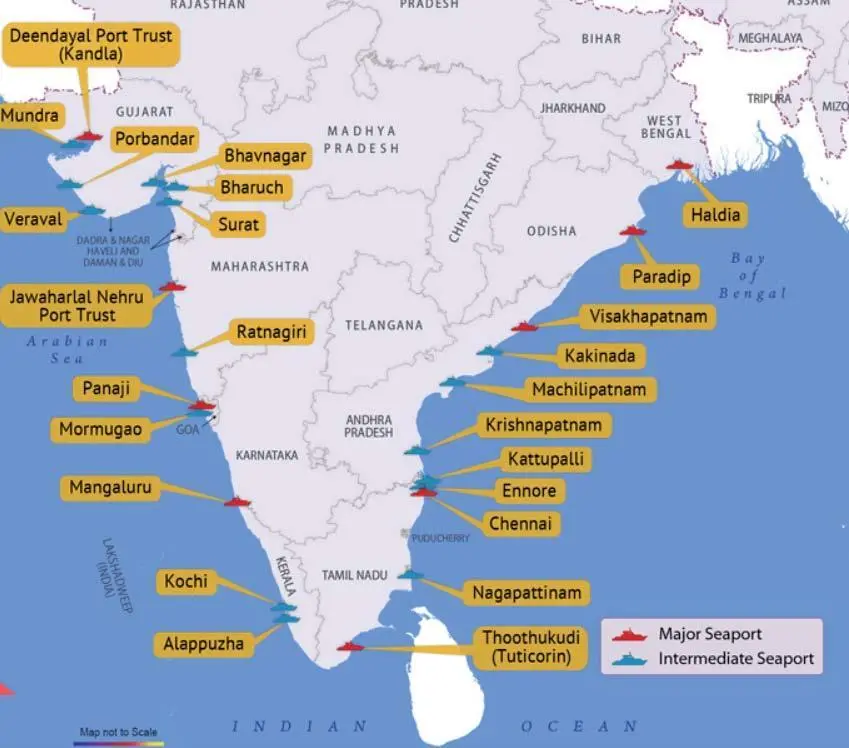
Figure 1 provides an overview of the location of the main Indian container ports spread along the east and west coasts.
There are a number of confirmed or known projects inIndia set to increase container capacity on both coasts.
EAST COAST STATUS & PLANS
Table 1 provides a listing of the main East Coast container ports and a summary of terminal operator(s), current annual throughput capacity, and investment plans.
The following represents a summary of the investment and capacity plans at selected East Coast ports:
- Chennai: According to the Chennai Masterplan, 2022, the combined berth capacity at the first and second container terminals “may barely be sufficient for the expected container volume in 2035.” As a result, the Port Authority is planning to augment infrastructure and points out that the “existing concession agreements have a provision for the upgradation and renewal of container handling equipment by the operator in 15 to 20 years of operation.” A total of 3.7 million TEU per annum capacity by 2025 is cited in the masterplan, although this currently looks an optimistic build date.
- Gangararam: The port handled 30 million tonnes in FY 2022 and forecasts a rise to 66 million tonnes by FY 2025. A new container terminal of 800,000 TEU per annum is part of the port’s ongoing development plans, with more than 400,000 TEU handled by FY 2025.
- Karaikal: APSEZ has completed the acquisition of Karaikal Port Private Limited (KPPL), located around 300 kilometres south of Chennai. It is the only major port between Chennai and Tuticorin, and its strategic location allows access to the hinterland of Central Tamil Nadu. APSEZ has stated it intends to double the capacity of the port within the next five years and to add a container terminal.
- VO Chidambaranar (Tuticorin): Confirmed plans to develop a transshipment hub by expanding container handling capacity to four million TEU per annum. The project includes construction of a breakwater, supporting yard, rail line and dredging in the Outer Harbour basin. A port official confirms: “This will be basically India’s answer to Colombo port. It will be a major container port, competing with Colombo, Singapore etc., the likes of which India has never seen before.” Big claims indeed.
- Visakhapatnam: COVID-19 delayed capacity expansion but at the end of 2022 the port said the project to develop 1.2 million TEU of new capacity was completed, as part of targeting traffic currently moving over Colombo. The project entailed berth length expansion from 450m to 850m, supported by Super Post-Panamax cranes so ships up to 20,000 TEU in size can be handled. Local reports indicate that cargo from Kolkata port has been using Colombo and India’s west coast due to a lack of adequate infrastructure on the east coast.
WEST COAST STATUS & PLANS
Table 2 presents a summary of select container ports on the West Coast of India and their respective plans:
- Cochin: Current capacity is one million TEU per annum and although there has been a Phase II development mooted, it remains unconfirmed. Doubts over the viability of the expansion were recently highlighted with the confirmation that for the fiscal year 2022-2023 period, the DP World facility saw transshipment activity fall by 30 per cent. As a result, only 104,666 TEU of transshipment cargo was handled, down on the 156,159 TEU in fiscal year 2021-22. The total volume of 695,230TEU in this recent year was down from 735,577TEU in the previous year..
- Kandla: In Q4 2022, the government of India approved development of two new container terminals at Tuna-Tekra in Deendayal Port (Kandla Port) at an estimated cost of Rs5,963 crore (US$720 million). In a statement the Cabinet Office said:: “From 2025, a net gap of 1.88 million TEU shall be available which can be catered for by a state-of-the-art container terminal at Tuna-Tekra, which will give it a strategic advantage as it will be the closest container terminal serving the vast hinterlands of northern India.”
- Hazira: Very substantial plans are known for this facility, with as many as 19 new multi-purpose berths that will see cargo capacity rise from 150 million tonnes to 234 million tonnes. Space for containers has been confirmed within the project. This expansion is despite a further six berths being already undeveloped under the current concession terms. The exact timescales are not known, and the project is certainly ambitious.
- Jawaharlal Nehru: CMA CGM Group subsidiary, CMA Terminals (CMAT), and J M Baxi Ports & Logistics Ltd., won the tender for privatisation of Jawaharlal Nehru Port Container Terminal (JNPCT), gaining a 30-year concession. The new Nhava Sheva Freeport Terminal has taken control of JNPCT’s 680m quay and 54ha yard and through equipment, yard and IT upgrades, intends to raise capacity to 1.8 million TEU per annum.
- Mundra: APSEZ operates four container terminals and is expanding its infrastructure, due to ongoing double-digit throughput growth. In Summer 2022 the operator commenced the CT5 project that is targeting additional capacity of 1.3 million TEU per annum.
- Pipavav: APM Terminals Pipavav is spending US$80 million, expanding its terminal to 1.6 million TEU capacity per annum to handle bigger ships and increased volumes from the implementation of its Western Dedicated Freight Corridor (DFC) initiative.
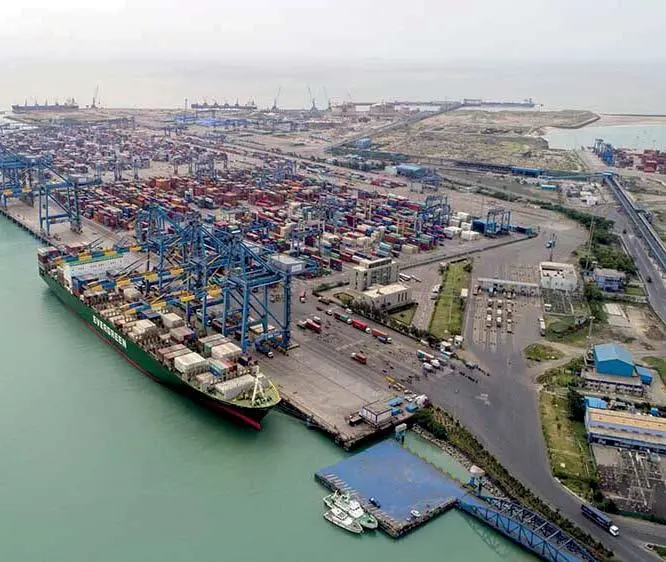
There are a number of ongoing and planned container port capacity projects on both the east and west coasts of India. Collectively, these will add extra capacity to the country’s ports and with the involvement of both specialists in the Indian port market and leading global terminal operators, should enhance and improve container handling efficiency.
Yet this investment may potentially see the weakest link in the supply chain moving inland, firmly placing the pressure on the quality and reliability of road and rail connectivity to support the country’s ports.
| Port | Terminal | Share / Notes | Capacity (TEU) | Expansion Plans |
|---|---|---|---|---|
| Chennai | Second Container Terminal (PSA) | PSA has 100% (SICAL sold 40% in 2010) | 1,500,000 | Chennai masterplan projects 1.72m TEU by 2025, 2.15m TEU by 2030 and 2.70m TEU by 2035 based on a 50% regional share. Handling capacity is to be raised from 2,5mTEU/yr to 3.7mTEU/yr by 2025 |
| Chennai Container Terminal (DPW) | Concession from 2001 / DPW 100% shareholder | 1,000,000 | ||
| Ennore | Ennore Container Terminal (APSEZ) | Operator sub-concession | 800,000 | Ennore Port expansion plan includes the development of a new container terminal with a handling capacity of 3.5 million TEUs and the creation of a multi-modal logistics park to enhance connectivity between the port and hinterland areas. |
| Gangavaram | Gangavaram Port Limited (GPL) (APSEZ) | APSEZ holds 100% stake | 150,000 | New 800,000 TEU terminal development |
| Karaikal | Berth 5 | Government of Puducherry on Public Private Partnership | 300,000 | Double capacity by 2028 and add a container terminal |
| Kattupalli | Kattupalli International Container Terminal (APSEZ) | Port authority & terminal operator | 1,200,000 | Expansion focused on coal and crude oil/gas |
| Kolkata | Bharat Kolkata Container Terminals (PSA) | Wholly owned subsidiary | 850,000 | Capacity increase of 20% planned, non- container emphasis |
| Krishnapatnam | Navayuga Container Terminal (APSEZ) | Share of 75% in port company | 1,200,000 | Phase 3 expansion, non-container |
| VO Chidambaranar (Tuticorin) | Tuticorin Container Terminal (PSA) | PSA SICAL 57.5% | 450,000 | Outer Harbour project of 4 million TEU |
| Visakhapatnam | Visakha Container Terminal (DPW) | 30-year lease from 2002. DPW (26%) and United Liner Agencies of India (74%) | 700,000 | Capacity up to 1.2 million TEU, longer-term could rise further |
| Port | Terminal | Share/Notes | Capacity (TEU) | Expansion Plans |
|---|---|---|---|---|
| Cochin (Kochi) | Vallarpadam International Container Transhipment Terminal (VICTT) (DPW) | 85% share | 1,000,000 | Phase II project unconfirmed |
| Deendayal (Kandla) | Two new terminals – Tuna Tekra | Up to 2.19 million TEU | ||
| Hazira | Adani Hazira Container Terminal (APSEZ) | Terminal operator | 1,200,000 | Between 6-19 multi- purpose berths under consideration |
| Jawaharlal Nehru (Nhava Sheva) | Bharat Mumbai Container Terminals (Fourth container terminal) (PSA) | New terminal, operational 2018 | 2,400,000 | Design capacity of 4.8 million TEU |
| APM Terminals Mumbai | 74% share (JV with CONCOR) | 2,250,000 | Infrastructure upgrades to 2.8 million TEU | |
| Nhava-Sheva International Container Terminal (DPW) | DPW has 100% share in terminal operator | 1,200,000 | ||
| Nhava-Sheva India Gateway Terminal (NSIGT) (DPW) | DPW has 100% share in terminal operator | 1,000,000 | ||
| JNPCT (CMA CGM & Baxi Ports) |
50-50 joint-venture | Container capacity to be raised to 1.8 million TEU | ||
| Mundra | Mundra International Container Terminal – CT1 (DPW) | DPW has 100% share, gained from Adani Group in 2003 | 1,300,000 | |
| Adani Mundra Container Terminal (AMCT) CT2 | Port authority & terminal operator | 1,800,000 | Adani Group started on CT5 project in Summer 2022 and this will add 1.3 million TEU/yr of capacity | |
| Adani International Container Terminal Pvt Limited (AICTPL) (TiL) – CT3 | 50-50 JV between TiL / APSEZ | 3,100,000 | ||
| Fourth container terminal (CMA Terminals) CT4 | 50-50 JV with APSEZ | 1,300,000 | ||
| New Mangalore | New container terminal under a PPP model | 400,000 | Terminal 1 due by FY 2024 | |
| Paradip | Containers handled via general cargo/multi-purpose infrastructure | Largescale Outer Harbour project shelved in 2020 | ||
| Pipavav | APM Terminals Pipavav | Share of 43% & local investors | 1,300,00 | 1,600,000 |
Related Articles
 CONTAINER & CARGO HANDLING
 CONTAINER & CARGO HANDLING
 EQUIPMENT