






Developing efficiency with electrification
As emissions-reducing equipment continues to play a key part in the transport and logistics green agenda, Hyster is demonstrating its commitment to the cause, discovers Rebecca Jeffrey.
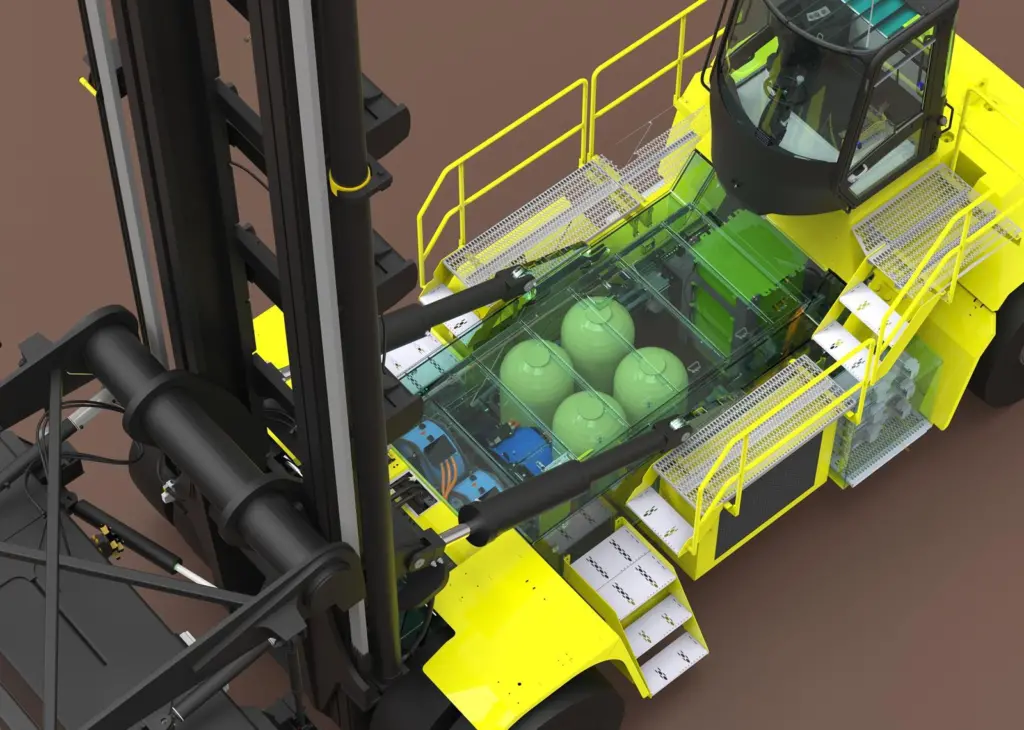
Currently testing its first electric 48t container handling truck with zero emissions at its facility in Weeze, Germany, Hyster is concluding the first stage of a project to deliver an electric truck with performance that can match the prototype’s diesel counterparts.
The case for electrification was simple for Hyster, it decided a hybrid model wouldn’t provide enough of a financial return to be a viable economic option. Jan-Willem van den Brand, director of big truck product strategy & solutions for Hyster, explains: “Using the electric truck, a saving on energy costs can be made when compared to diesel. We want to have profitable zero emissions which means the additional investments into the equipment has payback within the lifetime of the machine.”
While it’s clear from initiatives – such as the forthcoming World Ports Sustainability Programme – that ports are gearing up for electrification, the challenge for Hyster has always been how an electric truck can supply enough power for continuous operations whilst still being energy efficient by reducing power consumption. Mr. van den Brand stresses: “We are working to ensure it will work for heavy applications. We want to make sure it is reliable and dependable.”
Charging options
To meet this challenge, Hyster is developing three charging options. The first is a large lithium-ion battery pack which charges for a few hours at a time and requires a 200kW capacity charging station. This option could be used for a small barge terminal with a low duty cycle.
The second option involves the same battery pack but with opportunity charging in the duty cycle when the truck is not being used. One such charging method is a quick disconnect charging system with an automatic pin, carried out while the driver remains in the truck. Alternatively, charging stations could be built in terminals so wireless opportunity charging could be implemented. This would enable a truck to drive over a plate which then charges a coil fitted underneath the vehicle.
Opportunity charging could be used for busy rail terminal or large inland ports, but the time it takes to charge batteries when they are depleted needs to be a key consideration. Robust infrastructure planning is also crucial in establishing where to place the coils, for example understanding where in the duty cycle trucks are breaking to wait for deliveries.
Transformational hydrogen
Companies are also expected to have the choice of using a rechargeable lithium-ion battery combined with a hydrogen fuel cell in the future. The technology, in development by Nuvera Fuel Cells – acquired by Hyster’s parent company Hyster-Yale Group in 2014 – will work as an onboard generator to charge the battery during the cycle and allow for continuous use, increased productivity, flexibility of charging and longer run times between cell refills.
The power density of the fuel cell can help relieve pressure on or provide an alternative to electrification infrastructure for handling power peaks at ports such as Los Angeles and Long Beach, which have plans to operate with zero emissions by 2035.
Future use
Despite market variables in the price of hydrogen Mr van den Brand is confident that electrification is here to stay: “Over the past decade there has been a steady growth of electric taking over from diesel units. You always have early adoptors pressed through regulation, preference company culture but the rest of the world will follow. That’s a given.”
He confirmed that developing other electrified trucks is part of the company’s green strategy going forward. “The technology is at a point where it makes economic sense to do these kinds of larger trucks electrically. So, it is expected to work its way through the whole range,” he said.
Related Articles
 EQUIPMENT
 ALTERNATIVE FUELS GREENPORT